MMD200S160B Standard Recovery Dual Diode Module: High-Ruggedness Industrial Rectification Solution
MMD200S160B Standard Recovery Dual Diode Module | 1600V 200A
High-Ruggedness Industrial Rectification with MMD200S160B
The MMD200S160B is a high-performance standard recovery dual diode module engineered for demanding industrial power conversion tasks. By integrating two high-current diodes into a single isolated package, this module provides an optimal balance between power density and thermal reliability. Its 1600V blocking voltage ensures a significant safety margin for 400V and 480V AC line applications, effectively mitigating the risks posed by transient voltage spikes in noisy industrial grids.
- Core Specifications: 1600V $V_{RRM}$ | 200A $I_{F(AV)}$ | $V_F$ ~ 1.20V
- Key Advantages: Superior surge current handling ($I_{FSM}$) and high isolation voltage (up to 3000V AC).
- Addressing Thermal Intent: Engineers often ask how to manage heat in high-current diode blocks; the MMD200S160B simplifies this with a direct-bonded copper (DBC) baseplate that minimizes thermal resistance.
Download Official MMD200S160B Datasheet (PDF)
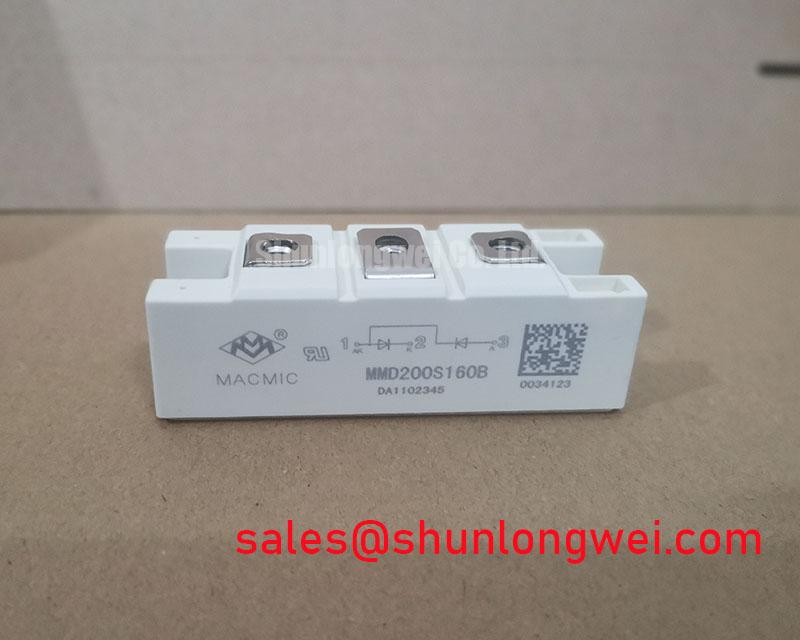

Technical Analysis of the MMD200S160B Performance
The engineering value of the MMD200S160B lies in its exceptional ruggedness under continuous heavy-duty cycles. The 1600V repetitive peak reverse voltage ($V_{RRM}$) is not just a limit; it is a shield. In industrial environments, inductive load switching often causes reflective voltage transients. This module’s high voltage ceiling prevents avalanche breakdown during these unpredictable events, ensuring long-term system stability without requiring oversized snubber circuits.
One of the most critical parameters for system designers is the junction-to-case thermal resistance ($R_{thJC}$). You can visualize thermal resistance as the width of a heat escape tunnel; a lower value means the heat generated by high-current conduction can “flow” out of the silicon chip much faster. The MMD200S160B utilizes a DBC substrate to achieve an incredibly low $R_{thJC}$, allowing the module to maintain a lower internal temperature even when operating near its 200A limit. This directly translates to increased reliability and smaller heatsink requirements for the end-user.


Optimized Application Scenarios
The MMD200S160B is a versatile component in the power semiconductor ecosystem. Its characteristics make it ideal for the following applications:
- Front-End Rectification for VFDs: The 200A rating handles the input current of medium-power motor drives, while the 1600V rating protects against grid-side noise.
- Industrial Welding Power Supplies: High surge current capability ($I_{FSM}$) allows the module to withstand the short-circuit spikes typical during arc striking.
- Battery Charging Systems: Low forward voltage drop reduces conduction losses, improving the overall efficiency of high-capacity DC chargers.
- Uninterruptible Power Supplies (UPS): Stable performance and isolated baseplate construction facilitate safe and compact multi-module configurations.
Best Match: The MMD200S160B is best suited for secondary-side rectification in welding or input-side AC/DC conversion in 400V+ industrial systems.
Key Specifications Table
| Parameter Group | Metric | Value |
|---|---|---|
| Absolute Maximum Ratings | Repetitive Peak Reverse Voltage ($V_{RRM}$) | 1600V |
| Average Forward Current ($I_{F(AV)}$) | 200A (at $T_C = 100^circ C$) | |
| Surge Forward Current ($I_{FSM}$) | ~6800A (10ms, 50Hz) | |
| Electrical Characteristics | Forward Voltage Drop ($V_F$) | Typ. 1.20V (at $I_F = 600A$) |
| Reverse Leakage Current ($I_{RRM}$) | < 9.0mA (at $150^circ C$) | |
| Thermal & Mechanical | Thermal Resistance ($R_{thJC}$) | 0.16 K/W (per diode) |
| Isolation Voltage ($V_{ISOL}$) | 3000V AC (1 min) |
Engineer FAQ
Q1: What is the recommended mounting torque for the MMD200S160B?
A: Based on standard industrial module housings of this size, terminal mounting torque is typically 3-5 Nm, and baseplate-to-heatsink torque should be 3-5 Nm. Proper torque ensures consistent thermal contact and prevents mechanical stress. For detailed heat design strategies, refer to our guide on thermal design fundamentals.
Q2: Can this module be used in a three-phase bridge configuration?
A: Yes. A three-phase bridge requires three MMD200S160B modules if they are configured as dual-series diodes, or a combination of common-anode and common-cathode modules depending on the internal wiring layout of the specific “B” suffix variant. Always verify the internal schematic on the datasheet.
Q3: How does the standard recovery time affect efficiency compared to fast recovery diodes?
A: Standard recovery diodes like the MMD200S160B are optimized for line frequency (50/60Hz) rectification. They offer lower forward voltage drops ($V_F$) than fast-recovery types, making them more efficient for input-side rectification where high-speed switching is not required.
Expert Conclusion
The MMD200S160B stands as a foundational component for high-power rectification, offering engineers a reliable solution that excels in thermal dissipation and voltage resilience. By leveraging its low thermal impedance and high isolation ratings, design teams can achieve greater power density in industrial motor drives and power supplies while maintaining stringent safety standards. This module effectively empowers robust power architecture through proven silicon performance and industrial-grade packaging.