Optrex DMF-50773NF-FW: High-Contrast 240×64 FSTN LCD Module with T6963C Controller
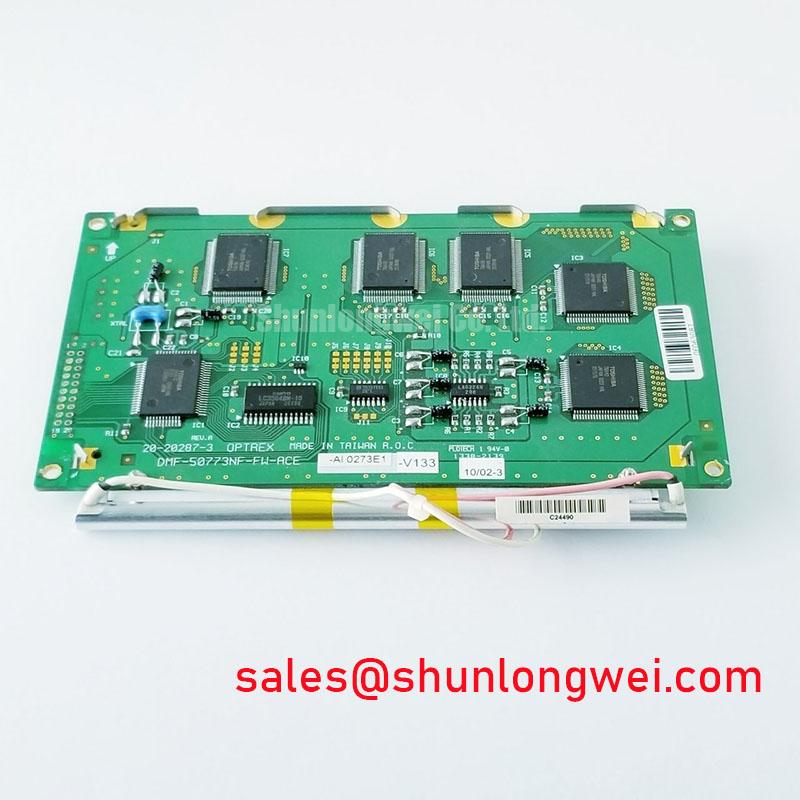
Optrex DMF-50773NF-FW Monochrome Graphic LCD Module
Reliable Visualization with the Industry-Standard T6963C Controller
The Optrex DMF-50773NF-FW represents a specialized 240 x 64 dot matrix monochrome graphic LCD module engineered for long-term reliability in industrial human-machine interfaces (HMIs). By utilizing Film-compensated Super Twisted Nematic (FSTN) technology and the venerable T6963C built-in controller, this module ensures seamless integration with legacy hardware while maintaining high visual clarity. It is a robust solution for engineers seeking a high-contrast display that balances power efficiency with sunlight readability.
- Core Specifications: 240 x 64 Dots | FSTN Monochrome | T6963C Controller
- Engineering Advantages: Transflective optics for superior ambient light handling and standard 8-bit parallel interface for rapid system firmware development.
- User Intent Answer: For those asking “how to interface a 240×64 LCD with existing logic,” the DMF-50773NF-FW employs an industry-standard 8-bit parallel bus, making it directly compatible with many common microcontroller architectures.
Download Official DMF-50773NF-FW Datasheet (PDF)

Technical Analysis: FSTN Optics and Thermal Stability
The defining technical characteristic of the DMF-50773NF-FW is its FSTN (Film-compensated Super Twisted Nematic) liquid crystal structure. Unlike standard STN displays, FSTN uses a compensation film to eliminate the yellow-green or blue-white tint common in older technologies. This results in a crisp, black-on-white appearance that significantly enhances legibility under various lighting conditions. Understanding LCD core technology is vital for engineers who prioritize operator accuracy in high-stress environments.
Consider the FSTN layer as a high-precision optical filter; it effectively sharpens the boundaries between active and inactive pixels. This is much like how high-quality polarizing sunglasses reduce glare to reveal hidden details in a landscape. By sharpening the contrast ratio (typically 6:1 for this model), Optrex has ensured that information remains readable even when viewed from wide angles (up to 40 degrees in the vertical axis). This optical precision is critical when specifying HMI display specifications for industrial automation.


Integrated Control via the T6963C Interface
By integrating the T6963C controller, the DMF-50773NF-FW offloads complex graphical rendering tasks from the host microprocessor. This controller manages the internal display RAM, allowing for text and graphic layers to be superimposed. This feature is particularly useful for designing complex menus where a background grid or icon must remain visible while text data updates in the foreground. Furthermore, the module supports both internal and external character generation, offering flexibility for multi-language support in global industrial applications.
Thermal management is another critical design factor. The DMF-50773NF-FW operates across a temperature range of 0°C to +50°C, suitable for indoor factory floor environments. While monochrome displays generally generate less heat than TFT counterparts, the LED backlight requires stable current regulation to ensure longevity. Proper implementation of industrial LCD dimming techniques, such as PWM (Pulse Width Modulation), can further extend the backlight’s 50,000-hour half-life while reducing fatigue for operators who must monitor the screen for extended shifts.
Optimized Application Scenarios
- Medical Diagnostics: The FSTN contrast is ideal for displaying waveform data and numerical readings on portable ventilators or diagnostic monitors where clarity is paramount.
- Industrial Weighing Systems: Transflective properties allow scales used in warehouses with both bright overhead lights and dark corners to remain legible without constant backlight adjustment.
- Telecommunications Infrastructure: Standard 8-bit parallel compatibility allows for easy maintenance and replacement in legacy rack-mounted server consoles and PBX control units.
- Process Control Panels: The compact dot pitch (0.50 x 0.50 mm) enables high-density data display, allowing operators to see comprehensive system status at a glance.
Conclusion: The DMF-50773NF-FW is the best match for legacy system sustainment requiring high-contrast, black-on-white graphics and low-latency T6963C controller integration.
Key Specifications Table
| Parameter | Value |
|---|---|
| Mechanical Characteristics | |
| Module Dimensions | 180.0 (W) x 65.0 (H) x 12.0 (D) mm |
| Viewing Area | 132.0 (W) x 39.0 (H) mm |
| Dot Pitch | 0.53 x 0.53 mm |
| Electrical & Optical Data | |
| Supply Voltage (Logic) | +5.0V Typ. |
| Display Technology | FSTN (Film-compensated STN) |
| Contrast Ratio | 6.0:1 (at 25°C) |
| Response Time (Rise/Fall) | 160ms / 100ms |
Engineer’s FAQ
Q1: Is the DMF-50773NF-FW compatible with standard T6963C software libraries?
A: Yes, it uses the standard T6963C instruction set, making it compatible with existing software drivers designed for 240×64 graphic displays. Always verify the pinout configuration against the datasheet before connection.
Q2: Can I use this display in outdoor sunlight?
A: The transflective optics utilize ambient light to increase contrast, making it significantly more readable in direct sunlight than purely transmissive displays. However, high-temperature exposure should be monitored to stay within the +50°C limit.
Q3: What is the recommended power sequence for this module?
A: According to the datasheet, logic voltage (VCC) must be applied before the LCD driving voltage (VEE). Reversing this sequence or applying VEE without logic power can cause permanent electrochemical damage to the liquid crystal fluid.
The Optrex DMF-50773NF-FW serves as a high-fidelity window into industrial processes, providing the optical clarity and hardware compatibility required for demanding HMI designs. Its FSTN architecture ensures that critical data remains visible from multiple angles, empowering engineers to maintain high standards of equipment safety and usability.