R1271NS12C: Technical Analysis and Engineering Guide to the 1200V Westcode Capsule Phase Control Thyristor
R1271NS12C Phase Control Thyristor | 1200V Westcode Capsule SCR
Introduction and Core Engineering Highlights
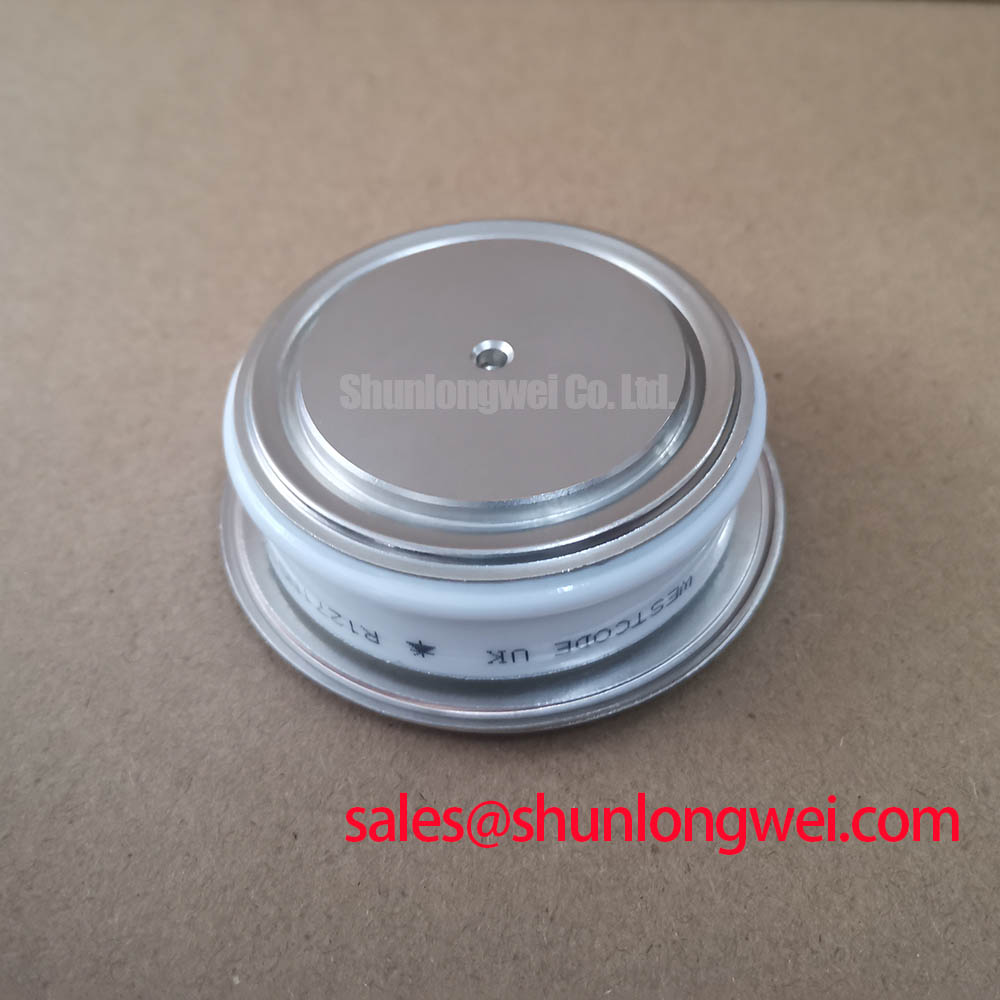
The R1271NS12C is a high-performance Phase Control Thyristor manufactured by Westcode (an IXYS/Littelfuse company), engineered specifically for high-power rectification and industrial switching. Utilizing a robust capsule (press-pack) housing, this device delivers a unique value proposition of exceptional current density combined with the superior thermal management capability of double-sided cooling. It is designed to handle the rigorous demands of line-frequency applications where surge resilience and low conduction losses are non-negotiable.
- Core Specifications: 1200V ($V_{DRM}/V_{RRM}$) | 1271A ($I_{T(AV)}$) | 19,000A ($I_{TSM}$)
- Engineering Advantage: Enhanced thermal cycling reliability due to the compression-bonded contact design.
- Operational Benefit: Minimizes on-state power dissipation to reduce the complexity of the required cooling infrastructure.
A common inquiry among power electronics engineers is how the mounting force affects the electrical performance of the R1271NS12C. Proper clamping is essential because the electrical and thermal resistance are inversely proportional to the pressure applied; insufficient force leads to localized hotspots and premature failure.
Download Official R1271NS12C Datasheet (PDF)

Technical Analysis of the Press-Pack Architecture
The R1271NS12C leverages a press-pack design that stands in contrast to conventional power semiconductors housed in isolated modules. This capsule structure allows for double-sided cooling, effectively doubling the surface area available for heat extraction. The absence of a traditional solder layer between the silicon wafer and the external contacts eliminates one of the primary failure modes in high-power systems: solder fatigue caused by repetitive thermal expansion and contraction.
One of the most critical parameters for the R1271NS12C is the On-State Voltage ($V_T$), which remains remarkably low even at peak current levels. To understand its importance, imagine the electrical path as a multi-lane highway; a lower $V_T$ acts like a perfectly smooth road surface with minimal friction, allowing thousands of Amperes to flow with very little energy being “wasted” as heat. This efficiency is what allows the device to maintain a continuous average current of 1271A within such a compact footprint.


Furthermore, the $I^2t$ rating of the R1271NS12C is specifically optimized for coordination with high-speed fuses. This ensures that in the event of a downstream short circuit, the protective elements will clear the fault before the thyristor’s junction temperature exceeds its critical threshold. This level of robustness is a hallmark of press-pack vs. welded modules, making the capsule design the preferred choice for heavy-duty industrial environments.
Optimized Application Scenarios
The unique thermal and electrical characteristics of the R1271NS12C make it ideal for several demanding roles:
- High-Power Soft Starters: Its high surge current rating ($I_{TSM}$ of 19kA) allows it to handle the massive inrush currents characteristic of large motor startups without degrading.
- Industrial DC Drives: The precise phase control capability enables smooth torque management in heavy industrial machinery, utilizing the device’s 1200V blocking voltage for 400-480V AC line systems.
- Static VAR Compensators (SVC): For grid stability, the device’s rapid switching at line frequencies facilitates effective reactive power control.
- Electrolysis Power Supplies: High average current capacity ($I_{T(AV)}$) ensures efficient, continuous operation in chemical processing plants.
Conclusion: The R1271NS12C is the best match for systems requiring multi-megawatt power control where downtime caused by thermal fatigue is not an option.

Key Technical Specifications
| Parameter Group | Symbol | Typical Value |
|---|---|---|
| Absolute Maximum Ratings | $V_{RRM}/V_{DRM}$ | 1200V |
| $I_{T(AV)}$ ($T_{case}=55°C$) | 1271A | |
| $I_{TSM}$ (10ms surge) | 19,000A | |
| Electrical Characteristics | $V_{GT}$ (Gate Trigger) | 3.0V |
| $I_{GT}$ (Gate Trigger) | 200mA | |
| Thermal & Mechanical | $R_{thJC}$ (Double side) | 0.022 K/W |
| Mounting Force ($F$) | 19kN – 26kN |

Engineer’s Frequently Asked Questions
Q1: Why is the mounting force range so narrow (19kN – 26kN)?
The R1271NS12C relies on mechanical pressure to establish uniform electrical and thermal contact across the silicon wafer. Insufficient force increases contact resistance, while excessive force risks fracturing the internal ceramic or silicon components. Adhering to the datasheet’s specified force ensures long-term thermal management stability.
Q2: Can the R1271NS12C be used in series for higher voltage applications?
Yes, but it requires carefully matched $Q_{rr}$ (reverse recovery charge) and static/dynamic voltage sharing networks (RC snubbers). Because these are phase control devices, ensuring simultaneous triggering is vital to avoid overvoltage on the slowest-turning-on unit.
Q3: How does double-sided cooling impact the current rating?
Using double-sided cooling reduces the junction-to-case thermal resistance ($R_{thJC}$) to approximately 0.022 K/W. If single-sided cooling is used instead, the current rating must be significantly derated (often by 40-50%) because the heat cannot escape as efficiently from the non-cooled side.
For large-scale power conversion, the Westcode R1271NS12C remains a benchmark for reliability. Its press-pack construction offers a high-integrity interface that thrives in high-vibration and high-thermal-cycling environments, empowering engineers to build more resilient power infrastructures. By prioritizing thermal efficiency and surge robustness, the R1271NS12C ensures consistent performance throughout the lifecycle of critical industrial assets.