SanRex QF15AA60: A Technical Review of an Integrated Darlington Power Module
## SanRex QF15AA60 Transistor Module Technical Review
Introduction to the QF15AA60 for Power Control Systems
The SanRex QF15AA60 is a Darlington power transistor module integrating six transistors in a three-phase bridge configuration, complete with fast recovery freewheeling diodes. This module is engineered for efficient and reliable control in motor drives and power conversion systems. Its core value lies in its combination of a 600V collector-emitter voltage, a 15A continuous collector current, and an electrically isolated mounting base, which simplifies thermal management and enhances system safety.
* **Core Specifications**: 600V | 15A | 100W Power Dissipation
* **Key Attributes**: Integrated fast recovery diodes, 2500V isolation voltage.
* **Engineering Value**: Streamlines three-phase inverter design, reduces complexity by integrating six transistors and diodes, and simplifies heatsink assembly. For engineers designing compact motor controls, the QF15AA60 provides a thermally efficient and electrically robust building block.
Download the QF15AA60 Datasheet (PDF)

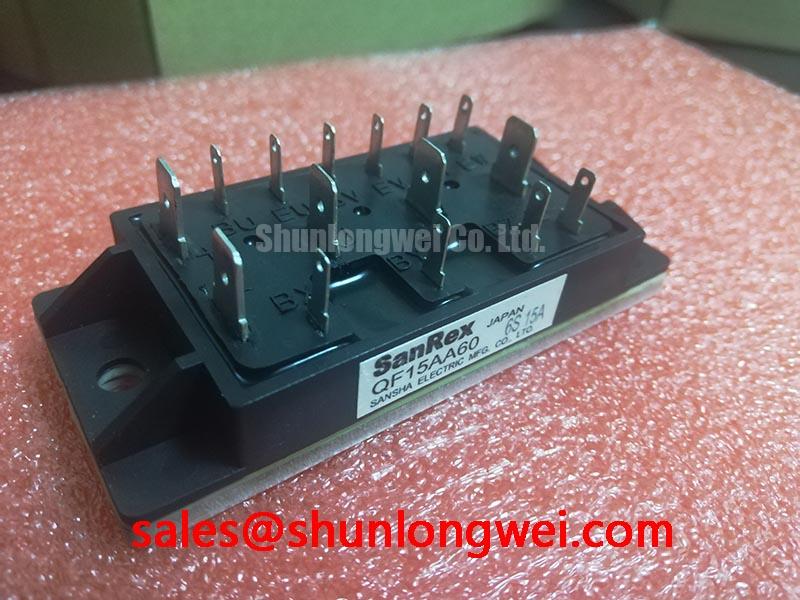
Technical Analysis for System Integration
The performance of the QF15AA60 is anchored in several key parameters documented in its datasheet. The maximum collector-emitter voltage (V_CEX) of 600V provides a substantial safety margin for systems operating on 200/240V AC lines, protecting against transient voltage spikes common in industrial environments. This high voltage rating is fundamental to the module’s reliability in applications like variable frequency drives (VFDs).
Another critical aspect is the module’s thermal performance. The total power dissipation is rated at 100W, a figure that dictates the required heatsinking to maintain the junction temperature within its safe operating limit of 150°C. The module’s electrically isolated baseplate offers a significant advantage, providing 2500V of isolation. Think of the thermal path from the transistor junction to the heatsink like a pipeline for heat; the isolated baseplate is like having a robust, insulated pipe that safely contains the electrical potential while allowing heat to flow efficiently to the heatsink, preventing electrical shock and simplifying mechanical assembly.
The inclusion of fast recovery diodes (FRDs) is also a key feature. These diodes are crucial for commutating inductive load currents, such as those in motor windings, with minimal switching losses. This integrated approach not only saves board space but also ensures that the diode characteristics are well-matched to the transistor’s performance, contributing to overall system efficiency.
Optimized Application Scenarios
The specific characteristics of the QF15AA60 make it a strong candidate for several medium-power applications.
* **AC Servo Drives**: The module’s integrated three-phase bridge is ideal for the inverter stage of AC servo systems, where precise control and rapid response are necessary.
* **General Purpose Inverters**: For small to medium-sized motor control, the QF15AA60 offers a compact and reliable solution, simplifying the power stage design.
* **Uninterruptible Power Supplies (UPS)**: The 600V rating and 15A current handling are well-suited for the inverter section of online UPS systems that protect critical equipment.
* **Welding Power Supplies**: In smaller inverter-based welders, this module can effectively manage the power switching required for arc generation and control.
This module is best matched for power conversion systems requiring a compact, integrated three-phase bridge rated for up to approximately 5 kW.
Key Specifications of the QF15AA60
| Parameter | Symbol | Value | Unit |
|---|---|---|---|
| Absolute Maximum Ratings (Tj = 25°C) | |||
| Collector-Emitter Voltage | V_CEX | 600 | V |
| Collector Current | I_C | 15 | A |
| Total Power Dissipation | P_C | 100 | W |
| Electrical Characteristics | |||
| Collector-Emitter Saturation Voltage (I_C=15A) | V_CE(sat) | 2.0 (Max) | V |
| DC Current Gain (V_CE=2V, I_C=15A) | h_FE | 75 (Min) | – |
| Thermal and Mechanical Characteristics | |||
| Junction Temperature | T_j | -40 to +150 | °C |
| Isolation Voltage (AC, 1 min.) | V_ISO | 2500 | V |
| Mounting Torque (M5 screws) | – | 1.5 – 2.5 | N·m |
Engineer’s FAQ for the QF15AA60
1. What are the key thermal management considerations for the QF15AA60?
To operate reliably, the module’s case temperature must be kept low enough to prevent the junction temperature from exceeding 150°C. This requires a properly sized heatsink. The datasheet specifies the mounting torque for the M5 screws; applying the correct torque is critical to ensure low thermal resistance between the module’s baseplate and the heatsink. A thermal compound should always be used.
2. How does the Darlington configuration impact the gate drive design?
As a Darlington transistor module, the QF15AA60 exhibits very high DC current gain (h_FE), which means it requires significantly less base current to drive the 15A collector current compared to a single transistor. This simplifies the gate drive circuit design, potentially reducing component count and cost. However, Darlington pairs typically have a higher saturation voltage and slower switching speed than a single transistor or an IGBT, which must be considered in the design.
3. What is the benefit of the integrated three-phase bridge topology?
The primary benefit is system integration. Instead of sourcing, testing, and mounting six separate transistors and six diodes, an engineer can use a single, pre-characterized module. This reduces assembly time, minimizes PCB layout complexity, and often results in a more compact final product. The internal connections are optimized for performance, which can be difficult to achieve with discrete components.
4. Can this module be used for single-phase applications?
Yes. While designed as a three-phase bridge, two of the legs can be utilized to form a full-bridge (H-bridge) inverter for single-phase motor control or DC-AC conversion, leaving the third leg unused.
The QF15AA60 transistor module offers a consolidated and reliable foundation for power electronics engineers developing compact motor drives and power converters. Its integrated nature and robust electrical and thermal specifications enable the development of efficient and durable power semiconductor systems.