Semikron SKKD 162/18: A Technical Guide to High-Reliability Power Control
SKKD 162/18 | Semikron Thyristor/Diode Module, 1800V
Engineered for High-Reliability Power Control
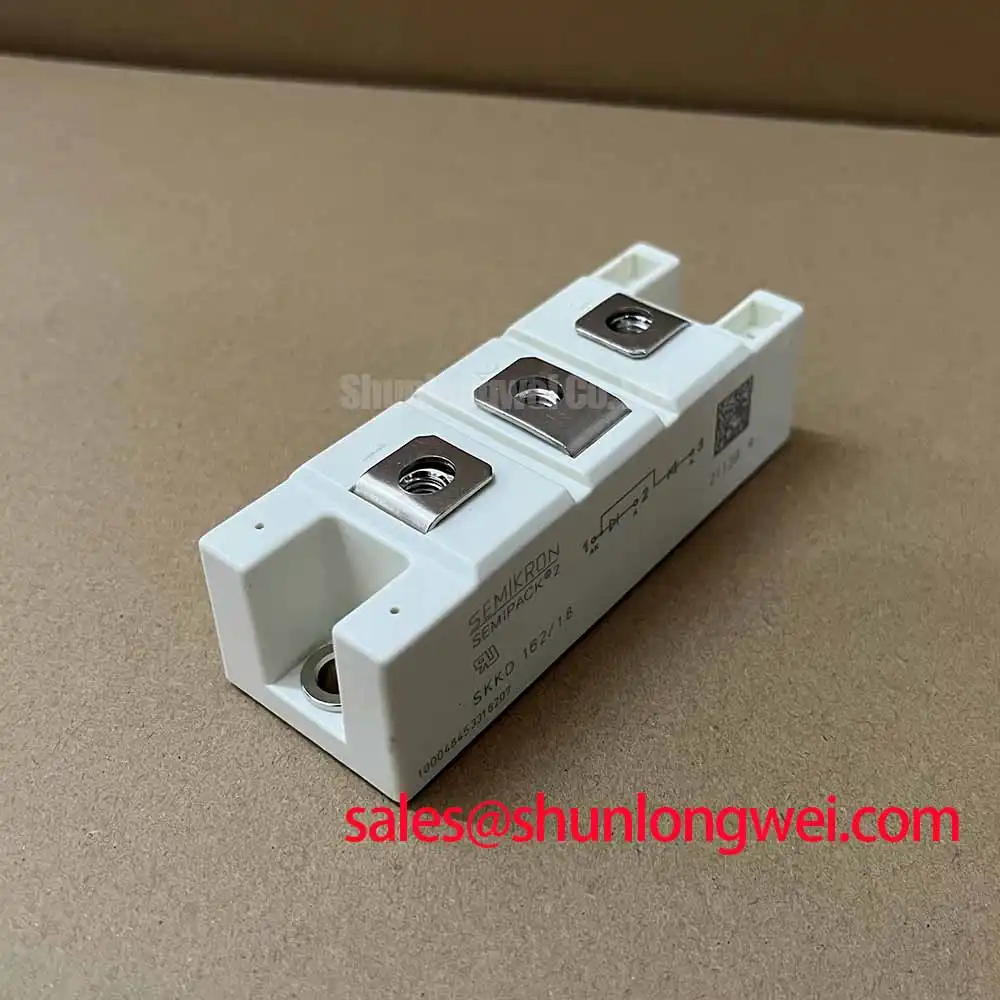
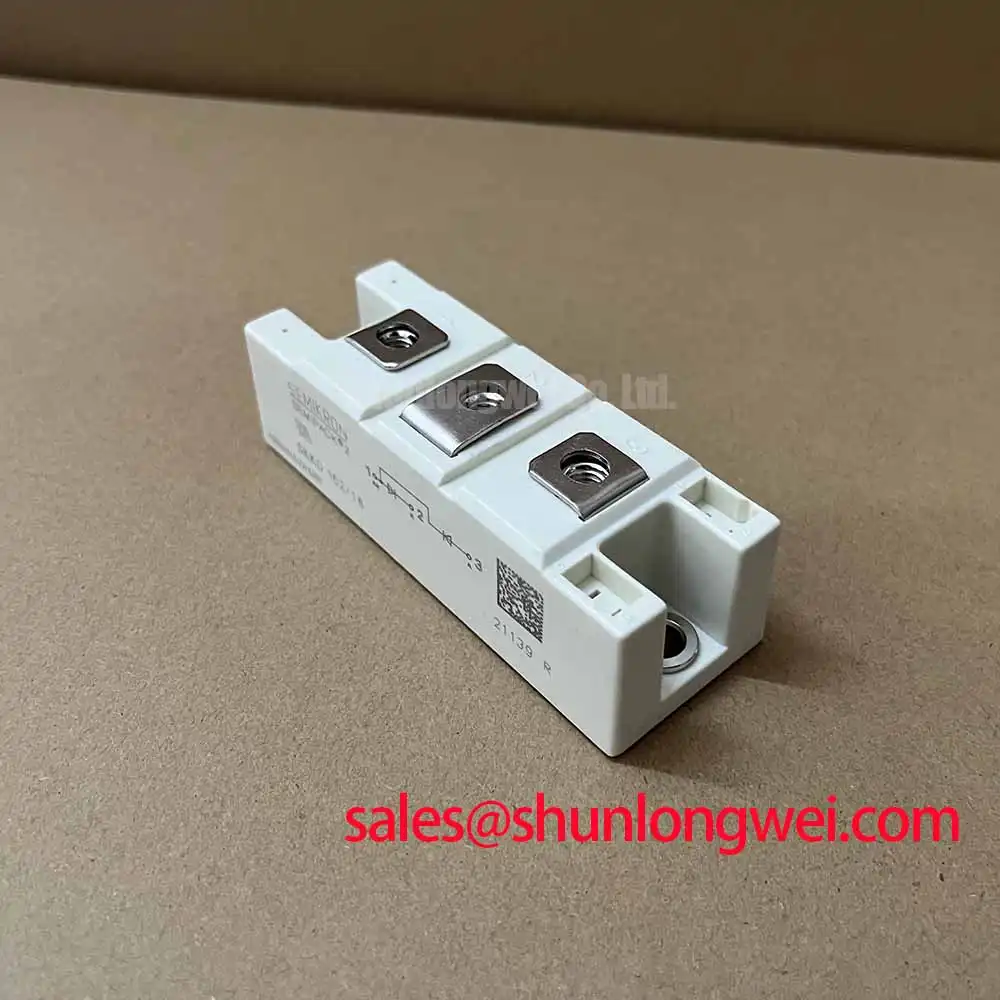
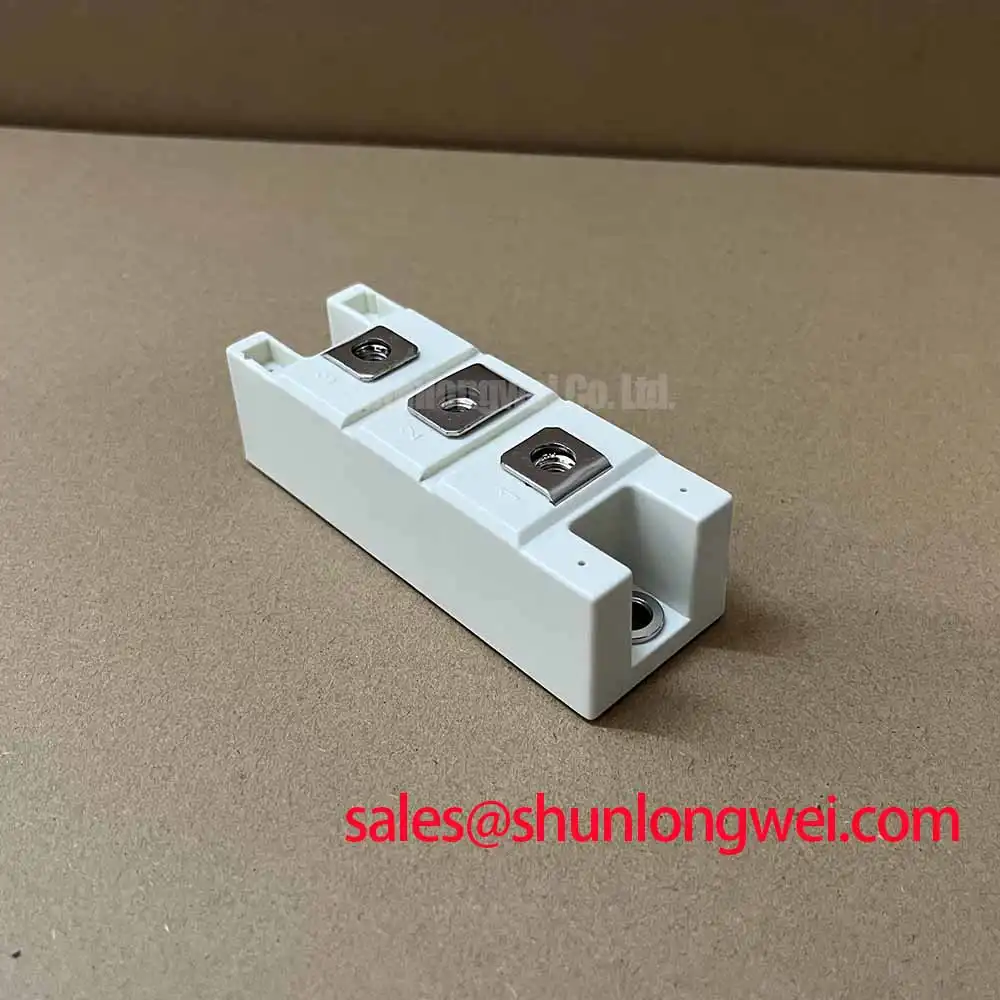
The Semikron SKKD 162/18 is a Thyristor/Diode Module engineered for high-reliability power control in demanding industrial systems. Its design prioritizes operational longevity and robust performance through a mechanically superior construction, ensuring dependable power rectification even under rigorous thermal cycling conditions. This module’s integrated electrical isolation simplifies system design and enhances safety, making it a cornerstone for resilient power conversion architectures.
- Core Specifications: 1800V Repetitive Peak Reverse Voltage | 160A Average On-State Current (Tc = 85°C) | 3000V~ Isolation Voltage
- Key Advantages: Enhanced thermal cycling capability from hard-soldered joints. Simplified assembly with an electrically isolated baseplate. UL recognized for streamlined system approval.
- Intent Answered: The module’s high 3000V (RMS, 1 min) isolation voltage facilitates direct mounting to grounded heatsinks, which simplifies thermal design and meets stringent safety requirements without additional insulating hardware.
Download the Official SKKD 162/18 Datasheet (PDF)


Technical Analysis for Robust System Design
A key differentiator specified in the datasheet for the SKKD 162/18 is its use of “hard soldered joints for high reliability”. This manufacturing technique creates a stronger, more fatigue-resistant bond between the semiconductor die and the substrate compared to standard soft soldering. This is critical in applications like motor drives or soft starters where frequent load variations cause temperature swings. The robust joints minimize the risk of bond wire lift-off or solder fatigue, directly contributing to a longer operational lifetime and predictable performance.
The module’s thermal management is built upon an aluminum oxide ceramic insulated metal baseplate. This integrated isolation is crucial for both safety and thermal efficiency. Think of the thermal resistance junction-to-case, Rth(j-c), as the width of a pipeline for heat; the specified value of 0.18 K/W per diode indicates an effective path for waste heat to exit the semiconductor junction. Combining this with a high isolation voltage (VISOL) of 3000V~ allows engineers to mount the module directly onto a system chassis or a common heatsink, streamlining the mechanical design and improving overall thermal performance by eliminating the need for external, often less efficient, insulating pads. For more insights on this topic, see our guide to isolated baseplates.
Optimized Application Scenarios
The electrical and mechanical characteristics of the SKKD 162/18 make it a prime component for several power conversion applications:
- Line Rectifiers for AC Motor Controllers: Its high blocking voltage of 1800V provides a significant safety margin for drives operating on 400V, 480V, or even 690V AC lines.
- Field Supply for DC Motors: The high average forward current rating (IFAV = 160A) can easily supply the field windings of medium-to-large DC motors.
- Non-controllable Rectifiers for AC/AC Converters: Its simple, robust design is ideal for the input stages of frequency converters and other AC-AC systems.
- Industrial Welding Power Supplies: The massive surge current capability (IFSM = 6000A at 10ms) allows it to withstand the high inrush currents typical in welding applications.
For line-fed rectifiers in high-transient environments, the 1800V rating of the SKKD 162/18 provides superior robustness compared to standard 1200V or 1600V modules.
Key Specifications Table
| Parameter | Value | Conditions |
|---|---|---|
| Repetitive Peak Reverse Voltage (VRRM) | 1800 V | – |
| Average Forward Current (IFAV) | 160 A | sin. 180; Tcase = 85 °C |
| Surge Forward Current (IFSM) | 6000 A | Tvj = 25 °C, 10 ms |
| I²t Value | 180 000 A²s | Tvj = 25 °C, 10 ms |
| Threshold Voltage (V(TO)) | 0.85 V | Tvj = 135 °C |
| Slope Resistance (rT) | 1.2 mΩ | Tvj = 135 °C |
| Thermal Resistance, Junction to Case (Rth(j-c)) | 0.18 K/W | Per Diode |
| Isolation Test Voltage (VISOL) | 3000 V~ | RMS, 50 Hz, 1 min. |
| Operating Junction Temperature (Tvj) | -40 to +135 °C | – |
Engineer’s FAQ
Q1: What mounting torque should be used for the SKKD 162/18 module and its terminals?
A: The official datasheet specifies a mounting torque of 5 Nm ± 15% for both the heatsink mounting (Ms) and the electrical terminals (Mt). Adhering to these values is critical to ensure proper thermal contact and reliable electrical connections.
Q2: How is the Rth(j-c) value used for heatsink selection?
A: The thermal resistance junction-to-case (Rth(j-c)) is the first step in a thermal calculation. To select a heatsink, you must calculate power dissipation, determine the maximum allowable case temperature based on ambient temperature and junction temperature limits, and then choose a heatsink with an appropriate case-to-ambient resistance (Rth(c-a)) that keeps the case within its safe limit. A detailed guide on mastering thermal design can provide further context.
Q3: Is this module recognized for use in North American markets?
A: Yes, the SKKD 162/18 is UL recognized under file no. E 63 532. This can simplify the safety certification process for the end equipment in which it is installed.
Q4: Can two of these modules form a full single-phase bridge rectifier?
A: Yes. The SKKD 162/18 contains two series-connected diodes (common cathode configuration). By connecting two modules appropriately, you can easily form a single-phase, two-pulse bridge rectifier (B2) capable of handling high currents and voltages.
Enabling Dependable Power Conversion
The Semikron SKKD 162/18 provides engineers with a foundational building block for creating highly reliable and thermally efficient power systems. Its construction, centered around hard-soldered joints and an integrated high-isolation baseplate, addresses key failure points in demanding industrial environments. This focus on mechanical robustness allows for the design of resilient power conversion stages that prioritize uptime and long-term performance.