Sharp LJ640U35: A Robust EL Display for Critical Industrial Applications
“`html
Sharp LJ640U35 | 8.9-inch 640×400 EL Display Module
Introduction and Core Technical Merits
The Sharp LJ640U35 is an 8.9-inch Electroluminescent (EL) display module engineered for exceptional visual clarity and long-term reliability in demanding environments. Its core value proposition is rooted in its self-emitting pixel technology, which delivers superior contrast and performance stability where conventional LCDs may falter. This display is a critical component for maintaining and extending the life of high-value legacy systems in industrial and analytical fields.
- Core Specifications: 640×400 Resolution | 115 cd/m² Luminance | -5 to +55°C Operating Range
- Key Engineering Advantages: Delivers absolute black levels for maximum contrast and readability. Its solid-state nature provides inherent resistance to shock and vibration.
This module provides a direct, high-performance path for sustaining equipment that relies on a robust, clear visual interface. For sourcing information on this or other display technologies, explore our resources on LCD core technology.
Review Technical Specifications (Datasheet)
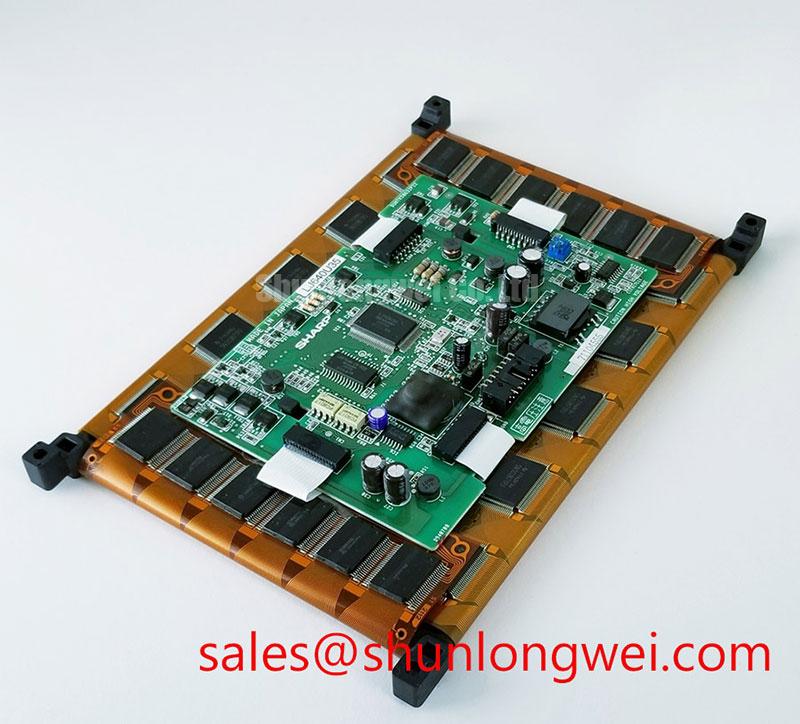


Technical Analysis: Emissive Technology and Environmental Stability
The fundamental advantage of the Sharp LJ640U35 lies in its electroluminescent technology. Each pixel is a direct light source, which provides an exceptionally high contrast ratio. [2] Think of the display’s contrast as the difference between observing stars in a true night sky versus viewing a backlit photograph of them. The self-emitting pixels of the LJ640U35 are the actual stars, creating perfect black levels that make the amber graphics appear incredibly sharp and defined. This is not achievable with standard TFT-LCDs that rely on a backlight and liquid crystal layer, which inherently leak light and limit true black performance. This high-contrast output is crucial for at-a-glance readability in complex machine interfaces.
This module is specified for operation between -5°C and +55°C, with a storage temperature range extending from -40°C to 80°C. [4] Unlike liquid crystal displays, whose response time can degrade significantly in colder temperatures causing ghosting or smearing, the solid-state physics of an EL display ensures a consistently fast pixel response time across its operating range. This stability is essential for applications displaying moving graphics, waveforms, or rapidly updating status data. The inherent ruggedness of this design also contributes to its excellent performance in environments with mechanical stress, a topic further explored in guides to vibration and shock resistance for industrial displays.
Optimized Application Scenarios
- CNC Machine Controllers: The EL panel’s immunity to motion blur and its extremely wide, symmetrical viewing angles (80° in all directions) ensure operators can clearly read machining coordinates and system status from anywhere on the shop floor. [4]
- Medical Instrumentation: In devices for patient monitoring or diagnostics, the crisp, flicker-free output of the LJ640U35 ensures that vital data is presented without ambiguity, a critical factor where misinterpretation is not an option.
- Test and Measurement Equipment: The fast pixel response time is ideal for rendering complex waveforms and measurements from oscilloscopes or spectrum analyzers without the artifacts or lag common to some LCD technologies.
- Legacy System Sustainment: As a form-fit-function replacement for aging displays in validated systems, it eliminates the need for costly re-engineering and recertification, preserving the operational life of high-value capital equipment.
The LJ640U35 is a best-in-class solution for maintaining critical equipment where visual clarity, reliability, and long-term component stability are the primary design drivers.
Key Specifications of the LJ640U35
| Display Characteristics | |
|---|---|
| Manufacturer | Sharp |
| Model | LJ640U35 |
| Technology | Electroluminescent (EL) |
| Screen Size | 8.9 inches diagonal |
| Resolution | 640 x 400 pixels |
| Active Area | 191.9 x 119.9 mm |
| Aspect Ratio | 16:10 [1] |
| Pixel Pitch | 0.300 x 0.300 mm [1] |
| Optical & Electrical Ratings | |
| Luminance | 115 cd/m² (Typ.) [4] |
| Display Color | Monochrome (Amber) |
| Viewing Angle (L/R/U/D) | 80/80/80/80 (Typ.) at CR≥10 [4] |
| Interface | 16-pin Connector (HIF3FC-16PA-2.54DS) [4] |
| Mechanical & Environmental | |
| Outline Dimensions | 246 x 158 x 26.5 mm [1] |
| Weight | 390 g [1, 4] |
| Operating Temperature | -5°C to +55°C [4] |
| Storage Temperature | -40°C to +80°C [4] |
Engineer’s FAQ for the LJ640U35
Why choose an EL display like the LJ640U35 over a modern TFT-LCD for an industrial machine?
The primary drivers are reliability and visual performance in difficult conditions. EL technology’s solid-state construction provides superior shock and vibration resistance. Furthermore, its self-emissive nature guarantees a very high contrast ratio and consistent, fast response times even in cold environments, avoiding the performance degradation that can affect liquid crystal-based displays.
What are the main power supply considerations for this display?
EL displays typically require multiple voltage rails for operation: a low-voltage supply for the logic board (e.g., +5V) and higher voltage AC or DC supplies for driving the EL panel itself. It is critical to consult the official product specification to ensure the power supply unit (PSU) is designed to provide the precise voltages and sequencing required for stable operation and maximum lifespan.
Is the LJ640U35 a direct replacement for other 640×400 EL displays?
While the LJ640U35 is often used for retrofits, engineers must verify three key areas for compatibility: mechanical dimensions (including mounting hole locations), the pinout and signal timing of the 16-pin interface, and the required power supply voltages. For further reading, see our guide on cross-brand LCD driver migration, which covers similar principles.
How does the display handle image retention or “burn-in”?
Like other emissive display technologies, EL panels can be susceptible to non-uniform aging if a static image is displayed for thousands of hours. The datasheets for these panels often specify a lifetime to half-brightness. In practice, for many industrial HMI applications where screen content changes periodically, this is a manageable characteristic. Employing simple strategies like screen savers or pixel shifting during idle periods can further mitigate this effect. Understanding these factors is part of a proactive management strategy for display lifespan.
Enabling Long-Term System Viability
By integrating the Sharp LJ640U35, engineers can ensure continued operational integrity and data clarity for essential industrial and analytical equipment. Its emissive technology provides a stable and highly readable visual interface, circumventing the common environmental and performance limitations of backlit panels. This makes it an indispensable component for extending the service life of proven, high-value systems.
“`