Sharp LJ64HB34 EL Display: A Comprehensive Technical Review
“`html
Sharp LJ64HB34 EL Display: 640×350 High-Contrast Module
Technical Analysis of the Sharp LJ64HB34 Electroluminescent Display
The Sharp LJ64HB34 is a self-contained 8.9-inch Electroluminescent (EL) display unit engineered for high performance in demanding environments. Its core value proposition is delivering exceptional image clarity and operational robustness through its self-emitting display technology. This eliminates the need for a backlight, resulting in superior visual characteristics compared to conventional liquid crystal displays of its era.
- Key Specifications: 640 x 350 Resolution | 120 cd/m² Brightness | 23mm Max Thickness
- Engineering Advantages: Inherently high contrast for excellent readability, integrated driver and power circuits for simplified system integration.
- Design Focus: Provides a stable, long-life human-machine interface (HMI) solution, particularly effective in conditions with fluctuating ambient light.
Download the official LJ64HB34 Datasheet (PDF)
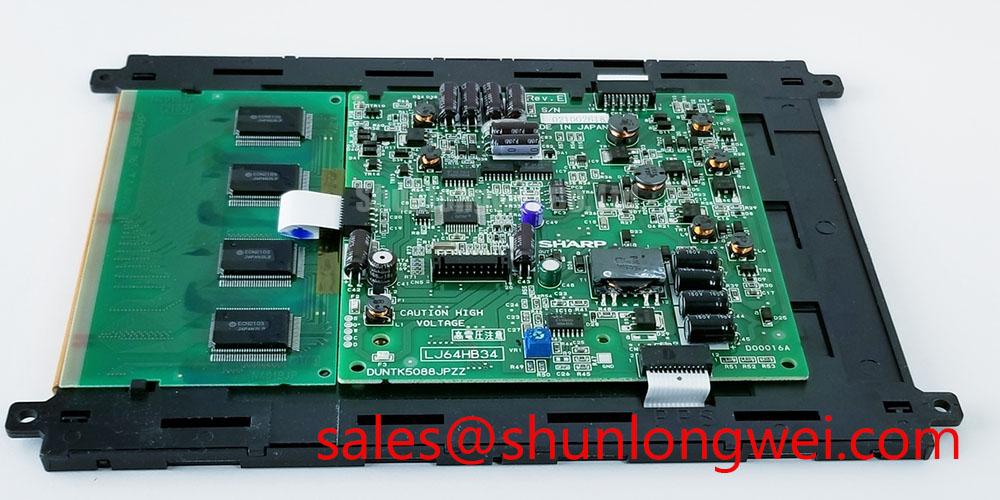

Engineered for Clarity and Reliability
The defining characteristic of the LJ64HB34 is its electroluminescent panel. Unlike a TFT-LCD, which filters light from a separate backlight, each pixel in an EL display generates its own light. Think of it like stars against a night sky; each point of light is distinct against a true black background. This physical property results in an inherently high contrast ratio and exceptionally wide viewing angles, ensuring that data is clearly legible from almost any perspective without color or contrast shift. This is a critical feature for industrial control panels where operators may be viewing the screen from off-angles.
Furthermore, the high degree of integration within the LJ64HB34 module simplifies the engineering process. The datasheet confirms that the display panel, driving circuitry, and power supply are combined into a single, slim unit. This reduces the bill of materials (BOM) for the host system and minimizes design complexity. Engineers only need to provide standard logic (+5V) and panel (+24V) power rails, as specified in the datasheet, rather than designing complex high-voltage drive electronics from scratch. This streamlined approach accelerates development and reduces potential points of failure, a principle that aligns with robust design practices like those discussed in guides for vibration and shock resistance for industrial displays.
Optimized Application Scenarios
The specific performance attributes of the LJ64HB34 make it a strong candidate for several specialized applications:
- Industrial Automation HMI: The high contrast and wide viewing angles ensure clear readability in variable factory lighting conditions.
- Test and Measurement Instruments: Its fast response time accurately renders changing waveforms and data without the motion blur common in passive-matrix LCDs.
- Medical Diagnostic Equipment: The sharp, stable image and high reliability are essential for displaying critical patient data.
- Legacy System Sustainment: Its 640×350 resolution and parallel interface make it a viable form-fit-function replacement for aging displays in long-deployed systems.
This display’s rugged EL technology and integrated architecture make it a prime choice for critical HMIs where long-term readability and reliability are non-negotiable.
Key Specifications of the LJ64HB34
| Parameter | Specification |
|---|---|
| Display Characteristics | |
| Display Technology | Electroluminescent (EL) |
| Resolution | 640 x 350 dots |
| Active Area | 191.9 (W) x 104.9 (H) mm |
| Dot Pitch | 0.30 (W) x 0.30 (H) mm |
| Display Color | Amber |
| Brightness (Typical) | 120 cd/m² |
| Electrical Ratings | |
| Logic Power Supply (Vcc) | +5V ± 5% |
| Panel Power Supply (Vdd) | +24V ± 5% |
| Power Consumption (Typical) | 16 W |
| Interface | 4-bit parallel (L/S, CL1, CL2, D0-D3) |
| Mechanical & Environmental | |
| Outline Dimensions | 241 (W) x 136 (H) x 23 (D) mm (max) |
| Weight | Approx. 600g |
| Operating Temperature Range | 0°C to +50°C |
| Storage Temperature Range | -25°C to +70°C |
Note: All specifications are based on the preliminary datasheet and should be verified with the final official documentation.
Engineer’s FAQ for the LJ64HB34
1. What are the main advantages of this EL display over a comparable monochrome LCD?
The primary advantage of the LJ64HB34’s EL technology is its self-emitting nature. This results in a much higher contrast ratio and virtually unlimited viewing angles compared to STN or early TFT monochrome LCDs. It also offers a significantly faster pixel response time, which is critical for non-static data.
2. What are the specific power supply requirements for integrating the LJ64HB34?
According to the datasheet, the module requires a dual power supply. A +5V DC source is needed for the logic circuits (Vcc), and a separate +24V DC source is required for the panel drive electronics (Vdd). Both supplies should be regulated within a ±5% tolerance.
3. How should the display data be interfaced with a host controller?
The LJ64HB34 uses a parallel interface. The datasheet specifies a 4-bit data bus (D0-D3) along with control signals like Data Shift Clock (CL1), Latch Pulse (CL2), and Scanning Line Data signal (L/S) to manage data flow and refresh the display frame.
4. How does the display handle heat dissipation?
The module is designed for convection cooling in its specified operating temperature range of 0 to 50°C. With a typical power consumption of 16W, designers must ensure adequate airflow around the unit to prevent overheating, especially the rear surface where the drive electronics are located. Poor thermal management can impact display lifespan.
Enabling Robust and Clear HMI Design
The Sharp LJ64HB34 offers a focused solution for systems that cannot compromise on visual clarity or operational dependability. By leveraging the intrinsic strengths of EL technology, this integrated display unit provides engineers with a reliable foundation for building clear and durable industrial interfaces.
“`