SKKT 162/16 E Semikron Danfoss: Technical Overview of the 1600V 160A Thyristor Diode Module
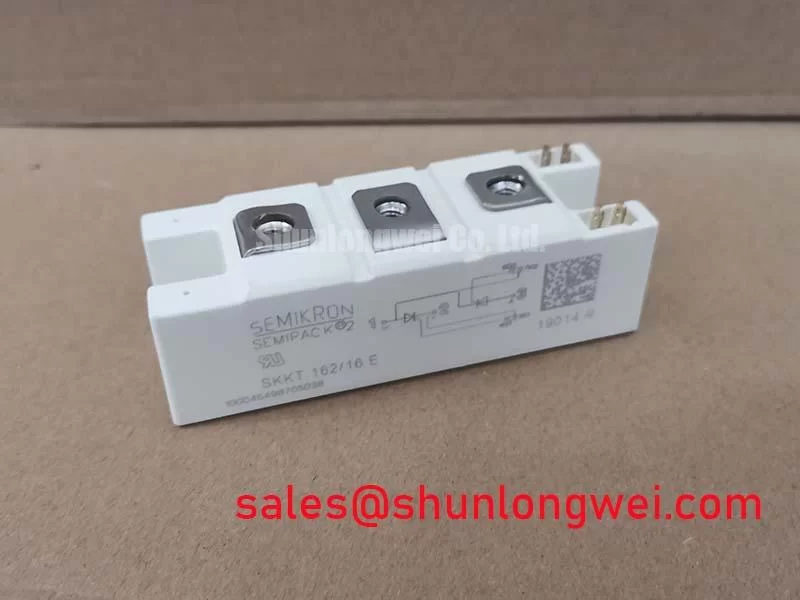
SKKT 162/16 E Semikron Danfoss Thyristor Diode Module
Semikron SKKT 162/16 E: High-Reliability SEMIPACK 2 Solution
The SKKT 162/16 E is a high-performance Thyristor/Diode module engineered for robust AC power control and rectification in demanding industrial environments. Utilizing a standardized SEMIPACK 2 footprint, this module integrates one thyristor and one diode in series, offering a critical balance of high surge current resilience and efficient thermal dissipation. By employing hard soldered joints and transfer molded isolation, the device ensures long-term operational stability under repetitive thermal cycling, making it a staple for heavy-duty power semiconductors applications.
- Core Specifications: 1600V Peak Reverse Voltage | 160A Average On-State Current | 5400A Surge Current capability.
- Key Engineering Advantages: Enhanced dielectric strength through specialized isolation materials and reduced mechanical stress via hard-soldered internal connections.
- Design Intent: Engineers often ask how to manage high-voltage transients in 480V AC systems; the 1600V $V_{RRM}$ rating of the SKKT 162/16 E provides the necessary safety overhead to prevent breakdown during grid fluctuations.
Download Official Datasheet (PDF)

Technical Analysis: Reliability Through Surge Resilience
The engineering philosophy behind the SKKT 162/16 E centers on its exceptional $I_{TSM}$ (non-repetitive peak surge current) rating of 5400A. In power electronics, you can visualize the surge current capacity as the structural “crumple zone” of a vehicle; it defines the maximum energy impact the semiconductor junction can absorb during a short-circuit fault before catastrophic failure occurs. This high threshold allows protective fuses more time to clear the fault, preserving the integrity of the power stage.
Furthermore, the module features an isolated metal baseplate using AL2O3 ceramic. As discussed in our analysis of isolated baseplates, this construction is vital for high-voltage reliability. It provides a direct thermal path to the heatsink while maintaining electrical isolation between the power terminals and the chassis. The transient thermal impedance ($Z_{th}$) curve for this device demonstrates its ability to handle pulse loads efficiently, which is critical for applications involving high inrush currents, such as motor starting or large transformer magnetization.


Optimized Industrial Application Scenarios
The technical characteristics of the SKKT 162/16 E make it a preferred choice for the following industrial roles:
- AC Motor Soft Starters: The high $I_{TSM}$ manages the significant current spikes during motor acceleration without degrading the semiconductor junction.
- Input Rectifiers for VFDs: The 1600V $V_{RRM}$ rating allows the module to withstand significant line transients in unregulated industrial grids.
- Heat Control and Temperature Regulation: Precise phase control capability enables its use in industrial furnaces and high-power plastic processing equipment.
- DC Power Supplies: Suitable for field excitation rectifiers for DC motors where isolation and high current density are required.
Best Match Conclusion: This module is ideally suited for 400V-600V AC line applications requiring high surge robustness and standardized mechanical integration.
SKKT 162/16 E Critical Specifications
| Parameter Group | Parameter | Value |
|---|---|---|
| Absolute Maximum Ratings | Repetitive Peak Voltage ($V_{RRM}$) | 1600 V |
| Average On-State Current ($I_{T(AV)}$) | 160 A (at $T_c = 85^circ C$) | |
| Peak Surge Current ($I_{TSM}$) | 5400 A (at $10ms, 25^circ C$) | |
| Electrical Characteristics | Critical Rate of Current Rise ($di/dt$) | 200 A/µs |
| Gate Trigger Voltage ($V_{GT}$) | 3.0 V (max) | |
| Thermal / Mechanical | Thermal Resistance ($R_{th(j-c)}$) | 0.16 K/W (Thyristor/Diode) |
| Isolation Voltage ($V_{isol}$) | 3600 V~ |
Engineer’s FAQ
Q1: What is the significance of the 1600V rating for a 480V application?
A: Standard industrial 480V systems experience voltage spikes due to inductive switching and lightning transients. A 1600V $V_{RRM}$ provides a safety factor of roughly 3.3x, which is industry-standard for ensuring the semiconductor junction does not enter avalanche breakdown during grid disturbances.
Q2: How do mounting torque specifications affect the module’s performance?
A: Proper mounting torque (typically 5 Nm for SEMIPACK 2 baseplates) is essential to ensure consistent thermal contact. Under-tightening increases the junction-to-case thermal resistance ($R_{th(j-c)}$), leading to overheating, while over-tightening can crack the internal ceramic substrate, compromising the electrical isolation.
Q3: Does the module require specialized internal insulation like silicone gel?
A: Yes, Semikron Danfoss SEMIPACK modules use high-grade potting compounds and transfer molding to prevent partial discharge and moisture ingress, which are critical for maintaining the 3600V isolation rating over the life of the component.
The SKKT 162/16 E is a foundational component for power electronics engineers tasked with designing high-availability AC control systems. By prioritizing thermal mechanical stability and peak voltage overhead, this module empowers the creation of robust industrial systems that withstand the rigors of modern electrical grids.