SKM 120 B 020 Power MOSFET Module: A Technical Analysis for High-Efficiency Applications
## SKM 120 B 020: 200V Power MOSFET Module Technical Analysis
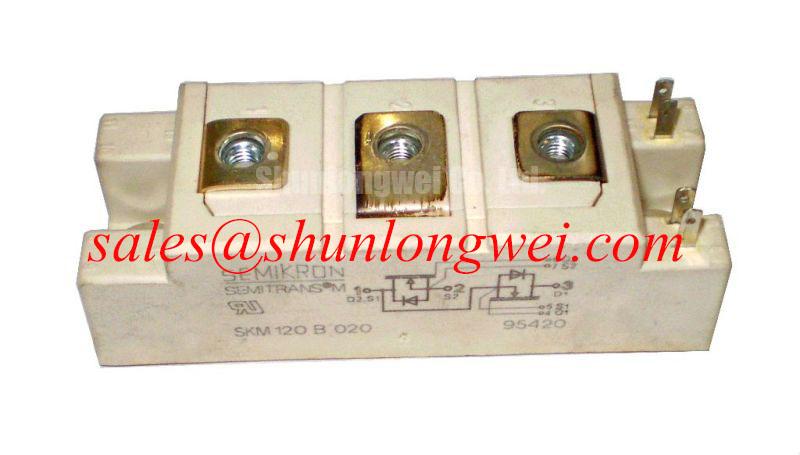
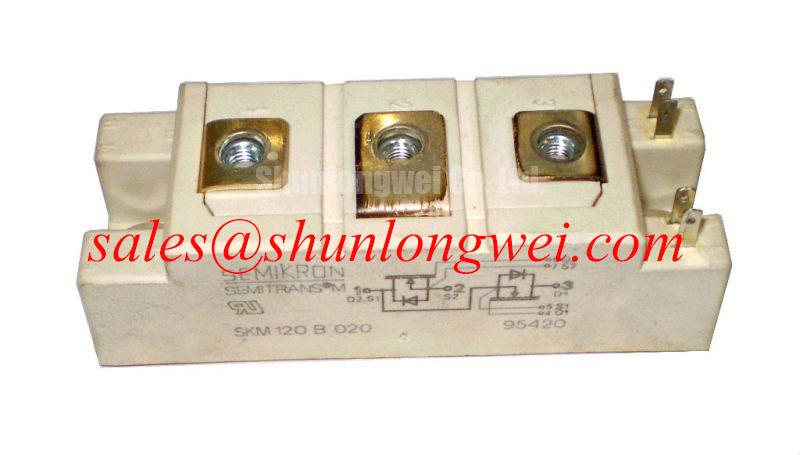
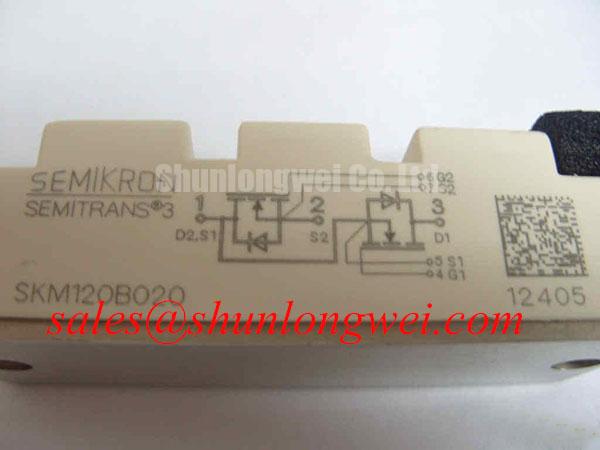
The Semikron SKM 120 B 020 is a Power MOSFET Module that integrates a high-current N-channel, enhancement-mode MOSFET into a robust, isolated package. Its architecture is centered on delivering low on-state resistance and simplified thermal management, making it a functional component for high-efficiency power conversion systems.
* **Core Specifications**: 200V VDS | 120A ID (at Tc=25°C) | 17 mΩ RDS(on) (max)
* **Key Engineering Advantages**:
* Low conduction losses due to a low RDS(on) value.
* Simplified assembly and enhanced safety via a 2500V isolated baseplate.
* **Design Application Focus**: This module provides a direct path to efficient power switching in applications where minimizing heat generated during conduction is a primary objective.
Download Official Datasheet (PDF)
### Technical Analysis Based on Datasheet Metrics
The engineering value of the SKM 120 B 020 is defined by key parameters in its datasheet. The maximum on-state resistance, **RDS(on)**, is specified at 17 mΩ while conducting 120 A. This value is critical as it directly determines the conduction power loss (P = I² * R). A lower RDS(on) means less energy is converted into waste heat, allowing for higher system efficiency and potentially smaller heatsinks. This contributes to more compact and reliable end-systems.
Further enhancing its thermal performance is the module’s construction. It features an **isolated copper baseplate that utilizes Al2O3 ceramic** and Direct Copper Bonding (DCB) technology. This provides a high dielectric strength, with an isolation test voltage (Visol) of 2500V AC for 1 minute. The thermal resistance from junction to case (Rthjc) per MOSFET is 0.25 K/W. Think of thermal resistance like the narrowness of a pipe; a lower value indicates a wider pipe, allowing heat to flow more easily from the active silicon die to the heatsink. This integrated isolation and efficient thermal path simplify mechanical assembly by removing the need for external insulating pads, which can add thermal resistance and complexity.
### Optimized Application Scenarios
The characteristics of the SKM 120 B 020 make it well-suited for specific power electronic applications:
* **Switched-Mode Power Supplies (SMPS):** The low RDS(on) minimizes conduction losses, which is a primary concern in achieving high efficiency ratings for SMPS.
* **DC Servo and Robot Drives:** Fast and efficient control of motor current is essential. The module’s 120A current rating and efficient thermal dissipation support the dynamic loads found in robotics.
* **DC Choppers:** In DC-to-DC converters, the low on-state resistance directly translates to higher conversion efficiency and reduced thermal stress on the switching element.
* **UPS Equipment:** The module’s ability to handle high currents reliably is valuable for the inverter stage of an uninterruptible power supply, ensuring efficient power delivery during an outage.
This module is best matched for high-current, switched-mode DC applications where low conduction loss and simplified, safe thermal assembly are paramount design criteria.
### Key Specification Parameters
| Absolute Maximum Ratings (Tcase = 25 °C unless otherwise specified) | ||
|---|---|---|
| Drain-Source Voltage (VDS) | 200 V | – |
| Continuous Drain Current (ID) | 120 A | at Tcase = 25 °C |
| Pulsed Drain Current (IDM) | 360 A | – |
| Gate-Source Voltage (VGS) | ± 20 V | – |
| Total Power Dissipation (PD) | 500 W | – |
| Electrical & Thermal Characteristics (Tcase = 25 °C unless otherwise specified) | ||
| Drain-Source On-State Resistance (RDS(on)) | 17 mΩ (max) | at VGS = 10 V, ID = 120 A |
| Gate Threshold Voltage (VGS(th)) | 2.1 V (min), 4.0 V (max) | at VGS = VDS, ID = 1 mA |
| Isolation Test Voltage (Visol) | 2500 V | AC, 1 minute |
| Thermal Resistance, Junction to Case (Rthjc) | 0.25 K/W | per MOSFET |
### Engineer FAQ
**1. How does the low RDS(on) of the SKM 120 B 020 impact thermal design?**
The low on-state resistance of 17 mΩ (max) directly reduces the power lost as heat during operation (P_loss = I_D² × RDS(on)). This reduction in generated heat means a smaller, less complex, and potentially lower-cost heatsink may be required to maintain the junction temperature within safe operating limits, simplifying the overall thermal management strategy.
**2. What are the specified mounting torque values for this module?**
The datasheet specifies torque values for proper mechanical and thermal connection. For the M6 mounting bolts to the heatsink, a torque of 3-5 Nm is indicated. For the M5 electrical terminals, a torque of 2.5-3.5 Nm is specified. Adhering to these values is critical for reliable, long-term operation.
**3. Does the integrated isolated baseplate affect heat transfer?**
Yes, the Al2O3 ceramic baseplate is engineered to provide high electrical isolation while maintaining effective thermal conductivity. While any insulating material will have a higher thermal resistance than a direct metal-to-metal contact, the DCB technology used in the SKM 120 B 020 is designed to optimize this trade-off. It provides a low Rth(j-c) of 0.25 K/W, ensuring efficient heat transfer to the heatsink. More on baseplate technology can be found in our guide to isolated baseplates.
**4. What is the benefit of the top-side electrical connections?**
The top-side connection design simplifies the assembly process, particularly when using laminated busbars for power distribution. This layout provides clear access for connections, reduces stray inductance compared to wire-based connections, and facilitates a cleaner, more organized system architecture. This is a key feature in modern power semiconductor modules.
### Enabling Efficient Power Conversion
The SKM 120 B 020 module provides a robust foundation for high-current switching circuits. Its thoughtful integration of a low-loss MOSFET with a high-performance isolated baseplate allows engineers to focus on system-level optimization, confident in the component’s ability to manage thermal loads and simplify mechanical integration.