SKKT162/12E: A Technical Review for Robust Power Control Systems
SKKT162/12E SEMIKRON Thyristor/Diode Module | 1200V 162A
Technical Analysis of the SKKT162/12E for Power Control Systems
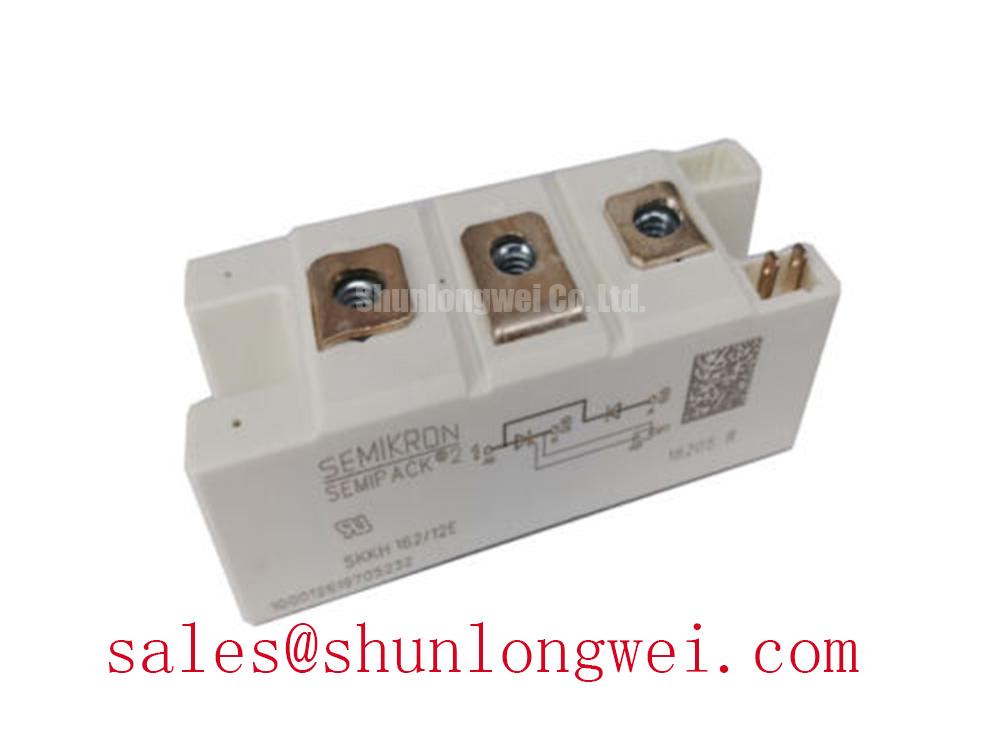
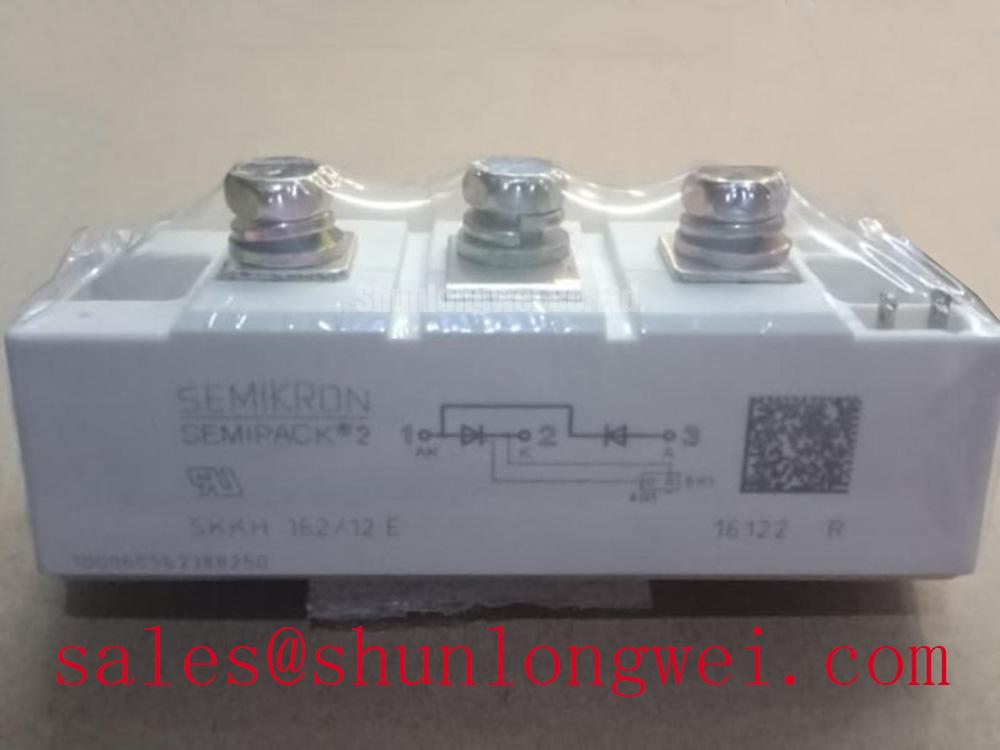
The SKKT162/12E is a Thyristor/Diode Module from Semikron that provides robust and reliable AC power control. Its unique value is rooted in a high surge current capability combined with strong electrical isolation and the long-term stability of glass-passivated semiconductor chips, all housed within an industry-standard SEMIPACK® 2 package.
- Core Specifications: 1200V VDRM/VRRM | 162A ITAV | 3000V Isolation
- Key Advantages: High survivability against fault currents, simplified and safe heatsink mounting.
This module’s configuration is well-suited for engineers developing AC controllers and controlled rectifiers where operational reliability under demanding line conditions is a primary design objective. Download the Official SKKT162/12E Datasheet (PDF)


Engineered for Electrical and Thermal Robustness
A defining characteristic of the SKKT162/12E is its substantial surge current rating (ITSM) of 3300 A for a 10 ms pulse. This high rating provides a critical safety margin, allowing the module to withstand the significant inrush currents typical of motor starting or fault conditions in rectifier circuits without degradation. This robustness is further enhanced by the use of glass-passivated thyristor chips, a manufacturing technique that protects the semiconductor junctions from environmental contaminants and improves voltage stability over the component’s operational life.
Effective thermal management is directly addressed by the module’s construction. The SEMIPACK® 2 package features an aluminium oxide ceramic isolated baseplate, providing a high dielectric strength of 3000V (Visol). This design simplifies mechanical assembly by allowing the module to be mounted directly to a grounded heatsink without requiring additional insulating materials, reducing thermal barriers and component count. The low thermal resistance from junction to case (Rth(j-c)) of 0.16 K/W per thyristor is a key parameter for heatsink design. You can think of thermal resistance like the width of a pipe for heat flow; a lower value signifies a wider pipe, enabling heat to be extracted more efficiently from the active semiconductor, which is essential for maintaining reliability at high power levels.
Optimized Application Scenarios
The electrical characteristics and physical construction of the SKKT162/12E make it a strong candidate for several specific industrial applications:
- AC Motor Soft Starters: The high ITSM rating is critical for handling the large, brief currents that occur when starting inductive loads.
- Controlled Rectifiers: Its dual thyristor configuration is the fundamental building block for phase-controlled bridges used in DC power supplies and battery chargers.
- Industrial Heating and Lighting Control: The module enables precise AC power regulation through phase-angle control, ideal for managing large resistive loads.
- Static AC Switches: Provides a durable and reliable solid-state solution for switching AC mains, offering advantages over mechanical contactors.
Its specifications make it an optimal choice for high-power AC line-frequency control systems that demand high operational reliability and simplified thermal design.
Key Specifications of the SKKT162/12E
| Electrical & Thermal Characteristics (Tvj = 25 °C, unless otherwise specified) | |
|---|---|
| Repetitive Peak Off-State and Reverse Voltages (VDRM, VRRM) | 1200 V |
| Average On-State Current (ITAV), Single Phase, 180° Conduction, Tc=85°C | 162 A |
| RMS On-State Current (ITRMS) | 255 A |
| Peak Surge On-State Current (ITSM), t=10ms, Tvj=25°C | 3300 A |
| Maximum On-State Voltage (VT), IT=500A, Tvj=25°C | ≤ 1.85 V |
| Gate Trigger Current (IGT), Tvj=25°C | ≤ 150 mA |
| Thermal Resistance, Junction to Case (Rth(j-c)), per thyristor | 0.16 K/W |
| Isolation Test Voltage (Visol), RMS, t=1min | 3000 V |
| Operating Junction Temperature Range (Tvj) | -40 to +125 °C |
Engineer’s FAQ
1. What is the internal circuit configuration of the SKKT162/12E?
The module contains two thyristors connected in series with a common cathode terminal. This configuration is also known as a half-controlled bridge or a doubler circuit, suitable for AC phase control and controlled rectification.
2. How do I calculate the heatsink required for this module?
To determine the required heatsink thermal resistance (Rth(c-a)), you must first calculate the total power dissipation (PAV) based on your application’s current and conduction angle using the graphs in the datasheet. Then, use the formula: Rth(c-a) ≤ (ΔT / PAV) – Rth(j-c) – Rth(c-s), where ΔT is the maximum allowed junction temperature rise, Rth(j-c) is from the datasheet (0.16 K/W), and Rth(c-s) is the thermal resistance of your mounting interface (thermal grease).
3. What are the correct mounting torque specifications?
For the M6 mounting bolts that secure the module to the heatsink, the recommended torque is 5 Nm ± 15%. For the electrical terminals (M5), the recommended torque is 2.5 Nm ± 15%. Adhering to these values is critical for ensuring proper thermal contact and reliable electrical connections.
4. What does “glass passivated” mean for system reliability?
Glass passivation involves applying a layer of glass over the semiconductor junction. This provides a hermetic seal that protects the sensitive area from moisture and contaminants, significantly improving long-term stability, reducing leakage currents, and ensuring consistent blocking voltage capability over the module’s lifetime.
Design Considerations
This power semiconductor empowers engineers to create high-current AC control systems with a foundation of high reliability. The module’s inherent surge survivability and thermally efficient isolated package allow for durable designs capable of operating consistently in demanding industrial environments.