Sharp LM64C032: A Low-Power VGA Display for Industrial Systems
Sharp LM64C032 | 9.4-inch VGA Color STN LCD Module
High-Contrast, Low-Power Display for Industrial Systems
The Sharp LM64C032 is a 9.4-inch Color Super-Twist Nematic (CSTN) liquid crystal display module engineered for sustained performance in industrial equipment. Its primary value is the delivery of clear, reliable visual data with exceptionally low power consumption. This makes it a suitable component for legacy systems where power budgets and thermal output are key design constraints. The panel provides essential functionality for human-machine interfaces that require straightforward, readable graphics and status indicators.
- Core Specifications: 640×480 VGA Resolution | 9.4-inch Diagonal | 2.4W Power Consumption
- Key Advantages: Minimal power draw reduces thermal stress in enclosed systems. Slim and lightweight construction simplifies mechanical integration.
- Primary Use Case: Ideal as a drop-in replacement or for new designs in long-lifecycle industrial control panels and portable instrumentation.
Download Official Datasheet (PDF)
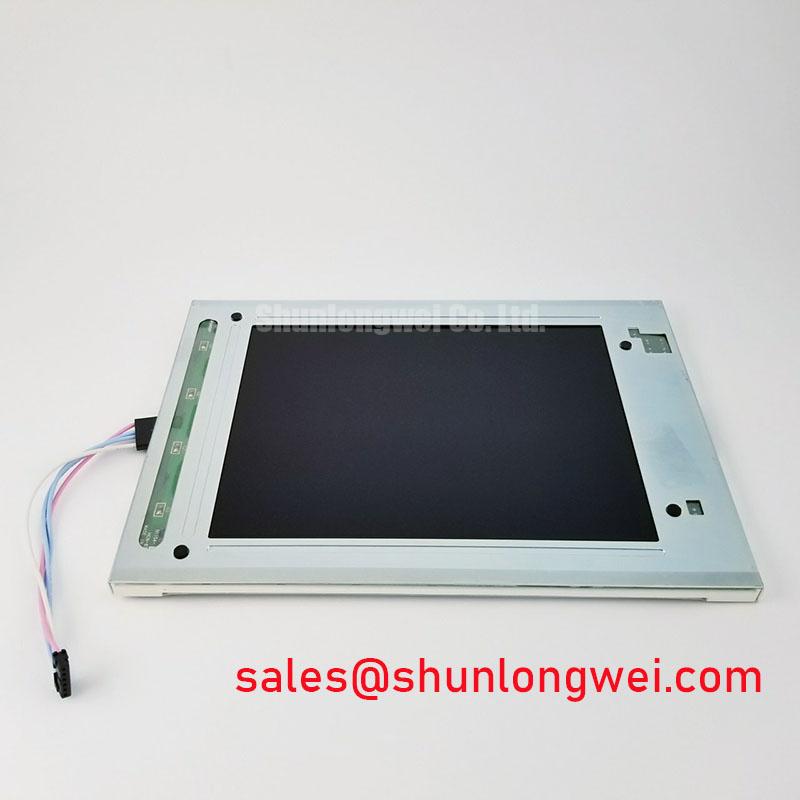

Technical Analysis for System Integration
The engineering value of the LM64C032 is centered on its efficiency and straightforward integration. The module’s total power consumption is specified at a typical 2.4 watts, a figure that includes both the logic board and the Cold Cathode Fluorescent Lamp (CCFL) backlight. This low power draw is critical for systems with limited ventilation or those powered by batteries, as it minimizes heat generation and extends operational time. Effective thermal management is simplified, allowing for more compact and reliable end-product designs.
Visual performance is defined by a typical contrast ratio of 25:1. You can think of contrast ratio as the perceptual difference between the display’s deepest black and its brightest white. For industrial user interfaces, a distinct contrast ensures that text, numerical readouts, and status icons are clearly legible, reducing the chance of operator error. While not intended for full-motion video, its response time is adequate for the graphical user interfaces common in manufacturing controls and analytical instruments. The panel’s architecture supports the display of 512 distinct colors, enabling designers to create intuitive, color-coded interfaces.
Optimized Application Scenarios
The specific feature set of the LM64C032 makes it a strong candidate for applications where long-term availability and energy efficiency are paramount.
- Industrial Control Panels: The standard VGA resolution and low power profile are an excellent match for PLCs and CNC machine interfaces where thermal buildup inside an enclosure must be minimized.
- Portable Test & Measurement Equipment: Its low 2.4W power consumption is a significant benefit for battery-powered devices, allowing for longer field operation between charges.
- Medical Monitoring Systems: Suitable for displaying patient data and waveforms with sufficient clarity and color differentiation for non-diagnostic monitoring applications.
- Legacy System Sustainment: Serves as a reliable, form-fit-function replacement for aging displays in equipment where a complete system overhaul is not feasible. This aligns with strategies for managing component end-of-life challenges.
This module is best matched for systems requiring a robust, energy-efficient VGA display with a long, stable supply chain for maintenance and production.
Key Specifications of the LM64C032
| Parameter | Specification |
|---|---|
| Display Type | CSTN (Color Super-Twist Nematic) LCD |
| Screen Size | 9.4 inches (24 cm) diagonal |
| Resolution | 640 x 480 (VGA) |
| Pixel Pitch | 0.30 x 0.30 mm |
| Active Area | 192.0 x 144.0 mm |
| Display Colors | 512 |
| Contrast Ratio | 25:1 (Typical) |
| Power Consumption | 2.4 W (Typical, Panel + Backlight) |
| Backlight | 1x CCFL with an estimated lifetime of 20,000 hours |
| Module Dimensions | 242.0 x 179.0 x 10.0 mm |
| Weight | 360 g (Max) |
| Operating Temperature | 0°C to +40°C |
Engineer’s FAQ
What are the required power supply voltages for the LM64C032?
The module requires two primary supply voltages. The logic circuit (Vdd) requires a stable +5V DC supply. The LCD drive voltage (Vlcd) is generated from a separate input (VEE) which requires -22V DC. Both supplies must be within the tolerances specified in the datasheet to ensure proper operation and avoid damage.
What is the expected lifetime of the CCFL backlight?
The datasheet specifies the typical CCFL tube lifetime as 20,000 hours. This is defined as the time until the brightness falls to 50% of its initial value when operated under specified conditions. The CCFL tube is a serviceable component, though replacement requires appropriate handling of high-voltage connections for the inverter.
How does the display’s response time impact its usability?
The typical response time (rise + fall) is 350 ms. This is characteristic of passive-matrix STN technology and is well-suited for static or slow-changing GUIs, such as those in process controllers or data loggers. It is not intended for applications requiring full-motion video playback, where faster response times are necessary to prevent motion blur. Understanding this limitation is a core part of LCD core technology selection.
Can this display be operated outside its specified temperature range?
Operation outside the 0°C to +40°C range is not recommended. Below 0°C, the liquid crystal fluid can become more viscous, severely slowing response time and potentially causing display uniformity issues. Above +40°C, the display may suffer from reduced contrast and, in extreme cases, permanent damage. Adhering to the specified range is essential for ensuring long-term display reliability.
Enabling Reliable System Performance
The LM64C032 provides a proven, efficient, and mechanically convenient solution for integrating VGA-resolution color graphics into industrial systems. By delivering essential visual performance within a stringent power and thermal budget, this module allows engineers to maintain the operational life of existing equipment and develop new, reliable products without the complexity of more advanced display technologies. Its design focuses on stability and efficiency, providing a dependable foundation for clear human-machine interaction.