TT250N16KOF Module: A Technical Guide to Robust AC Power Control
“`html
TT250N16KOF Thyristor/Diode Module | 1600V 250A Control
Introduction to the TT250N16KOF Power Module
The Infineon TT250N16KOF is a Thyristor/Diode Module engineered for high-reliability AC power control. This device integrates a thyristor and a diode in a single, electrically isolated package, providing a robust solution for managing high-power loads. Its primary value is delivered through a combination of high blocking voltage for system safety, exceptional surge current handling for operational resilience, and efficient thermal performance for simplified cooling system design.
- Core Specifications: 1600V | 250A | VISOL 3000V~
- Key Advantages: High operational safety margin on industrial mains, superior survivability during fault conditions.
This module’s electrical characteristics are well-suited for engineers needing to implement precise control over high-power AC circuits, such as in industrial motor drives. For detailed specifications, please download the official TT250N16KOF datasheet (PDF).
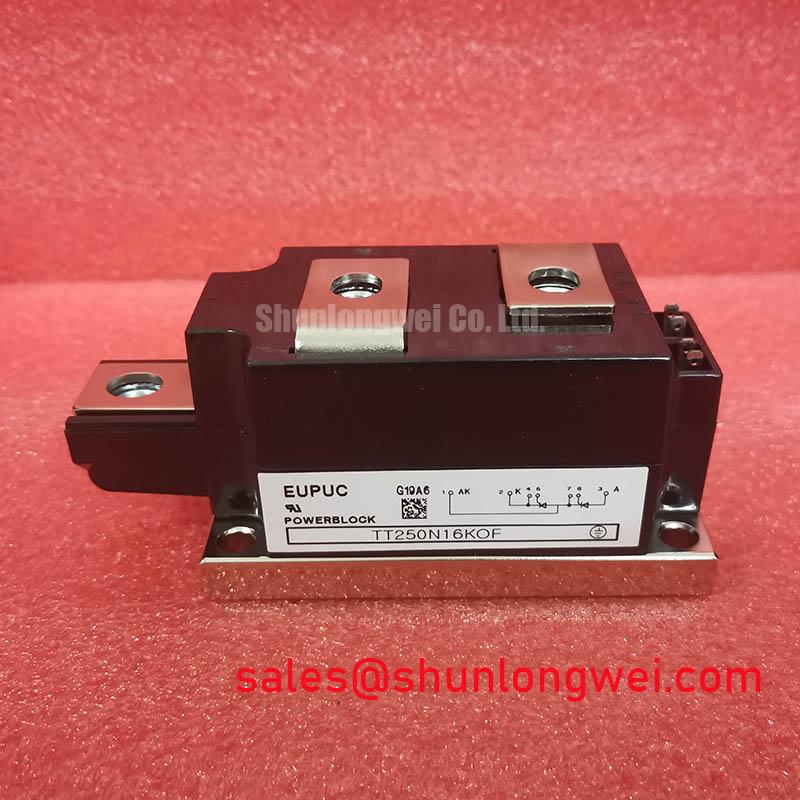

Technical Analysis for System Integration
The module’s 1600V repetitive peak reverse voltage (VRRM) rating offers a substantial safety margin for applications connected to 400V, 480V, or even 690V AC mains. This high blocking voltage capability enhances system reliability by providing tolerance against line voltage transients and surges, which are common in industrial environments. It allows designers to build more robust systems without requiring complex external overvoltage protection circuits.
A critical parameter for reliability is the module’s surge current handling, defined by its I²t value of 325,000 A²s. Think of the I²t rating as the module’s ability to withstand a sudden, massive burst of current, much like a dam is built to withstand a flash flood. This high rating ensures the TT250N16KOF can survive inrush currents and fault conditions without failure, a crucial attribute in motor starters and protection circuits. For more on this topic, see our analysis on the I²t rating for robust protection.


Optimized Application Scenarios
The performance characteristics of the TT250N16KOF make it highly suitable for specific industrial applications:
- AC Motor Soft Starters: The high surge current capability effectively manages the large inrush currents typical of motor startup, preventing stress on both the motor and the electrical system.
- Controlled Rectifiers: Its 1600V rating and 250A average current provide the robustness and capacity required for industrial DC power supplies and battery charging systems.
- AC Power Controllers: For applications like industrial heating or lighting control, the module offers precise and reliable phase-angle control of high-power loads.
- Static Switches: The device can be used to build fast-acting static switches that provide a more reliable alternative to mechanical contactors for load switching.
This module is an optimal match for line-voltage AC applications demanding high reliability and robust fault current handling capabilities.
Key Specifications of the TT250N16KOF
| Key Electrical and Thermal Parameters | |
|---|---|
| Repetitive Peak Reverse Voltage (VRRM) | 1600 V |
| Average On-state Current (ITAVM) @ TC=85°C | 250 A |
| RMS On-state Current (ITRMS) | 500 A |
| Surge Current (ITSM) @ 10ms, Tvj=25°C | 7500 A |
| I²t-value @ 10ms, Tvj=25°C | 325,000 A²s |
| Gate Trigger Current (IGT) max. | 200 mA |
| Thermal Resistance, Junction to Case (Rth(j-c)) – Thyristor | 0.10 K/W |
| Thermal Resistance, Junction to Case (Rth(j-c)) – Diode | 0.17 K/W |
| Isolation Test Voltage (VISOL), 50 Hz, RMS, 1 min | 3000 V |
| Operating Junction Temperature (Tvj op) | -40 to 125 °C |
Engineer’s Frequently Asked Questions
1. How should I calculate the required heatsink performance for the TT250N16KOF?
To determine the required heatsink, you must first calculate the total power dissipation of the module in your specific application. Then, use the thermal resistance from junction to case (Rth(j-c)) provided in the datasheet (0.10 K/W for the thyristor) along with the thermal resistance of the thermal interface material (TIM) to find the maximum allowable heatsink thermal resistance (Rth(c-a)). The formula is: Rth(c-a) = (Tj max – Ta) / Ptotal – Rth(j-c) – Rth(c-s).
2. What is the correct mounting procedure for this module?
The datasheet specifies a mounting torque of 5 Nm ± 15% for the M6 mounting screws. It is critical to apply this torque evenly to ensure a flat, low-resistance thermal connection between the module’s baseplate and the heatsink. Use of a calibrated torque wrench is highly recommended. More information on thermal management can be found in our guide to the Zth curve.
3. Can this module be used for a three-phase controlled bridge rectifier?
Yes. Three TT250N16KOF modules can be configured to create a B6C fully-controlled three-phase bridge rectifier. Their isolated baseplates simplify the mechanical and electrical assembly onto a common heatsink. A deeper understanding of topologies can be found in our guide to multi-level inverters.
Enabling Robust Power System Design
The TT250N16KOF Thyristor/Diode Module provides the essential building block for developing durable and efficient high-power AC control systems. Its high voltage rating, superior surge handling, and well-defined thermal characteristics give engineers the technical foundation needed to design equipment that performs reliably, even under demanding industrial conditions. This focus on electrical and thermal robustness directly supports the creation of long-lasting and safe power conversion systems.
“`