MCD40-16io6 Thyristor Diode Module: Technical Analysis and Industrial Applications
MCD40-16io6 Thyristor Diode Module: 1600V 40A TO-240AA Specs
Introduction and Core Technical Highlights
The MCD40-16io6 is a standard phase-leg thyristor diode module built for robust industrial rectification. It integrates planar passivated semiconductor chips on an isolated copper baseplate. This configuration yields high thermal cycling stability and excellent blocking reliability. Key technical specifications include:
- Maximum Repetitive Peak Voltage (VRRM/VDRM): 1600V
- Average Forward Current (IT(AV)): 40A at a case temperature of 85°C
- RMS Forward Current (ITRMS): 63A
- Isolation Voltage (VISOL): 3600V AC (RMS for 1 minute)
By employing a Direct Copper Bonded (DCB) ceramic baseplate, the module simplifies design in space-constrained enclosures. Engineers looking to evaluate electrical behavior can view the official details in the IXYS / Littelfuse datasheet.
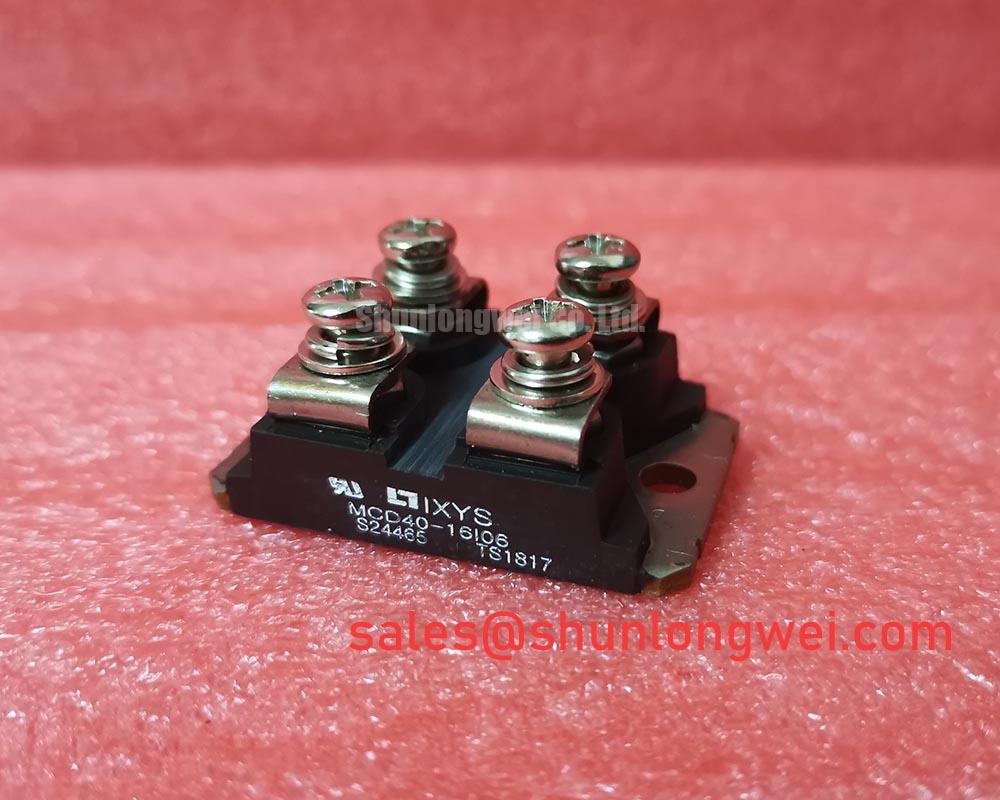
UVP Technical Analysis: Thermal Path and Junction Security
Thermal management is key to preventing system failures in high-power semiconductor assemblies. The MCD40-16io6 utilizes an alumina (Al2O3) ceramic substrate. This substrate provides a low thermal resistance from junction to case (RthJC) of 0.66 K/W per thyristor.
You can compare thermal resistance to a narrow point in a water pipe. A thin pipe restricts water flow, while a wider pipe allows volume to pass freely. A lower thermal resistance rating allows heat to transfer easily from the silicon to the heatsink. This keeps the internal junctions cool and increases stability.
The module implements planar passivation to secure the silicon junctions. Planar passivation deposits a protective oxide layer over the exposed junction boundaries. This layer limits leakage currents during reverse bias. It ensures stable operation up to the maximum virtual junction temperature of 125°C. For insights on chip-level passivation, read about fortifying reliability with glass passivation.

Electrical safety is enhanced by the isolated baseplate package. The ceramic DCB structure isolates active electrical paths from the heatsink. This arrangement enables engineers to mount multiple modules on a single metal surface. You can learn more about this packaging layout by reading about isolated baseplates for high-voltage reliability. For comparable designs in this current class, you may also check the MCD162-16io1 technical analysis.
Optimized Application Scenarios
- Line Rectifiers for 50/60 Hz AC Networks: The 1600V rating offers protection against line voltage surges in 480VAC industrial systems.
- Soft Starters for AC Motors: The high surge current rating (ITSM) of 520A handles inrush transients during startup.
- DC Motor Drivers: Serves as a control element in phase-controlled rectification bridges.
- Power Supply Input Stages: Rectifies AC input before the DC link capacitor in motor control platforms.
Best Match: The MCD40-16io6 serves as a durable phase-leg component for line rectifiers in 480V industrial grids.

Key Specifications Table
| Parameter | Symbol | Maximum Value | Conditions |
|---|---|---|---|
| Max. Peak Reverse Voltage | VRRM / VDRM | 1600V | TVJ = 25°C to 125°C |
| Average Forward Current | IT(AV) | 40A | TC = 85°C, 180° sine phase leg |
| Peak Surge Current (10ms) | ITSM | 520A | TVJ = 45°C; VR = 0V |
| On-State Voltage Drop | VT | 1.57V | IT = 120A; TVJ = 25°C |
| Gate Trigger Current | IGT | 100mA | TVJ = 25°C; VD = 6V |
| Thermal Resistance (Junction-Case) | RthJC | 0.66 K/W | Per Thyristor / Diode block |
Engineer FAQ
How do isolated baseplates impact the thermal stack assembly?
The integrated Al2O3 DCB substrate insulates the baseplate from the semiconductor dies. This allows engineers to bolt the MCD40-16io6 directly to a metal heatsink. There is no need for external isolation barriers like mica sheets, which would add thermal resistance to the path.
What is the transient thermal impedance (ZthJC) significance during start-up?
For short pulse operations or start-up surges, the heat is absorbed by the package thermal capacitance before reaching steady state. The ZthJC curves in the manufacturer datasheet define the allowable duration of these overload current peaks.
How does planar passivation lower leakages compared to conventional mesa structures?
Planar passivation provides a flat, controlled surface layer that reduces active surface charge. This structure reduces high-field stress concentrations at the junctions, leading to lower, stable leakage currents at high operating temperatures.
Closing Statement
The MCD40-16io6 module provides a reliable solution for line-frequency power rectification and motor control. Its 1600V blocking voltage and isolated DCB baseplate package make it a versatile choice for designers building industrial power converters. For detailed parameters and layout specifications, consult the official manufacturer resources.