A Technical Review of the Fuji 6MBI450VM-170-50 High-Efficiency IGBT Module
Fuji 6MBI450VM-170-50 | 1700V 450A V-Series IGBT Module
High-Efficiency Power Conversion for Demanding Applications
The Fuji Electric 6MBI450VM-170-50 is a high-current 6-pack IGBT module engineered for robust performance in high-power conversion systems. Leveraging Fuji’s advanced V-Series trench gate and field-stop technology, this module delivers an exceptional combination of a high 1700V blocking voltage with low conduction and switching losses. This balance makes it a superior component for improving system efficiency and reliability.
- Core Specifications: 1700V | 450A | VCE(sat) (typ) 2.65V @ 25°C
- Key Advantages: Reduces overall power loss, enabling smaller heatsink requirements and higher power density. The integrated NTC thermistor allows for precise temperature monitoring, enhancing system protection.
- Engineering Value: The 1700V rating provides a substantial design margin for inverters operating on high DC bus voltages, mitigating risks from voltage transients and improving long-term reliability in applications like 1000V solar systems.
Download Official Datasheet (Link)
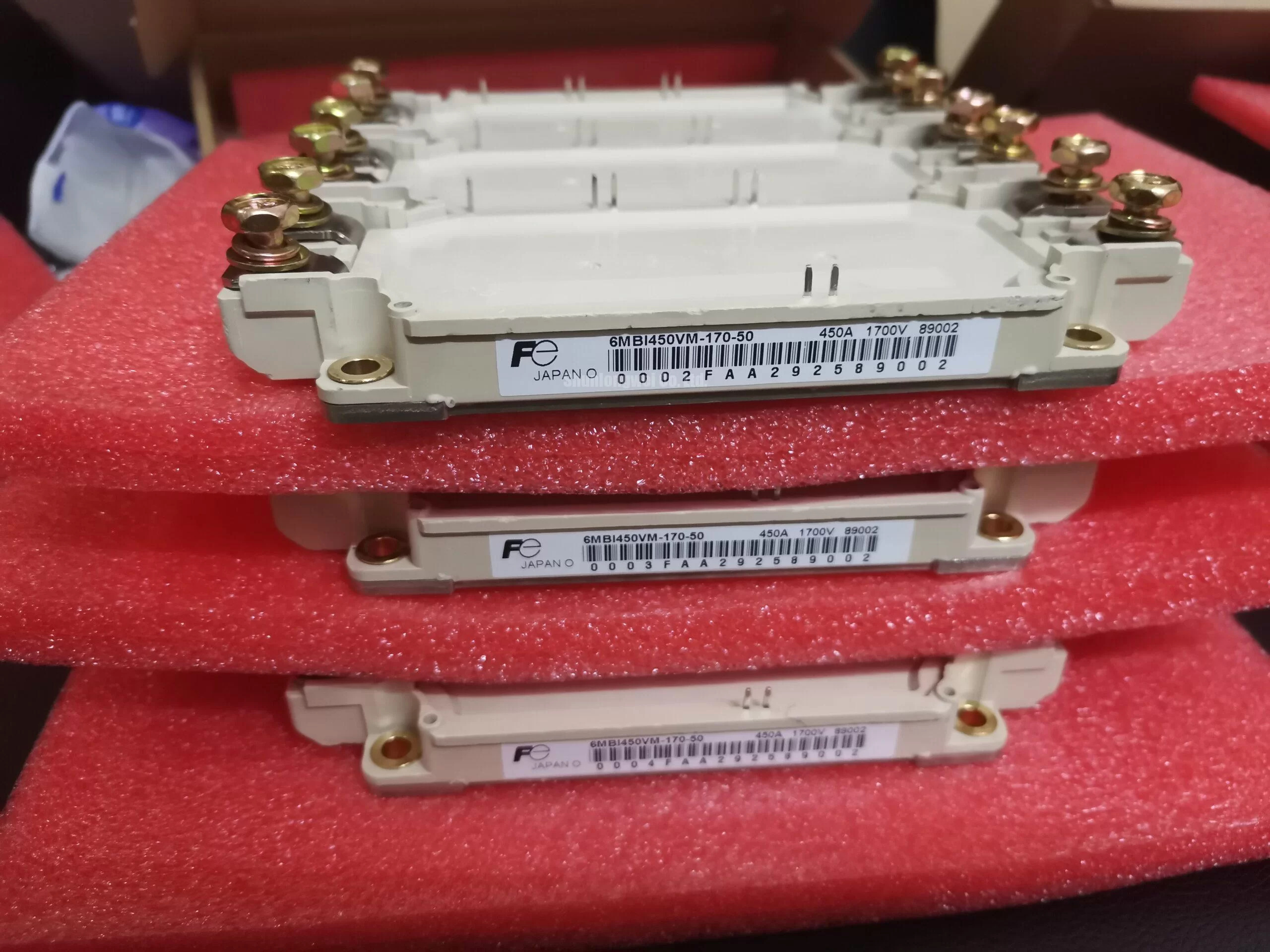

Technical Analysis: V-Series Technology
The core of the 6MBI450VM-170-50’s performance lies in its V-Series chip technology. A key parameter for engineers is the collector-emitter saturation voltage, VCE(sat), which is a direct measure of conduction losses. This module specifies a typical VCE(sat) of 3.10V at its operating junction temperature of 125°C. Think of VCE(sat) as the resistance a switch presents when it’s on; a lower value means less power is burned as waste heat. This low conduction loss directly translates to higher inverter efficiency and a reduced thermal management burden.
Furthermore, the 1700V collector-emitter voltage (VCES) rating provides critical reliability in high DC-link voltage applications. Systems such as large-scale solar inverters and industrial motor drives often operate with DC voltages approaching or exceeding 1000V. The substantial headroom offered by a 1700V rating ensures the device remains well within its Safe Operating Area (SOA), even during transient voltage spikes common in industrial environments.
Optimized Application Scenarios
The specifications of the 6MBI450VM-170-50 make it a strong candidate for several high-power applications:
- Renewable Energy Inverters: The 1700V rating is well-suited for 1000V and 1100V DC bus architectures found in large solar and wind power systems, providing necessary voltage margin for reliable operation.
- High-Power Motor Drives: With a 450A continuous current rating at a case temperature of 100°C, it can effectively control multi-megawatt industrial motors, offering the efficiency needed to reduce operational costs.
- Uninterruptible Power Supplies (UPS): Its robust V-Series construction and high reliability are essential for critical infrastructure like data centers, where stable and efficient power is non-negotiable.
- Welding Power Supplies: The module’s ability to handle high pulse currents (up to 900A) makes it suitable for advanced welding applications requiring precise power delivery.
Its high voltage rating and low conduction losses make this module an excellent match for high-power, three-phase inverter systems prioritizing efficiency and reliability.
Key Specifications of the 6MBI450VM-170-50
| Absolute Maximum Ratings (Tc=25°C) | ||
|---|---|---|
| Collector-Emitter Voltage (VCES) | 1700V | – |
| Gate-Emitter Voltage (VGES) | ±20V | – |
| Continuous Collector Current (IC) | 450A | @ Tc=100°C |
| Collector Power Dissipation (PC) | 2500W | Per device |
| Operating Junction Temperature (Tjop) | 150°C | Under switching |
| Electrical & Thermal Characteristics (Tj=125°C unless otherwise specified) | ||
| Collector-Emitter Saturation Voltage (VCE(sat)) | 3.10V | Typ., @ IC=450A, VGE=15V |
| Forward Voltage (VF) of FWD | 2.75V | Typ., @ IF=450A, VGE=0V |
| Thermal Resistance (Rth(j-c)) | 0.056 K/W | Max, IGBT part |
| NTC Thermistor Resistance (R) | 5.0 kΩ | @ T=25°C |
Engineer’s FAQ
1. What are the main thermal design considerations for the 6MBI450VM-170-50?
The primary consideration is efficiently extracting heat to keep the junction temperature below the 150°C operating maximum. The datasheet specifies a maximum thermal resistance from junction to case (Rth(j-c)) of 0.056 K/W for the IGBT. Engineers must use this value, along with calculated power losses (conduction and switching), to select an appropriate heatsink with a low enough case-to-ambient thermal resistance to ensure safe operation under worst-case load conditions.
2. What is the recommended gate drive voltage?
The electrical characteristics are tested and specified with a gate-emitter voltage (VGE) of ±15V. Operating within this recommended range ensures the module achieves its specified low VCE(sat) when on and remains reliably off to prevent shoot-through.
3. How does the integrated NTC thermistor improve system reliability?
The built-in NTC thermistor provides a real-time temperature feedback signal from near the IGBT chips. A gate driver or system controller can monitor this resistance (5 kΩ at 25°C) to implement over-temperature protection (OTP). This allows for a controlled shutdown or power reduction if the module exceeds safe thermal limits, preventing catastrophic IGBT failures.
4. Is the 6-pack configuration beneficial?
Yes, the 6-in-1 or “6-pack” configuration contains all six IGBTs and their corresponding freewheeling diodes required to build a complete three-phase inverter bridge in a single module. This simplifies the mechanical layout, reduces busbar inductance compared to using discrete components, and streamlines the manufacturing assembly process.
Enabling Efficient and Reliable High-Power Systems
For engineers tasked with designing high-voltage, high-current power conversion systems, the Fuji Electric 6MBI450VM-170-50 provides a robust, thermally efficient, and highly integrated solution. Its foundation in V-Series technology directly addresses the critical design goals of maximizing power density and ensuring long-term operational reliability in the most demanding industrial and renewable energy applications.