FEC15-24D15 Review: A Robust 15W DC-DC Converter for Industrial Reliability
FEC15-24D15 DC-DC Converter: 15W, Wide 2:1 Input Range
Introduction and Core Highlights
The P-DUKE FEC15-24D15 is a 15W isolated DC-DC converter module engineered for reliability in demanding industrial applications. Its defining feature is a wide 2:1 input voltage range, which accommodates significant input fluctuations while delivering a stable, regulated dual output. This operational flexibility is complemented by high efficiency and comprehensive internal protections, making it a robust solution for powering sensitive electronics where input stability and safety are paramount. It directly addresses the need for a dependable, isolated power source capable of operating from variable DC buses.
- Core Specifications: 18-36VDC Input | ±15V Dual Output | 15W Power
- Key Advantages: Ensures stable output during input voltage sags or surges, simplifies thermal management due to high efficiency.
Download Official Datasheet (PDF)
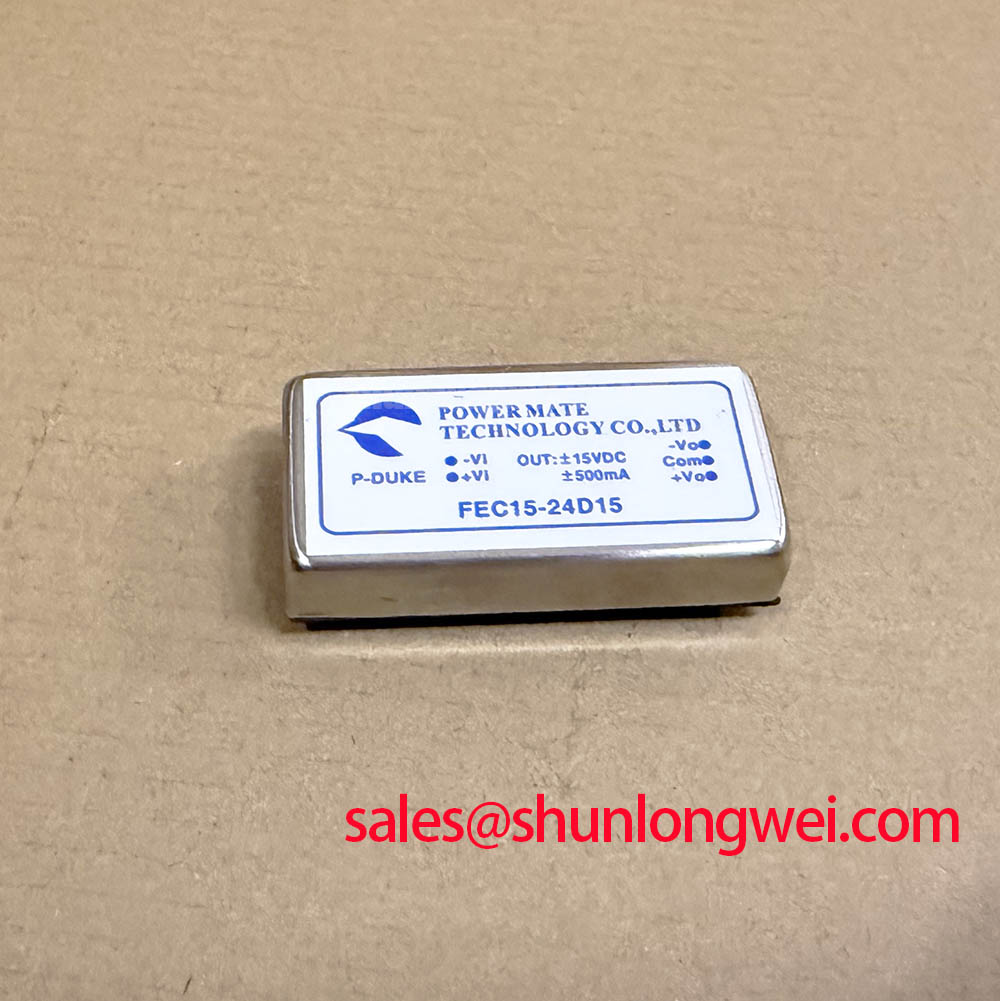

Technical Analysis of Core Features
The engineering value of the FEC15-24D15 is rooted in its key datasheet parameters. The 2:1 wide input voltage range (18VDC to 36VDC) allows the converter to maintain a regulated ±15V output even when the source voltage is unstable. This is critical in battery-powered systems where voltage drops as the battery discharges, or in distributed power architectures with long cable runs causing voltage sag. This feature eliminates the need for upstream pre-regulation circuits, saving both space and component cost.
Efficiency, specified up to 86%, is another cornerstone of its performance. Think of inefficiency as a leaky bucket; every watt lost to heat is energy that doesn’t reach the load and must be dissipated. The high efficiency of the FEC15-24D15 minimizes this waste, resulting in less heat generation. This directly translates to a lower operating temperature, which enhances the reliability and lifespan of both the converter and surrounding components, and simplifies overall system thermal management.
Furthermore, the module provides 1600VDC input-to-output isolation. This electrical separation is essential for safety, preventing fault currents from passing from input to output. It also breaks ground loops, which are a common source of noise in industrial measurement and control systems. Combined with continuous short circuit, overcurrent, and overvoltage protections, the device provides a resilient power foundation that safeguards downstream electronics from adverse line conditions.

Optimized Application Scenarios
The specifications of this converter make it a strong candidate for several applications:
- Industrial Automation: The wide operating temperature range (-40°C to +85°C) and robust protections ensure reliable operation in harsh factory environments.
- Telecommunication Equipment: High I/O isolation and a shielded metal case minimize noise, which is critical for clear signal transmission.
- Data Acquisition Systems: The regulated and isolated output provides clean power to sensitive analog-to-digital converters and sensors, ensuring measurement accuracy.
- Distributed Power Architectures: Its ability to handle a wide input voltage range makes it ideal for systems where a central supply feeds multiple sub-circuits over varying distances.
This converter is an excellent match for systems requiring a compact, reliable, and isolated dual-output power source that can handle unpredictable input voltages.
Key Specifications of the FEC15-24D15
| Parameter | Specification | |
|---|---|---|
| Input | Voltage Range | 18 – 36 VDC (24V Nominal) |
| Max Input Current | 945mA (at 18VDC) | |
| Input Filter | Pi Type | |
| Output | Output Voltage | ±15 VDC |
| Output Current | ±500 mA | |
| Line Regulation | ±0.5% (Max) | |
| Load Regulation | ±1.0% (Max, 20-100% Load) | |
| General | Efficiency | 86% (Typical) |
| I/O Isolation Voltage | 1600 VDC | |
| Switching Frequency | 330 kHz (Typical) | |
| Environmental | Operating Temperature Range | -40°C to +85°C (with derating) |
| Storage Temperature Range | -55°C to +105°C | |
Engineer’s FAQ
- What is the primary benefit of the 2:1 input range on the FEC15-24D15?
- The primary benefit is system resilience. It allows the converter to deliver a constant, stable ±15V output even if its 24V nominal input sags to 18V or surges to 36V. This is crucial for maintaining operation in systems with fluctuating power sources, such as those powered by batteries or subject to line voltage variations, enhancing overall power system reliability.
- How should I manage thermal dissipation when integrating the FEC15-24D15?
- While the module has high efficiency, thermal management is still important. The datasheet provides a derating curve that shows the maximum output power available at different ambient temperatures. For operation at higher temperatures or in enclosed spaces with limited airflow, ensure sufficient convection or consider heatsinking to keep the case temperature below the specified maximum of 105°C.
- Is an external filter required for this converter?
- The datasheet states that the FEC15 series is designed to meet EN55022 Class A and FCC Level A with an external filter circuit. The specific component values and circuit diagram for this recommended EMI filter are provided in the official datasheet.
- What does the 1600VDC isolation rating signify in a practical application?
- The 1600VDC isolation creates a dielectric barrier between the input and output circuits. In practice, this prevents hazardous voltages on the input side from reaching the output, protecting both the load and personnel. It also isolates the output ground from the input ground, which is effective in eliminating ground loop noise in sensitive measurement applications.
Enabling Robust System Design
The FEC15-24D15 DC-DC converter provides a dependable power foundation for sophisticated electronic systems. By accommodating wide input voltage variations and integrating comprehensive protection features within a compact, isolated package, it empowers engineers to design with confidence. This focus on operational resilience and efficiency directly supports the development of reliable, long-life industrial and telecommunications equipment.