Fuji 7MBI75N-060: A Technical Review of the 7-in-1 IGBT Module
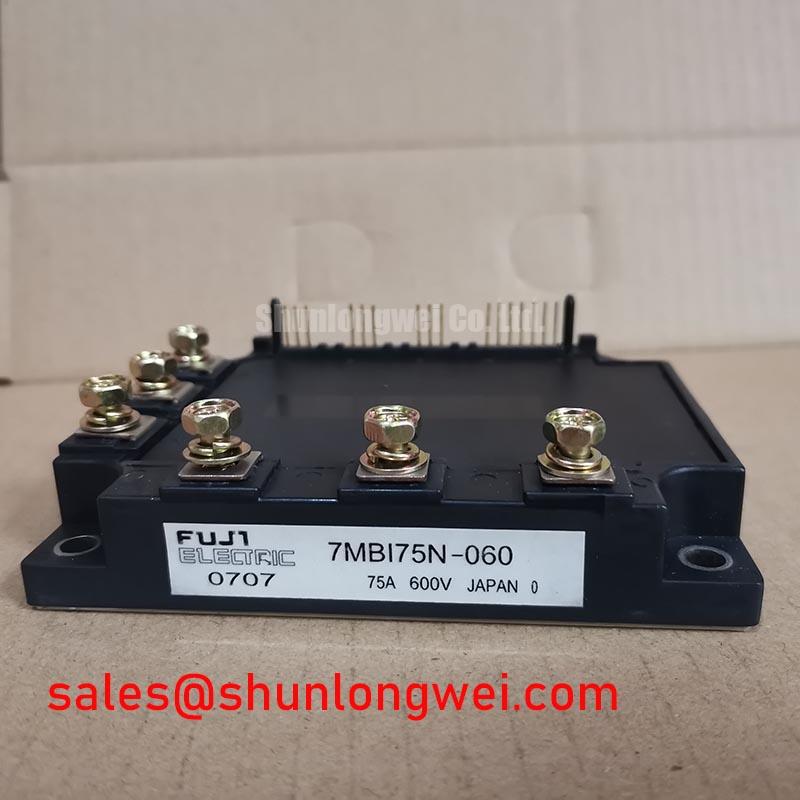
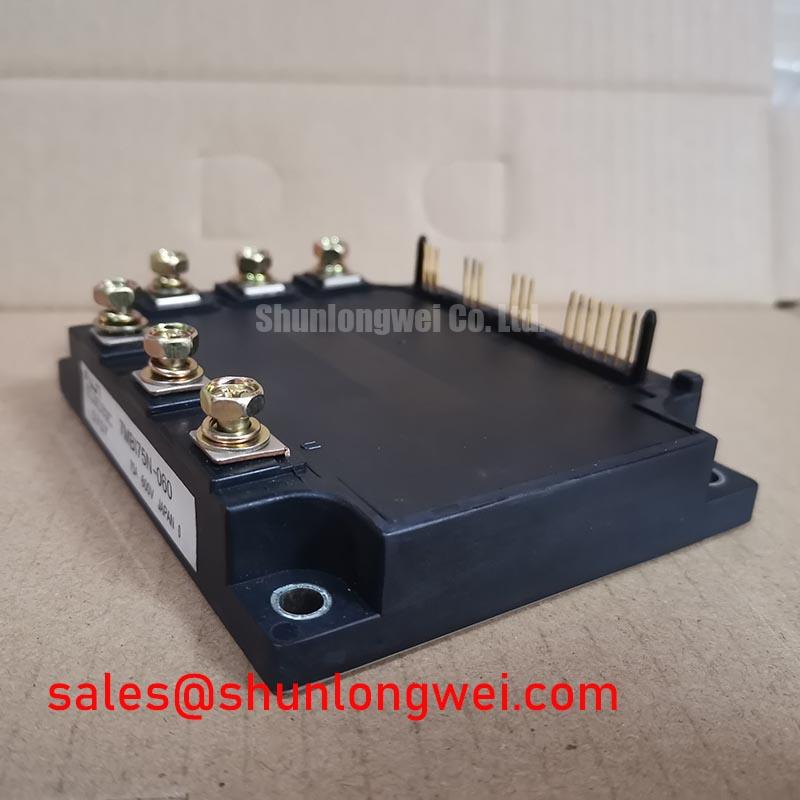
Fuji Electric 7MBI7N-060 7-in-1 IGBT Module
Introduction to the 7MBI75N-060 IGBT Module
The Fuji Electric 7MBI75N-060 is a 7-in-1 IGBT module that integrates a three-phase inverter, three-phase converter, and a brake chopper into a single compact package. This module’s primary value proposition is its high level of integration and robust performance, which streamlines the design of motor control and power conversion systems. It is engineered to provide a reliable power stage for applications prioritizing durability and simplified assembly.
- Core Specifications: 600V | 75A | 7-in-1 Configuration
- Key Advantages: Reduces component count and simplifies thermal management. Features an overcurrent limiting function for enhanced protection.
- Design Focus: The module’s Non-Punch-Through (NPT) IGBT technology offers a wide Safe Operating Area (SOA), making it a durable choice for industrial environments.
Download the Official 7MBI75N-060 Datasheet (PDF)
Technical Analysis of the 7-in-1 Integrated Module
The standout feature of the 7MBI75N-060 is its 7-in-1 configuration. By housing the inverter, converter, and brake chopper in one module, engineers can significantly reduce the physical footprint of their power systems. This integration minimizes stray inductance between components, which is a common challenge in designs using discrete parts. Lower stray inductance leads to reduced voltage overshoots during switching, enhancing the overall reliability of the system. This module also includes an integrated NTC thermistor for temperature monitoring, a critical feature for implementing over-temperature protection and ensuring long-term operational stability.
The collector-emitter saturation voltage (VCE(sat)) is a crucial parameter, specified at a typical value of 2.2V at 75A. This value directly influences the conduction losses within the IGBT. A lower VCE(sat) means less power is dissipated as heat during operation, which reduces the demands on the cooling system. Think of the thermal resistance (Rth(j-c)) as the width of a pipe for heat dissipation. The 7MBI75N-060’s low thermal resistance allows heat to flow efficiently from the semiconductor junction to the case, preventing overheating and ensuring the module operates within its specified temperature limits. This is fundamental for achieving a reliable thermal design.
Optimized Application Scenarios
The specific characteristics of the 7MBI75N-060 make it well-suited for several industrial applications where reliability and integration are key.
- AC Motor Drives: Its integrated 7-in-1 configuration is ideal for variable frequency drives (VFDs) up to approximately 15 kW, simplifying the power stage design for pumps, fans, and conveyor systems.
- Servo Drives: The built-in brake chopper circuit is essential for servo applications that require rapid deceleration and control of regenerative energy.
- Uninterruptible Power Supplies (UPS): The module’s robust design and overload protection capabilities provide the reliability needed for backup power systems.
- General Purpose Inverters: The module’s consolidated design reduces assembly time and complexity for a variety of power conversion tasks.
This module is a best-fit solution for low to medium-power motor control systems where a compact, all-in-one power stage simplifies manufacturing and improves reliability.
Key Specifications of the 7MBI75N-060
| Absolute Maximum Ratings (Tc=25°C unless otherwise specified) | |
|---|---|
| Collector-Emitter Voltage (Vces) | 600V |
| Gate-Emitter Voltage (Vges) | ±20V |
| Continuous Collector Current (Ic) at Tc=80°C | 75A (Inverter Part) |
| Total Power Dissipation (Pc) | 280W (per IGBT) |
| Electrical Characteristics (Inverter Part) | |
| Collector-Emitter Saturation Voltage (VCE(sat)) (typ.) at Ic=75A | 2.2V |
| Forward Voltage Drop (VF) (typ.) at Ie=75A | 2.1V |
| Thermal Characteristics | |
| Thermal Resistance (Rth(j-c)) per IGBT | 0.45 °C/W |
| Operating Junction Temperature (Tj) | +150°C |
Engineer’s FAQ for the 7MBI75N-060
What are the primary benefits of using a 7-in-1 IGBT module?
The main advantages are design simplification and increased power density. By integrating the converter, inverter, and brake chopper, you reduce the number of components on your bill of materials, minimize assembly labor, and shrink the overall size of your power unit. This also reduces parasitic inductance, which can improve electrical performance and reliability compared to solutions using discrete power semiconductors.
How does the NTC thermistor improve system reliability?
The integrated NTC thermistor provides a direct way to monitor the module’s internal temperature. This data can be fed back to the system controller to trigger alarms or shut down the system if it approaches its maximum operating temperature. This proactive thermal monitoring is crucial for preventing catastrophic failures and extending the service life of the power system.
What is the purpose of the brake chopper in this module?
The brake chopper is used to manage regenerative energy generated by a motor during deceleration. When the motor acts as a generator, it sends energy back to the DC bus, causing its voltage to rise. The brake chopper dissipates this excess energy, typically through a resistor, to prevent the DC bus voltage from reaching dangerous levels and protecting the inverter stage.
Is this module suitable for high-frequency switching applications?
The 7MBI75N-060 is based on NPT IGBT technology, which is optimized for ruggedness and reliability at lower switching frequencies, typically below 10 kHz. For applications requiring higher switching frequencies to reduce the size of magnetic components, designers might consider modules based on newer technologies like Trench Gate or Field Stop IGBTs.
Enabling Compact and Reliable Power Designs
The Fuji Electric 7MBI75N-060 provides a proven, integrated foundation for industrial power conversion systems. Its 7-in-1 configuration delivers a straightforward path to developing compact motor drives and inverters, while its robust electrical and thermal characteristics ensure dependable performance. This module enables engineers to reduce system complexity and accelerate time-to-market for a wide range of industrial applications.