HLM6323-040300: A Robust Wide-Temperature Industrial Display with Integrated Controller
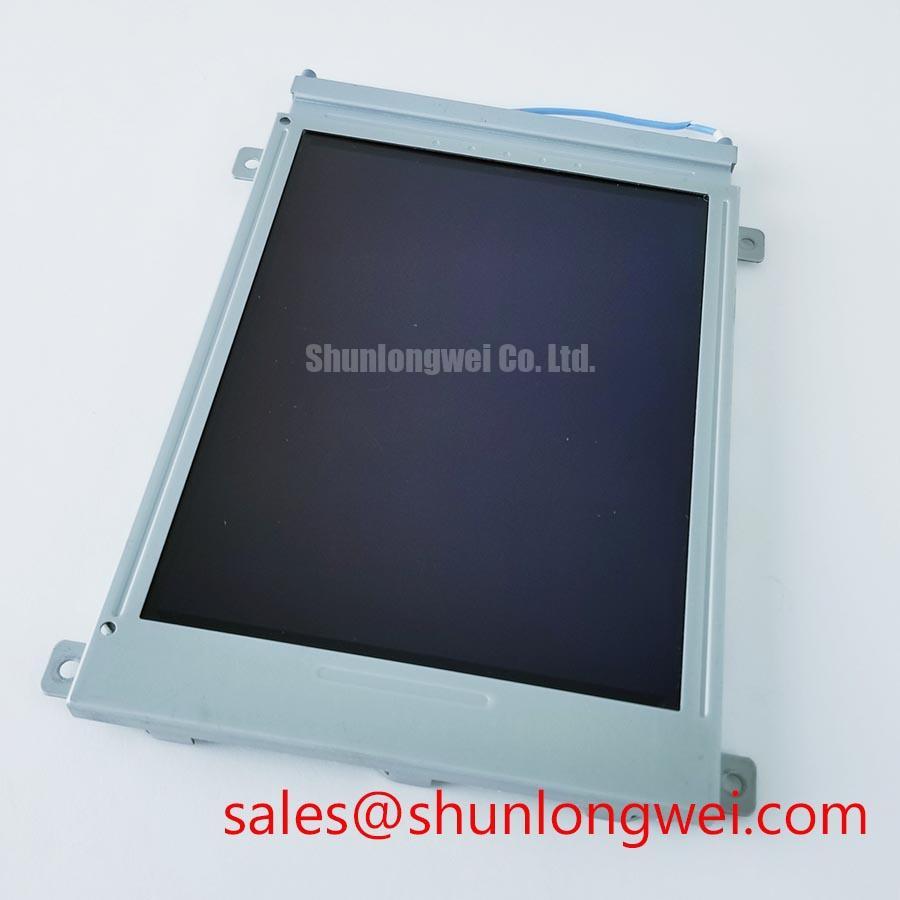
HLM6323-040300 | 5.2″ 240×64 STN Industrial LCD Module
Industrial Monochrome Display with Integrated T6963C Controller
The HLM6323-040304 is a 5.2-inch monochrome STN graphic LCD module engineered for high-reliability applications. Its primary value stems from the combination of an exceptionally wide operating temperature range and an integrated Toshiba T6963C controller, which simplifies system integration and reduces the processing load on the host CPU. This makes it a durable and efficient solution for demanding HMI tasks.
- Core Specifications: 240×64 Pixels | -20°C to +70°C Operating Temp. | Onboard T6963C Controller
- Key Advantages: Sustains performance in harsh thermal environments, accelerates development with a built-in framebuffer and character generator.
- Integration Focus: Utilizes a standard 4-bit parallel interface, enabling straightforward connection to a wide array of microcontrollers and legacy systems.
Download The Official HLM6323-040300 Datasheet (PDF)

Technical Analysis for System Integration
A standout feature of the HLM6323-040300 is its operational temperature range of -20 to +70 °C, and a storage range of -30 to +80 °C. This thermal resilience is not just a specification; it is a critical enabler for equipment deployed in environments without climate control, such as factory floors, outdoor-housed terminals, or field-use diagnostic tools. Think of this thermal tolerance as the display’s “all-weather capability,” ensuring consistent optical performance and reliability from freezing conditions to high-heat industrial settings. This durability is fundamental to achieving a long service life and reducing field failures.
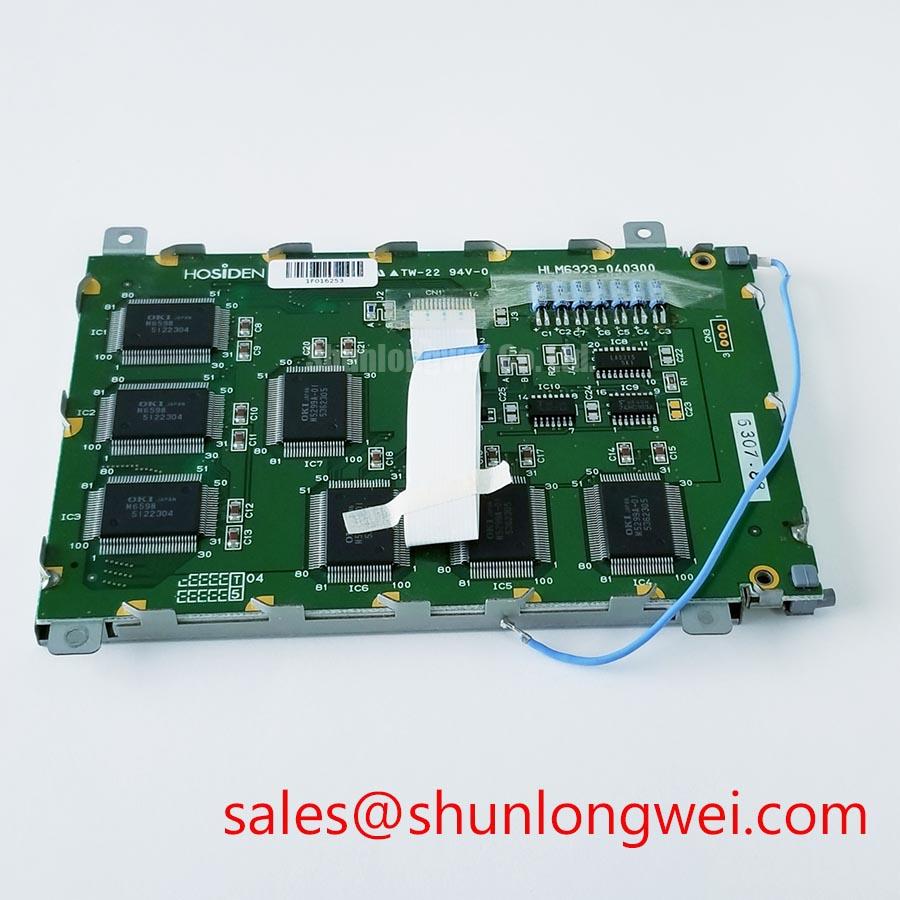
The integration of a Toshiba T6963C controller is a significant engineering advantage. This component functions as a dedicated graphics co-processor, managing the pixel data, character generation, and display timing independently from the main system processor. For an engineer, this means the host microcontroller is free to perform its primary tasks without the burden of constantly refreshing the screen. It simplifies the software driver development and reduces the hardware requirements, making it an ideal choice for both new designs and as a maintainable replacement in long-life industrial equipment.

Optimized Application Scenarios
The feature set of this module makes it a strong candidate for specific industrial and commercial applications:
- Industrial Control Panels & PLCs: The wide temperature range and robust build are ideal for displaying machine status, alarms, and operator menus directly on the factory floor.
- Test and Measurement Equipment: The clear, high-contrast monochrome display is well-suited for presenting precise numerical data, simple waveforms, and system settings in both benchtop and portable devices.
- Network Hardware and Rack-mount Servers: Its compact form factor can be used for displaying system status, IP addresses, and diagnostic information on front panels where space is limited.
- Legacy System Maintenance: The T6963C controller was an industry standard, making the HLM6323-040300 a viable candidate for repairing or replacing older displays in equipment with a long operational life.
This module is best matched for applications needing a proven, reliable, and easy-to-drive monochrome graphical display for harsh environments.
Key Specifications of the HLM6323-040300
| Module Characteristics | |
|---|---|
| Display Format | 240 x 64 Dots |
| Display Technology | STN (Super-Twisted Nematic), Negative, Transmissive |
| Outline Dimensions | 180.0(W) x 65.0(H) x 13.5(D) max mm |
| Viewing Area | 132.0(W) x 39.0(H) mm |
| Controller IC | Toshiba T6963C or Equivalent |
| Backlight | CFL (Cold Cathode Fluorescent Lamp) |
| Environmental & Electrical Ratings | |
| Operating Temperature | -20°C to +70°C |
| Storage Temperature | -30°C to +80°C |
| Supply Voltage (Logic) | 5.0V ± 0.25V |
Engineer’s FAQ
1. What is the data interface for the HLM6323-040300?
The module uses a 4-bit parallel data interface. All control, command, and data signals are managed through the onboard T6963C controller, simplifying the connection to a host microcontroller’s GPIO pins.
2. How is the CFL backlight powered and controlled?
The CFL backlight requires a separate high-voltage AC inverter, which is not integrated into the module. The power for this inverter is supplied via connector CN2. It is critical to select an inverter that matches the voltage and current requirements specified in the datasheet to ensure correct brightness, stable operation, and maximum backlight lifespan. For more information on backlight technologies, see our guide to proactive backlight lifespan management.
3. Can this display be read in direct sunlight?
This is a transmissive display, meaning it depends entirely on its backlight for visibility. It offers excellent contrast in indoor and low-to-moderate ambient light conditions. However, it is not designed for direct, bright sunlight readability, where the backlight would be overpowered. For such applications, a transflective or high-brightness display technology would be required.
4. Are programming libraries available for the T6963C controller?
Yes, the Toshiba T6963C has been a popular controller for many years. Numerous open-source libraries, code examples, and application notes are available for a wide range of platforms, from Arduino to various embedded microcontrollers. This extensive support base can significantly shorten development time. You can learn more about display integration in our articles on LCD core technology.
Enabling Robust HMI Solutions
The HLM6323-040300 provides a direct and reliable solution for implementing graphical user interfaces in equipment where operational uptime and environmental resilience are paramount. By combining a thermally robust design with an intelligent, self-contained controller, this module allows engineers to focus on application functionality rather than low-level display management. This makes it a valuable component for building clear, durable, and maintainable industrial HMIs. For more insights into component selection, explore our resources on power semiconductors and display technologies.