AUO G190ETN02.0: A High-Brightness Industrial Display for Demanding Environments
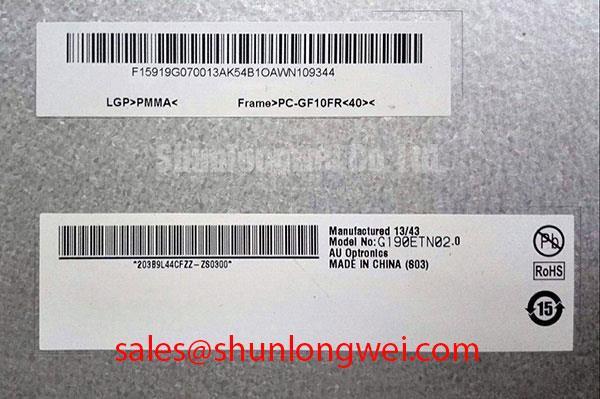
AUO G190ETN02.0 19.0-inch SXGA Industrial TFT-LCD Module
High-Clarity SXGA Display for Demanding Industrial Environments
The AUO G190ETN02.0 is a 19.0-inch TFT-LCD module delivering robust performance through its high brightness and exceptional image quality. This panel’s core value proposition is its combination of a classic 5:4 aspect ratio with modern display technology, providing a durable and visually reliable interface solution for systems requiring SXGA resolution. It is engineered for consistent readability and long-term operational stability.
- Core Specifications: 1280×1024 SXGA | 1000 cd/m² Brightness | 800:1 Contrast Ratio
- Key Advantages: Exceptional visibility in high ambient light, long-life WLED backlight system.
- Design Consideration: The panel’s standard LVDS interface simplifies integration into a wide range of existing industrial controllers and single-board computers.
Download Official Datasheet (PDF)


Technical Analysis for System Integration
The standout feature of the G190ETN02.0 is its high luminance of 1000 cd/m² (Typ.). This level of brightness ensures excellent screen legibility, even in environments with intense overhead lighting, such as factory floors or medical operating rooms. This characteristic is critical for applications where data must be read quickly and accurately without interference from reflections or glare. The display’s anti-glare surface treatment further enhances this capability, reducing specular reflections and operator eye strain.
The reliability of the display is anchored by its WLED backlight system, which is rated for a 50,000-hour lifetime. Think of this backlight lifespan as the operational endurance of the display; a 50,000-hour rating translates to over 5.7 years of continuous 24/7 operation. This longevity is a key factor for industrial equipment, minimizing the need for maintenance and reducing the total cost of ownership over the product’s lifecycle. The included LED driver simplifies the power design for system integrators.
Finally, the panel’s 5:4 aspect ratio and 1280×1024 SXGA resolution are significant for legacy system upgrades and specific HMI designs. Many industrial and medical applications were originally designed for this format. Integrating the G190ETN02.0 allows for the modernization of the user interface with a high-brightness, long-life panel without altering the existing software’s graphical layout. More information on such topics can be found in our guides to smart factory HMI specifications and vibration resistance for industrial displays.
Optimized Application Scenarios
The specific performance parameters of the G190ETN02.0 make it a strong candidate for several demanding applications:
- Industrial Control Panels: The high brightness and robust construction are well-suited for HMI applications in manufacturing and process control.
- Medical Imaging Displays: The SXGA resolution and consistent brightness provide the clarity needed for non-diagnostic viewing stations and medical equipment interfaces.
- ATM & Vending Machines: The 80/80/80/80 viewing angles ensure that information is clearly visible to users from various approach angles.
- Marine Bridge Systems: The panel’s strong luminance helps overcome the bright ambient light common in ship wheelhouses.
With its high-performance backlight and legacy-compatible format, this module is an optimal choice for new designs and system retrofits requiring long-term reliability.
Key Specifications of the G190ETN02.0
| Feature | Specification |
|---|---|
| Screen Size | 19.0 inch |
| Resolution | 1280(RGB)×1024, SXGA, 86 PPI |
| Display Technology | TN, Normally White, Transmissive |
| Luminance | 1000 cd/m² (Typ.) |
| Viewing Angle | 80/80/80/80 (Typ.) (CR≥10) |
| Contrast Ratio | 800:1 (Typ.) |
| Signal Interface | LVDS (2 ch, 8-bit), 30-pin connector |
| Operating Temperature | 0 ~ 60 °C |
| Backlight Lifetime | 50,000 hours (Min.) with LED driver |
| Outline Dimensions | 396(H) × 324(V) × 17.7(D) mm |
Engineer’s Frequently Asked Questions
1. What is the primary advantage of the 1000 cd/m² brightness?
The high brightness rating ensures the display is sunlight-readable or clearly visible in high-ambient-light industrial settings. This reduces the need for extensive shielding or enclosures, simplifying the mechanical design of the final product.
2. How is the WLED backlight driven and controlled?
The G190ETN02.0 module includes an integrated LED driver. As specified in the datasheet, system integrators need to supply the appropriate voltage to this driver. Dimming control is typically managed via a PWM signal, allowing for adjustable brightness to suit different operating conditions or to conserve power. For more details on this topic, consider our article on managing industrial LCD backlight lifespan.
3. Are there any special considerations for handling this display during assembly?
Yes, the front polarizer is sensitive to scratches and mechanical stress. It’s recommended to handle the module by its metal frame and avoid touching the display surface. Like all sensitive electronic components, proper ESD (Electrostatic Discharge) precautions must be taken during assembly to prevent damage to the internal driver circuitry.
4. Why choose a TN panel for an industrial application?
While IPS-type panels offer wider viewing angles, modern TN (Twisted Nematic) panels like this one provide a cost-effective solution with very fast response times (22/3 ms Tr/Td). The specified 80-degree viewing angles are sufficient for many industrial HMI and kiosk applications where the user is typically positioned directly in front of the screen. Further reading on industrial display substrates can provide additional context.
Enabling Clear and Durable HMI Solutions
The AUO G190ETN02.0 provides a direct and effective solution for industrial display requirements. By combining high brightness for excellent readability with a long-life backlight system, this module offers a dependable platform for building visually clear and durable human-machine interfaces. Its standard resolution and interface facilitate straightforward integration, allowing engineering teams to focus on system functionality rather than display implementation challenges.