Infineon TD162N16KOF 1600V 162A Thyristor Diode Module: Technical Specifications and Industrial Applications Guide
TD162N16KOF Infineon 1600V 162A Thyristor Diode Module
Product Overview & Primary Technical Highlights
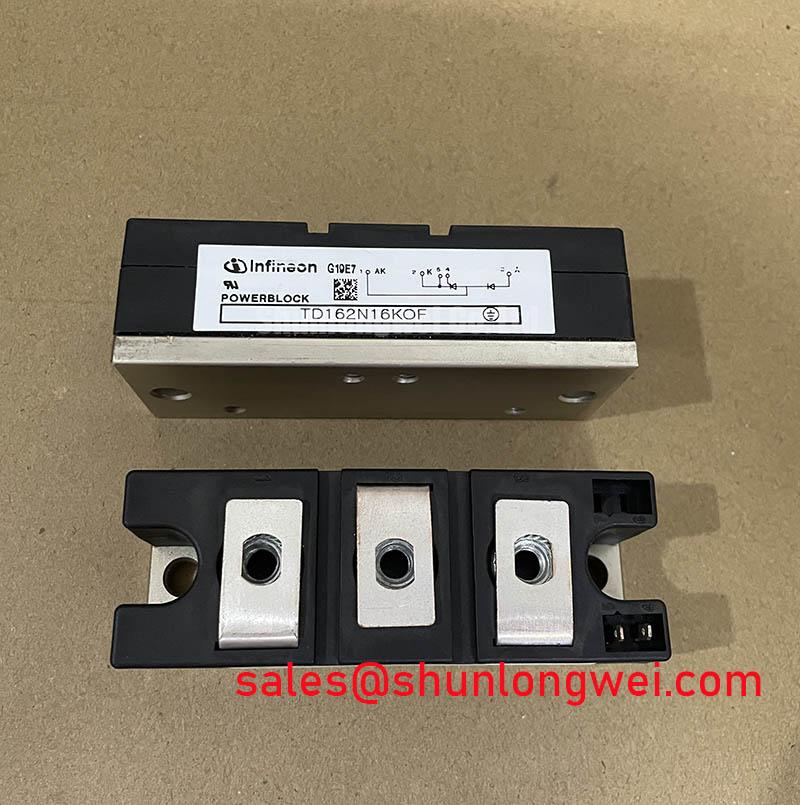
The TD162N16KOF is a high-power phase-leg thyristor/diode module manufactured by Infineon Technologies (Eupec series), engineered for heavy-duty industrial power conversion. Featuring internal pressure contact technology and electrically isolated baseplates, the module ensures high thermal cycling endurance and dependable line-rectification capability across standard three-phase AC mains.
- Core Specifications: 1600 V Repetitive Peak Voltage ($V_{RRM}/V_{DRM}$) | 162 A Continuous Average Current ($I_{TAVM}/I_{FAVM}$ at $T_C = 85^circtext{C}$) | 5200 A Surge Current ($I_{TSM}$ at 10 ms, $125^circtext{C}$).
- Key Advantages: High surge energy withstand capability ($I^2t = 135,000text{ A}^2text{s}$) prevents component destruction during transient faults, while pressure contact joints significantly extend operational lifetime under thermal fluctuations.
- Engineering Consideration: Engineers seeking reliable AC line rectification find that the isolated baseplate ($3.0text{ kV}_text{RMS}$ isolation) simplifies multi-module heatsink mounting without extra insulation barriers.


Technical Analysis & Engineering Value
The internal architecture of the TD162N16KOF integrates one phase control thyristor and one rectifier diode connected in series to form a half-controlled phase arm. Rated at a repetitive peak blocking voltage ($V_{DRM}/V_{RRM}$) of 1600 V, this device operates reliably on 400 V to 500 V AC supply grids with adequate overhead margin to absorb line voltage spikes.
A distinctive feature of Infineon’s PowerBLOCK technology in the TD162N16KOF is its solder-free pressure contact system. Solder joints in standard modules tend to degrade under repeated thermal cycles. In contrast, pressure contacts preserve mechanical integrity and consistent contact resistance over millions of power cycles. You can think of thermal resistance ($R_{thJC}$) as the width of a drainage valve; a low junction-to-case resistance of $0.170text{ K/W}$ per thyristor allows heat to drain away rapidly into the heatsink, keeping internal die temperatures well within safe limits.
The module exhibits a critical rate of rise of off-state voltage ($(dv/dt)_{cr}$) of $1000text{ V/}mutext{s}$ and a critical rate of rise of on-state current ($(di/dt)_{cr}$) of $150text{ A/}mutext{s}$. These parameters provide robust transient immunity when interfaced with inductive loads. System designers should review thyristor dv/dt and di/dt protection to select proper RC snubber topologies that maintain operation within the safe operating envelope.
Optimized Application Scenarios
- Soft Starters & AC Motor Controllers: Provides controlled conduction angles for torque and current ramping on high-inertia 3-phase industrial motors.
- Phase-Controlled Rectifiers & Power Supplies: Forms controlled bridge rectifiers for electroplating, welding equipment, and variable DC links.
- Static Switches & Bypass Units: Delivers sub-cycle transfer times and high surge withstand for uninterruptible power supply (UPS) systems.
- Industrial Temperature Controllers: Regulates resistive heating elements in industrial electric ovens via precision firing angle modulation.
Best Fit Summary: The TD162N16KOF delivers 1600V blocking and 5200A surge endurance, making it optimal for rugged 400V–500V line-fed industrial AC power stages.
Key Electrical & Thermal Specifications
| Parameter | Symbol | Test Conditions | Rated Value |
|---|---|---|---|
| Repetitive Peak Off-State / Reverse Voltage | $V_{DRM}, V_{RRM}$ | $T_j = -40^circtext{C} dots 125^circtext{C}$ | 1600 V |
| Maximum RMS On-State Current | $I_{TRMSM}, I_{FRMSM}$ | Continuous conduction | 260 A |
| Average On-State / Forward Current | $I_{TAVM}, I_{FAVM}$ | $T_C = 85^circtext{C}$, half sine wave | 162 A |
| Surge On-State Current | $I_{TSM}, I_{FSM}$ | 10 ms, $T_j = 125^circtext{C}$ | 5200 A |
| Surge Integral ($I^2t$ Value) | $I^2t$ | 10 ms, $T_j = 125^circtext{C}$ | $135,000text{ A}^2text{s}$ |
| Gate Trigger Voltage / Current | $V_{GT} / I_{GT}$ | $T_j = 25^circtext{C}, V_D = 6text{ V}$ | $2.0text{ V (max)} / 150text{ mA (max)}$ |
| Thermal Resistance (Junction to Case) | $R_{thJC}$ | Per chip, DC operation | $0.170text{ K/W}$ |
| RMS Isolation Voltage | $V_{ISOL}$ | $50text{ Hz}, 1text{ min}$ | $3.0text{ kV}_text{RMS}$ |
For related components in the same power family, explore our catalog of power semiconductors or review the technical documentation for the TD180N16KOF module and detailed TD162N16KOF technical analysis.
Engineer FAQ
Q: How do I select semiconductor fuses to protect the TD162N16KOF during short circuits?
A: Fuse selection depends on the maximum $I^2t$ rating of the module. At $T_j = 125^circtext{C}$, the module has an $I^2t$ capacity of $135,000text{ A}^2text{s}$ (10 ms). Select a fast-acting semiconductor fuse with a total clearing $I^2t$ below this rating at operating line voltages.
Q: What mounting torque is recommended for the baseplate and power terminals?
A: Standard M5 mounting screws on the baseplate require a tightening torque ($M_1$) of 4 Nm (tolerance $pm 15%$). Power terminal screws (M6) require a torque ($M_2$) between 5 Nm and 6 Nm. Applying uniform thermal interface compound ($50text{ mu m}$ thickness) ensures minimal thermal contact resistance ($R_{thCH} approx 0.04text{ K/W}$).
Q: Can the TD162N16KOF replace a dual thyristor (TT) or dual diode (DD) module?
A: No. The TD designation indicates a hybrid configuration containing one thyristor and one diode in a series leg. Replacing a TT (dual SCR) or DD (dual diode) requires matching circuit topologies.
Engineering Sourcing Summary
The TD162N16KOF module provides hardware engineers with verified 1600 V insulation ratings, 162 A nominal current delivery, and low thermal resistance through rugged pressure contact packaging. These characteristics allow power conversion platforms to achieve consistent thermal stability and electrical robustness under demanding industrial utility variations.