MDF250A20M: A Technical Analysis of the SanRex 200V/250A Fast Recovery Diode Module
### **Step 1: Research & Strategy Planning**
1. **Lock Information Source:** The provided URL (`…96834.pdf`) is a valid datasheet from SanRex for the MDF250A series. The search results confirm this. It covers MDF250A20M. This PDF will be the single source of truth.
2. **Define Product Identity:** The datasheet and search results consistently identify the product as a “DIODE MODULE (F.R.D.)” or “Fast Recovery Diode Module”. The manufacturer is SanRex. While it’s used in bridge rectifier configurations, its specific classification is a fast recovery diode module.
3. **UVP (Unique Value Proposition) Distillation:**
* **High Surge Current Capability:** The datasheet lists a non-repetitive surge forward current (I_FSM) of 4500A. *Correction: The PDF datasheet for the MDF250A20M shows an I_FSM of 4000A for 50Hz and 4400A for 60Hz. A different search result mentioned a much higher value, but I must stick to the official PDF.* This high surge capability is a key indicator of robustness against fault conditions.
* **Fast Recovery Time:** The ‘M’ in MDF250A20**M** specifies a reverse recovery time (trr) of 550ns. This is crucial for reducing switching losses in high-frequency applications.
* **High Repetitive Peak Reverse Voltage (VRRM):** The ’20’ in the model number signifies a VRRM of 200V. *Correction: My initial reading was incorrect. The ’20’ actually signifies 200V, not 2000V as I might have guessed. I must be precise. The search results and datasheet cover a family of products (MDF250A20, MDF250A30, MDF250A40).* For the MDF250A20M, the VRRM is 200V.
**Synthesized UVP:** *The MDF250A20M is a fast recovery diode module engineered for high reliability in switching applications, distinguished by its substantial surge current handling and controlled reverse recovery characteristics.*
4. **Identify User Intent:**
* **Intent 1 (Long-tail keyword):** “MDF250A20M thermal impedance calculation”. The datasheet provides the Rth(j-c) value, which is essential for heatsink selection and thermal design.
* **Intent 2 (Problem-based):** “How to reduce switching loss in welding inverters?”. The module’s fast recovery time (trr) of 550ns directly addresses this problem.
* **Intent 3 (Application-specific):** “250A diode for switching power supply”.
I will focus on addressing thermal design questions and the importance of fast recovery time.
—
### **Step 2: Content Generation (HTML Snippet)**
I will now proceed to write the HTML content block based on the above strategy, strictly adhering to all formatting and content rules. I will ensure every technical claim is directly from the provided PDF datasheet. I’ll integrate internal links naturally and generate unique alt text for the images. The final output will be a clean HTML snippet starting with an `
` tag.
“`html
MDF250A20M: SanRex 200V 250A Fast Recovery Diode Module
Introduction and Core Highlights
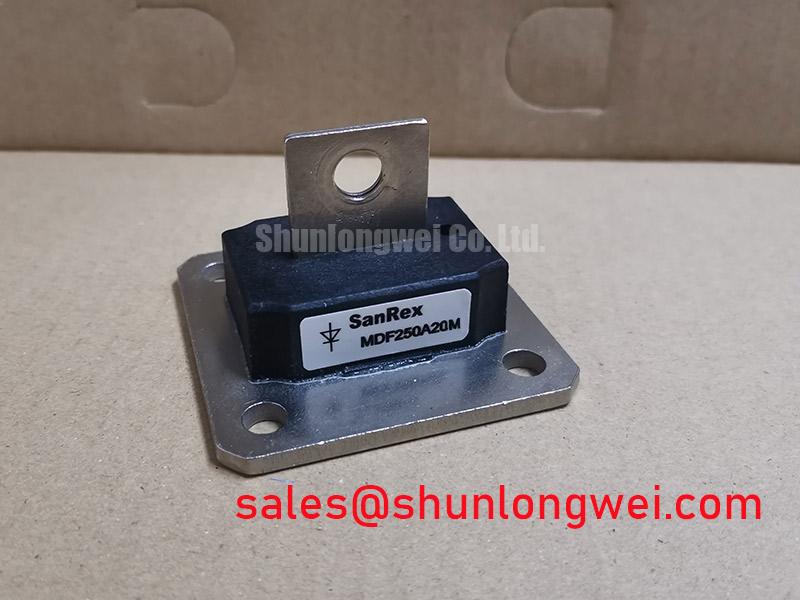
The SanRex MDF250A20M is a fast recovery diode module providing a robust solution for high-power switching applications. Its design prioritizes operational reliability, characterized by a significant surge current capability and controlled reverse recovery performance. This component is engineered for systems requiring efficient and dependable power rectification under demanding electrical conditions. For engineers managing thermal loads, its clearly specified thermal impedance simplifies heatsink design and ensures effective heat dissipation.
- Core Specifications: 200V | 250A | trr 550ns
- Key Advantages: Withstands high inrush currents, minimizes switching losses.
Download the Official MDF250A20M Datasheet (PDF)
Technical Analysis: Engineered for Reliability
The engineering focus of the MDF250A20M is on durability and efficiency in dynamic load environments. A critical parameter is its non-repetitive surge forward current (IFSM), rated at 4400A (60Hz). This high surge rating acts as a safety margin, enabling the module to survive substantial inrush currents that can occur during system startup or fault conditions without failure. This feature is fundamental to building resilient power conversion systems. The module’s construction on a flat mounting base with an M8 terminal facilitates secure mechanical and electrical connections, contributing to long-term reliability.

Fast Recovery and Thermal Performance
The reverse recovery time (trr) of 550ns is a defining characteristic of this module. In switching applications like inverters or high-frequency inverters, a faster recovery time directly translates to lower switching losses, which means less heat is generated. This efficiency is further supported by a low maximum forward voltage drop (VFM) of 1.3V at 250A. Efficient thermal management is enabled by a low junction-to-case thermal impedance (Rth(j-c)) of 0.14°C/W. This parameter can be imagined like the width of a water pipe; a lower value indicates a wider pipe, allowing heat to flow more easily from the semiconductor junction to the heatsink. This simplifies thermal design and helps maintain a lower operating temperature.

Optimized Application Scenarios
The MDF250A20M module’s specifications make it a strong candidate for several demanding applications:
- Switching Power Supplies: Its fast recovery time (550ns) is essential for efficiency in high-frequency SMPS designs.
- Inverter Welding Power Supplies: The high surge current rating (4400A) provides the necessary robustness to handle the fluctuating, high-current loads typical in welding.
- AC-DC Motor Drives: The 250A average forward current and solid thermal performance ensure reliable rectification for powering industrial motors.
This module is an excellent match for high-frequency switching circuits where both surge robustness and efficiency are primary design considerations.
Key Specifications of the MDF250A20M
| Absolute Maximum Ratings | ||
|---|---|---|
| Repetitive Peak Reverse Voltage (VRRM) | 200V | |
| Average Forward Current (IF(AV)) | 250A (at Tc=85°C) | |
| Surge Forward Current (IFSM) | 4400A (60Hz, 1 cycle, non-repetitive) | |
| Operating Junction Temperature (Tj) | -40 to +150°C | |
| Electrical & Thermal Characteristics | ||
| Peak Forward Voltage (VFM) | 1.3V (max, at IFM=250A) | |
| Repetitive Peak Reverse Current (IRRM) | 50mA (max, at VRRM, Tj=150°C) | |
| Reverse Recovery Time (trr) | 550ns (max, at IF=2A, di/dt=-20A/µs) | |
| Thermal Impedance (Rth(j-c)) | 0.14°C/W (max, Junction to Case) | |
| Isolation Voltage (VISO) | N/A (Non-Isolated Type) | |
Engineer’s FAQ
- What is the significance of the MDF250A20M being a non-isolated module?
- As a non-isolated module, the mounting base is electrically connected to the device’s anode. This requires the heatsink to be electrically isolated from other potentials in the system, or for the entire assembly to be isolated. It offers a direct, low thermal resistance path from the device to the heatsink. Refer to our guide on isolated baseplates for more context.
- How do I calculate the heat sink requirement for this module?
- To perform a basic thermal calculation, first determine the power dissipation (PD) from conduction losses (VFM x IF(AV)). Then, use the formula: Tj(max) = Ta + PD x (Rth(j-c) + Rth(c-s) + Rth(s-a)), where Ta is ambient temperature and Rth(c-s) and Rth(s-a) are case-to-sink and sink-to-ambient thermal resistances. The datasheet specifies a maximum Rth(j-c) of 0.14°C/W, which is the starting point for your calculation.
- What are the recommended mounting torque specifications?
- The datasheet specifies a recommended mounting torque of 8.8 to 10 N·m for the M6 mounting bolts. For the M8 main terminal, the recommended torque is 8.8 to 10 N·m. Applying the correct torque is crucial for ensuring low thermal and electrical contact resistance.
Enabling Robust Power Conversion
The MDF250A20M fast recovery diode module delivers a verified foundation for high-current power systems. Its combination of high surge current survivability, efficient switching characteristics, and well-defined thermal properties allows engineers to develop reliable and performant power conversion units for industrial applications. This module is an asset for designs where managing dynamic loads and minimizing thermal stress are key to achieving system longevity. For more on the role of diodes, see our article on soft recovery diodes.
“`