Mitsubishi CM100DY-24H IGBT Module: A Technical Review and Application Guide
Mitsubishi CM100DY-24H Dual IGBT Module: 1200V 100A
Introduction and Core Highlights
The Mitsubishi CM100DY-24H is a dual IGBT module from the H-Series, engineered to provide a robust and efficient power switching solution for industrial applications. This module’s key value is its balance of low conduction losses and effective thermal performance, enabling the design of reliable and compact power conversion systems. It integrates two IGBTs in a half-bridge configuration, simplifying the construction of inverter legs.
- Core Specifications: 1200V | 100A | VCE(sat) (typ) 2.2V
- Key Advantages: Minimizes power loss during conduction, ensures efficient heat transfer for enhanced reliability.
- Application Focus: The dual setup is particularly well-suited for building three-phase bridges for AC motor control systems.
Download Official Datasheet (PDF)
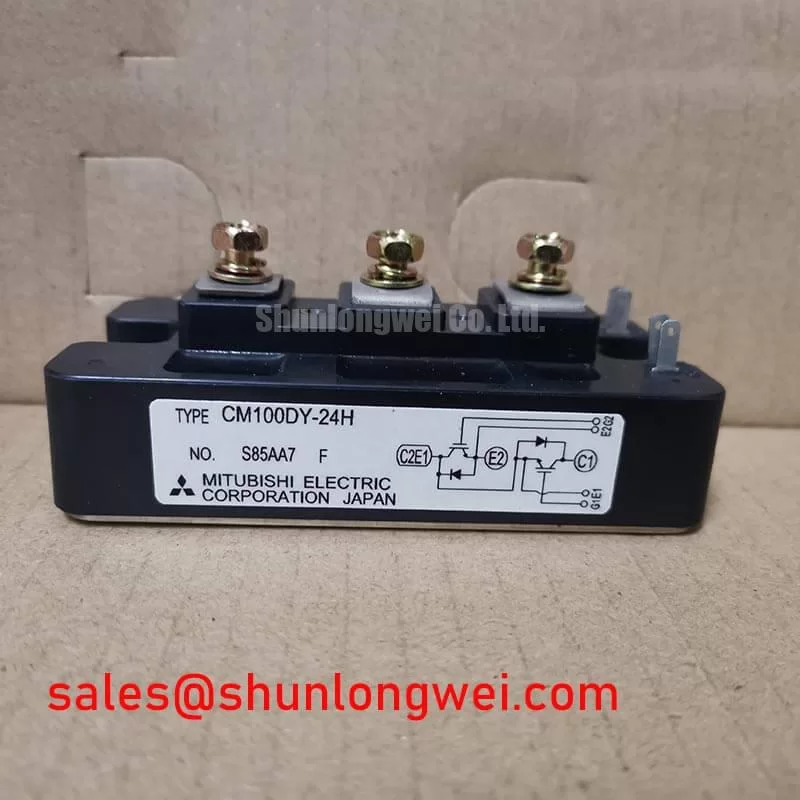

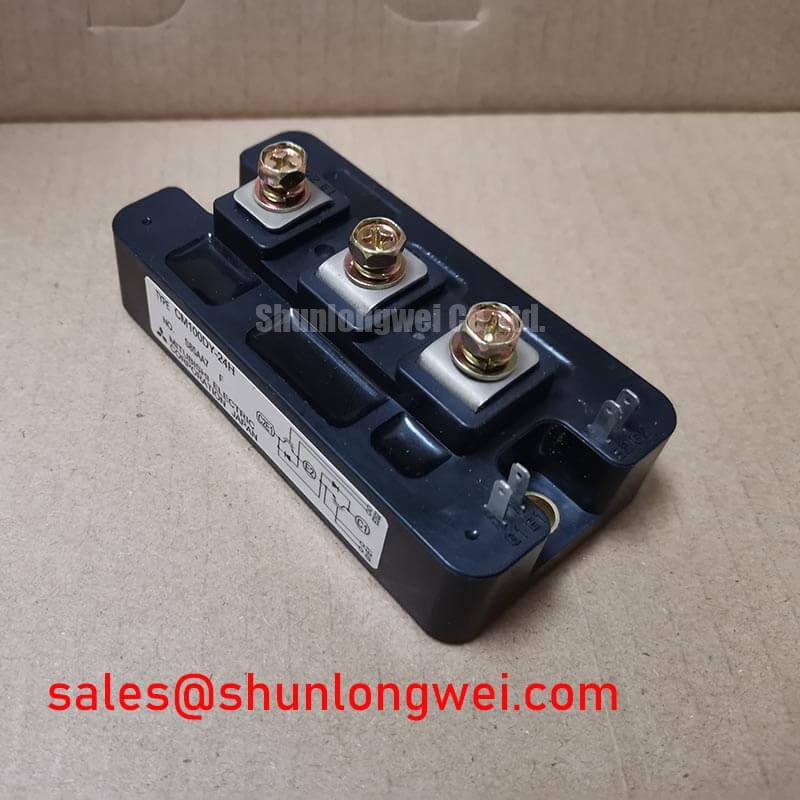
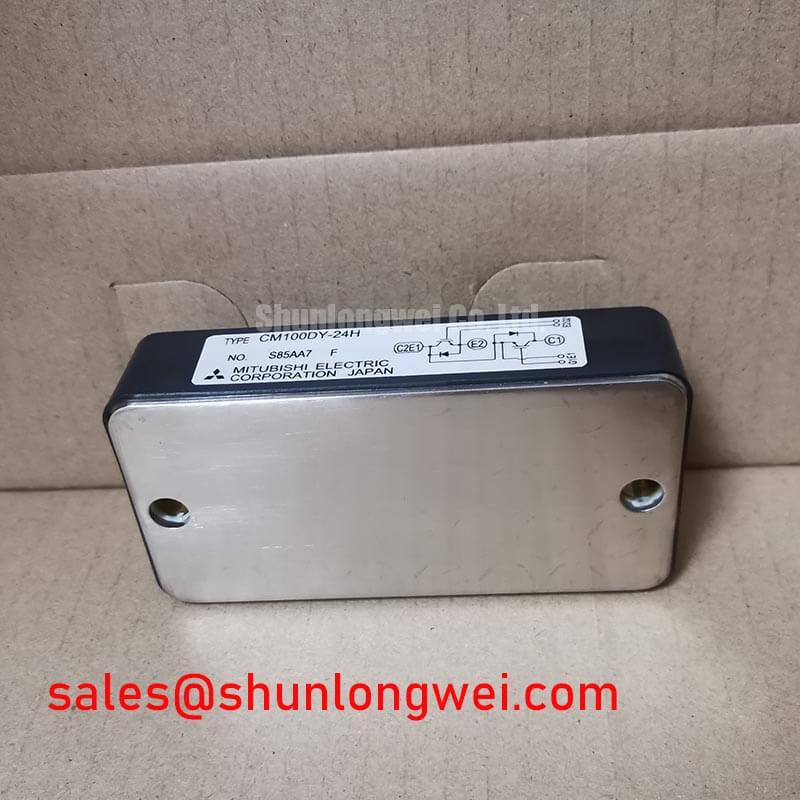
Technical Analysis of Core Features
The engineering behind the CM100DY-24H focuses on delivering efficiency and reliability. Two parameters from the datasheet are central to its performance: the collector-emitter saturation voltage (VCE(sat)) and the thermal resistance.
Low Conduction State Power Loss
The module specifies a typical VCE(sat) of 2.2V at the rated current of 100A and a junction temperature of 125°C. This low on-state voltage is a direct result of its internal chip technology and is critical for system efficiency. A lower VCE(sat) means less power is converted into waste heat while the IGBT is conducting current. This reduction in conduction losses directly contributes to higher overall efficiency, allowing for more compact system designs and potentially reducing the size and cost of the required cooling hardware.
Efficient Thermal Dissipation
Thermal resistance, Rth(j-c), can be imagined as the width of a pipe for heat flow; a lower value signifies a wider pipe, allowing heat to escape more easily. The CM100DY-24H specifies a thermal resistance from junction to case of 0.16°C/W for the IGBT. This efficient thermal pathway ensures that the heat generated within the silicon chip is effectively transferred to the module’s baseplate and subsequently to the heatsink. Proper thermal management is fundamental to long-term reliability, as it keeps the device operating within its safe temperature limits, even under demanding load conditions.
Optimized Application Scenarios
The balanced electrical and thermal characteristics of the CM100DY-24H make it a versatile component for various power conversion systems.
- AC Motor and Servo Drives: The dual half-bridge configuration is ideal for creating the three-phase inverter legs required for motor control. Its robust design reliably handles the variable loads seen in industrial automation.
- Uninterruptible Power Supplies (UPS): In applications where reliability is critical, this module’s proven performance and efficient operation help ensure a stable power output and minimize energy waste.
- Welding Power Supplies: The module’s ability to handle high currents (100A DC, 200A pulsed) makes it suitable for the demanding, high-energy pulses required in modern welding equipment.
- General-Purpose Inverters: Its standard voltage and current ratings, combined with a thermally efficient package, provide a solid foundation for a wide range of general-purpose power inverters.
This module is best matched for systems where a proven, industry-standard component is needed to ensure both high efficiency and long-term operational stability.
Key Specifications of the CM100DY-24H
| Absolute Maximum Ratings (Tj = 25°C) | |
|---|---|
| Collector-Emitter Voltage (VCES) | 1200V |
| Gate-Emitter Voltage (VGES) | ±20V |
| Collector Current (IC) | 100A |
| Peak Collector Current (ICP) | 200A |
| Maximum Power Dissipation (Pc) | 780W |
| Operating Junction Temperature (Tj) | -40 to +150°C |
| Electrical & Thermal Characteristics (Tj = 25°C unless otherwise noted) | |
| Collector-Emitter Saturation Voltage (VCE(sat)) @ 100A, Tj=125°C | 2.2V (typ), 2.7V (max) |
| Gate-Emitter Threshold Voltage (VGE(th)) | 5.5V to 7.5V |
| Diode Forward Voltage (VF) @ 100A, Tj=125°C | 2.1V (typ), 2.6V (max) |
| Thermal Resistance, Junction to Case (Rth(j-c)) – IGBT | 0.16 °C/W (max) |
| Thermal Resistance, Junction to Case (Rth(j-c)) – Diode | 0.35 °C/W (max) |
Engineer’s FAQ
What is the typical VCE(sat) for the CM100DY-24H at its rated current?
Based on the official datasheet, the typical collector-emitter saturation voltage is 2.2V at a collector current of 100A, a gate-emitter voltage of +15V, and a junction temperature of 125°C. The maximum specified value under these conditions is 2.7V.
What are the mounting torque specifications for this module?
To ensure proper thermal contact and mechanical stability, the datasheet specifies a mounting torque of 3.5 to 4.5 N·m for the M6 mounting screws. The M5 terminal screws should be tightened to 2.5 to 3.5 N·m. It is critical to use a calibrated torque wrench and apply a thin, uniform layer of thermal grease.
Can this module be used to build a complete three-phase inverter?
Yes. Because the CM100DY-24H is a dual or “half-bridge” module, three units can be used to construct a full three-phase inverter bridge—one module for each phase (U, V, W). This modular approach simplifies assembly and layout. More information on topologies can be found in our guide to H-bridge vs half-bridge configurations.
What gate drive voltage is recommended for the CM100DY-24H?
The electrical characteristics are specified with a gate-emitter voltage of +15V for turn-on. A negative voltage (e.g., -5V to -15V) is typically recommended for turn-off to provide a higher noise margin and prevent parasitic turn-on. For further details on this topic, refer to this analysis of robust gate drive design.
Enabling Efficient and Reliable Power Conversion
The CM100DY-24H delivers a well-documented and reliable platform for power electronics engineers. By providing low on-state losses and a package designed for effective heat dissipation, this module enables the development of efficient, cost-effective, and durable power systems for a wide array of industrial machinery.