Mitsubishi CP25TD1-24A 1200V 25A CIB IGBT Module: High-Density Power Conversion for Industrial Drives
Mitsubishi CP25TD1-24A 1200V 25A CIB IGBT Power Module
Introduction to High-Density Power Conversion
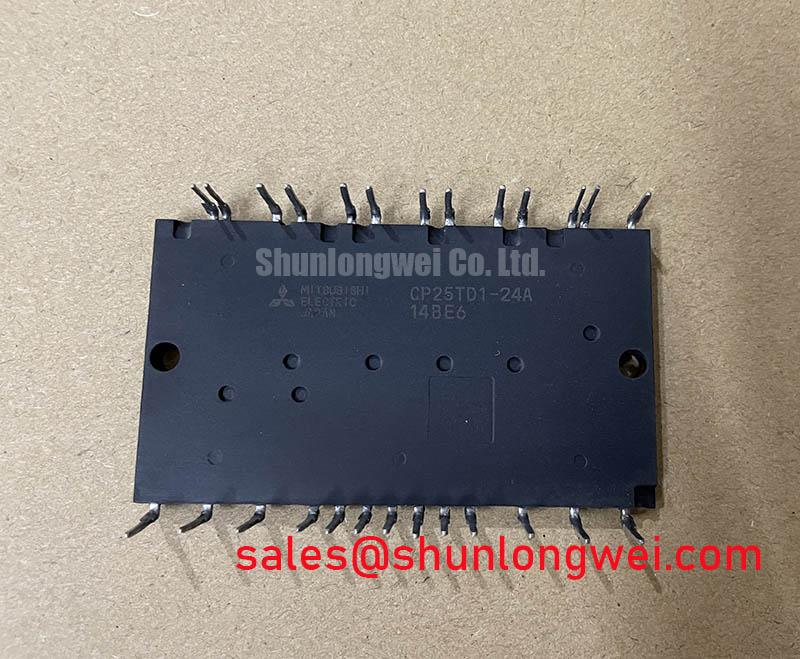
The Mitsubishi CP25TD1-24A represents a highly integrated Converter-Inverter-Brake (CIB) power module, providing a compact solution for industrial three-phase motor control. By housing a three-phase diode bridge converter, a three-phase IGBT inverter, and a dedicated brake circuit in a single package, it effectively consolidates complex discrete stages into one reliable unit. This 1200V | 25A module is engineered to provide efficient power switching while significantly reducing PCB footprint.
- Core Specifications: 1200V Breakdown Voltage | 25A Collector Current | Low VCE(sat)
- Key Advantages: High thermal stability through an integrated NTC thermistor and reduced parasitic inductance via optimized internal routing.
Engineers often ask: How does the CIB topology affect thermal management? The CP25TD1-24A addresses this by sharing a common baseplate for all internal stages, allowing for more uniform heat distribution compared to using separate discrete components. This simplifies the design of the cooling system and ensures consistent operation under varying loads.
Download Official CP25TD1-24A Datasheet (PDF)
Technical Analysis: Efficiency and Thermal Dynamics
The CP25TD1-24A utilizes 4th generation IGBT technology, focusing on achieving a lower saturation voltage (VCE(sat)) to minimize conduction losses. In industrial motor drives, conduction losses account for a major portion of the total power dissipation, particularly at lower switching frequencies. By maintaining a stable VCE(sat) across the operating temperature range, this module provides predictable performance, which is vital for long-term system reliability.
Thermal resistance (Rth(j-c)) is a critical parameter in the datasheet. You can visualize thermal resistance as a drainage pipe for heat; the smaller the resistance value, the “wider” the pipe is, allowing heat to flow away from the silicon die more effectively. In the CP25TD1-24A, the ceramic substrate provides high isolation while ensuring low thermal impedance, preventing localized hotspots that could lead to premature failure in a power semiconductor assembly.
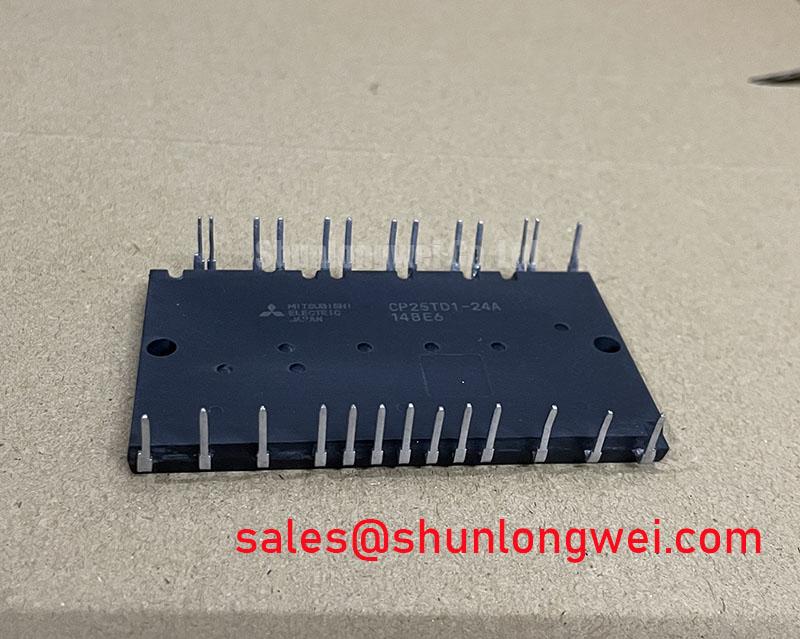
Choosing between a PIM vs discrete IGBT setup often involves weighing reliability against cost. This module prioritizes reliability by utilizing internal ultrasonic wire bonding and an isolated baseplate. This construction ensures that the internal electrical circuits are physically separated from the heatsink, meeting industrial safety standards while allowing for direct mounting without external mica insulators.
Optimized Application Scenarios
The electrical and mechanical characteristics of the CP25TD1-24A make it suitable for several high-demand industrial environments:
- Industrial Motor Drives (AC 400V Class): Ideal due to the integrated three-phase inverter stage that handles high-torque motor startup currents up to 50A (pulsed).
- Variable Frequency Drives (VFD): The integrated brake circuit provides an efficient path for energy dissipation during regenerative motor braking.
- Servo Control Systems: Low switching losses allow for higher PWM frequencies, which are necessary for the smooth and precise motion control required in robotics.
- Factory Automation HVAC: The robust 1200V rating offers a high safety margin against voltage transients commonly found on factory power grids.
Best Match: High-density 400V AC motor controllers requiring integrated thermal monitoring and compact Converter-Inverter-Brake functionality for precision motion control applications.
Key Specifications Table
| Category | Parameter | Typical Value / Rating |
|---|---|---|
| Absolute Ratings | VCES (Collector-Emitter Voltage) | 1200V |
| IC (Collector Current, DC) | 25A (at Tc = 80°C) | |
| Tj (Operating Junction Temp) | -40 to +150°C | |
| Electrical Characteristics | VCE(sat) (Collector Saturation) | 2.1V (at IC=25A, Tj=125°C) |
| VGE(th) (Gate Threshold) | 6.0V to 8.5V | |
| trr (Reverse Recovery Time) | 0.15 µs (Typical) | |
| Mechanical & Isolation | Visol (Isolation Voltage) | 2500 Vrms (AC 1 min) |
| Mounting Torque | 1.47 to 1.96 N·m (M4 Screw) |

Engineer FAQ
Q1: What is the significance of the 2500V isolation rating for the CP25TD1-24A?
This rating ensures the module can safely separate high-voltage AC lines from low-voltage logic control circuits. This eliminates the need for separate isolators on the heatsink, simplifying chassis grounding and safety certifications.
Q2: How should the mounting torque be managed for this DIP-CIB module?
The datasheet specifies M4 screws with a torque range of 1.47 to 1.96 N·m. Under-tightening leads to high thermal resistance, while over-tightening can crack the ceramic substrate, causing isolation failure.
Q3: Can the internal NTC thermistor be used for active over-temperature protection?
Yes, the NTC thermistor provides a resistance change proportional to the baseplate temperature. It is specifically intended for monitoring the thermal state of the module to trigger derating or emergency shutdown in the gate driver circuit.
Q4: What is the benefit of the integrated brake stage in the CP25TD1-24A?
The brake IGBT allows the system to control an external power resistor to bleed off excess DC link voltage during motor deceleration, preventing over-voltage trips without needing an external power transistor.
Summary of Capabilities
The CP25TD1-24A provides a robust and efficient platform for 1200V industrial power conversion by merging high-performance IGBT technology with comprehensive CIB integration. Its ability to maintain low saturation voltages and manage thermal loads through an integrated NTC makes it an excellent choice for engineers aiming to optimize drive performance while minimizing system complexity. This module empowers designers to meet stringent space constraints without compromising on industrial-grade durability or electrical safety.