SanRex DF75LB160: A Robust 1600V 75A 3-Phase Diode Rectifier Module
DF75LB160 SanRex 3-Phase Diode Rectifier Module | 1600V 75A
The SanRex DF75LB160 is an industrially proven 3-phase diode bridge rectifier module. It is engineered to deliver highly stable AC-to-DC power rectification under high thermal and electrical stress. This module is standard in high-power industrial equipment requiring dependable front-end conversion.
- Core Specifications: 1600V Repetitive Peak Reverse Voltage | 75A Average Rectified Output Current | 2500V AC Isolation Voltage
- Engineering Benefits: Low forward voltage drop reduces system heat generation, while the isolated copper baseplate simplifies mechanical design by allowing direct mounting to standard heatsinks.
- Line Transient Protection: Operating on 380V to 480V utility mains, this 1600V rated module provides a massive safety buffer against unpredictable inductive line surges and grid instability.
Download Official DF75LB160 Datasheet (PDF)
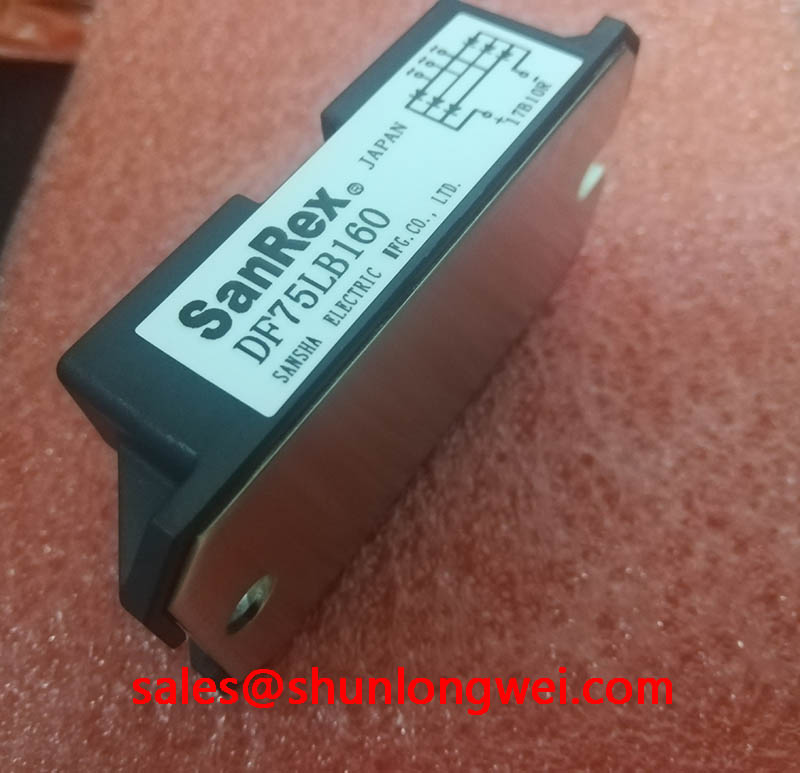
Optimized Thermal Path and Construction
The internal semiconductor dies of the DF75LB160 are bonded to an isolated copper baseplate. This layout optimizes the thermal path between the silicon junctions and the external heatsink.
We can compare thermal resistance to a narrow roadway; the lower the resistance value, the more easily heat traffic flows away from the sensitive silicon junctions. By achieving a low junction-to-case thermal resistance, the device remains significantly cooler under continuous heavy loads, preventing localized hot spots. This directly minimizes the risk of premature thermal cycling failures in high-reliability applications.
Robust Surge Current Handling
During system startup or sudden load shifts, inrush current spikes pose a severe threat to input rectifiers. The DF75LB160 handles a non-repetitive surge forward current ($I_{FSM}$) of up to 1000A at 60Hz. This ruggedness is achieved through high-quality internal silicon-to-copper wire bonding. It protects the rectification stage from failure during initial capacitor charging phases in industrial power semiconductor modules.
Grid-connected hardware must withstand high-voltage transients. Choosing a 1600V rated module for 400V AC lines provides a 3x voltage safety margin. This ensures the rectifying diodes do not enter avalanche breakdown during severe transient overvoltage events, preserving overall system integrity without needing oversized external snubber networks.

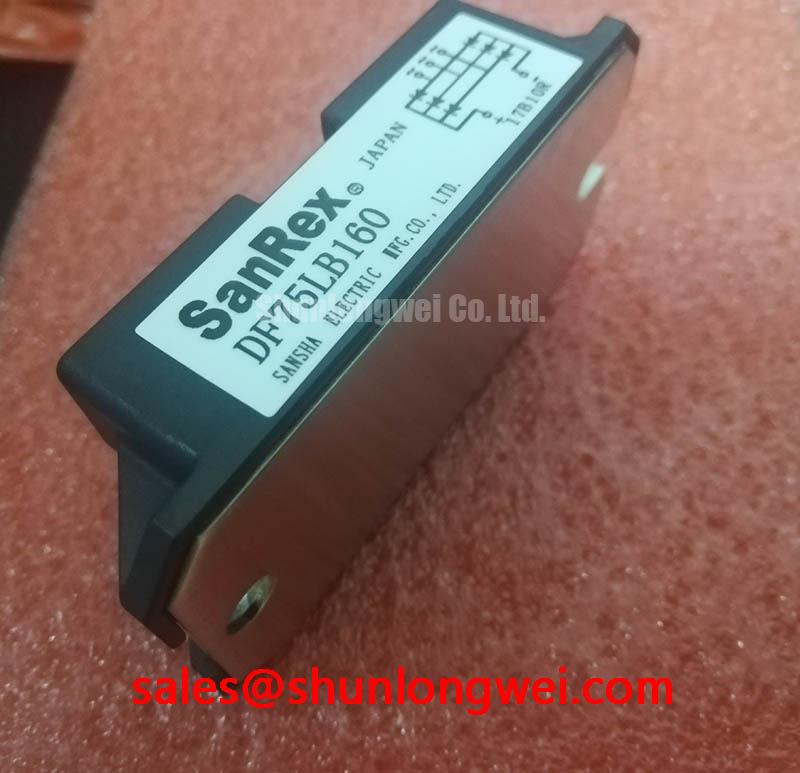
Industrial Applications
- Variable Frequency Drives (VFDs) and Motor Controllers: Provides a highly reliable front-end rectifier stage. The 75A continuous rating supports three-phase AC motor drive systems up to 30kW.
- Industrial Welding Power Supplies: Welding machines demand massive current during strike phases. The 1000A surge capability ensures the input bridge remains intact under repetitive short-circuit conditions.
- Battery Charging Stations: High-power battery rectifiers benefit from the isolated package, allowing multiple modules to be mounted on a single grounded heatsink.
- Uninterruptible Power Supplies (UPS): Serves as the primary AC-to-DC conversion bridge with low conduction losses, boosting overall system efficiency.
For industrial 400V input stages demanding under 75A continuous DC, this module offers the optimal balance of surge ruggedness and thermal efficiency.
Key Technical Specifications
| Parameter Group | Specification Name | Typical Symbol | Rated Value |
|---|---|---|---|
| Absolute Maximum Ratings | Repetitive Peak Reverse Voltage | $V_{RRM}$ | 1600 V |
| Average Rectified Output Current ($T_C = 111^circtext{C}$) | $I_O$ | 75 A | |
| Surge Forward Current (1 cycle, 60Hz) | $I_{FSM}$ | 1000 A | |
| Electrical Characteristics | Peak Forward Voltage Drop ($I_F = 75text{A}$) | $V_{FM}$ | Max 1.35 V |
| Repetitive Peak Reverse Current ($T_j = 150^circtext{C}$) | $I_{RRM}$ | Max 10 mA | |
| Thermal & Isolation | Thermal Resistance (Junction to Case) | $R_{th(j-c)}$ | 0.24 $^circtext{C/W}$ |
| Isolation Breakdown Voltage (A.C. 1 minute) | $V_{ISO}$ | 2500 V |
Engineer FAQ
Q1: What is the maximum forward voltage drop ($V_F$) of the DF75LB160, and how does it affect efficiency?
The maximum forward voltage drop per diode is 1.35V at $75text{A}$ ($T_j = 25^circtext{C}$). This low $V_F$ limits continuous power dissipation, enabling more compact heatsink designs.
Q2: Why is the 2500V AC isolation rating important for physical installation?
The 2500V AC isolation between the internal live terminals and the metal baseplate allows engineers to mount the module directly onto shared, grounded metallic enclosures. This eliminates external ceramic insulators, optimizing thermal transfer. Learn more about the advantages of isolated baseplates.
Q3: How does the DF75LB160 compare to discrete diodes in three-phase rectification?
Integrating six rectifying diodes into a single five-terminal module dramatically reduces wiring parasitic inductance, minimizes mounting space, and guarantees balanced thermal distribution across all three phases compared to discrete configurations. It simplifies design in complex high-power rectifiers.
The SanRex DF75LB160 represents a robust, highly optimized solution for three-phase power rectification. Its 1600V rating, combined with an isolated thermal baseplate design, provides power electronics engineers with the electrical security and thermal head-room required to construct long-lasting industrial machinery. By bridging grid transients and delivering stable DC outputs, this module establishes a reliable foundation for downstream inverter stages.