Sanrex PK55HB120: A Technical Analysis for Reliable AC Power Control
Sanrex PK55HB120: 1200V 55A Thyristor Module for AC Control
Engineered for High-Reliability AC Power Control and Rectification
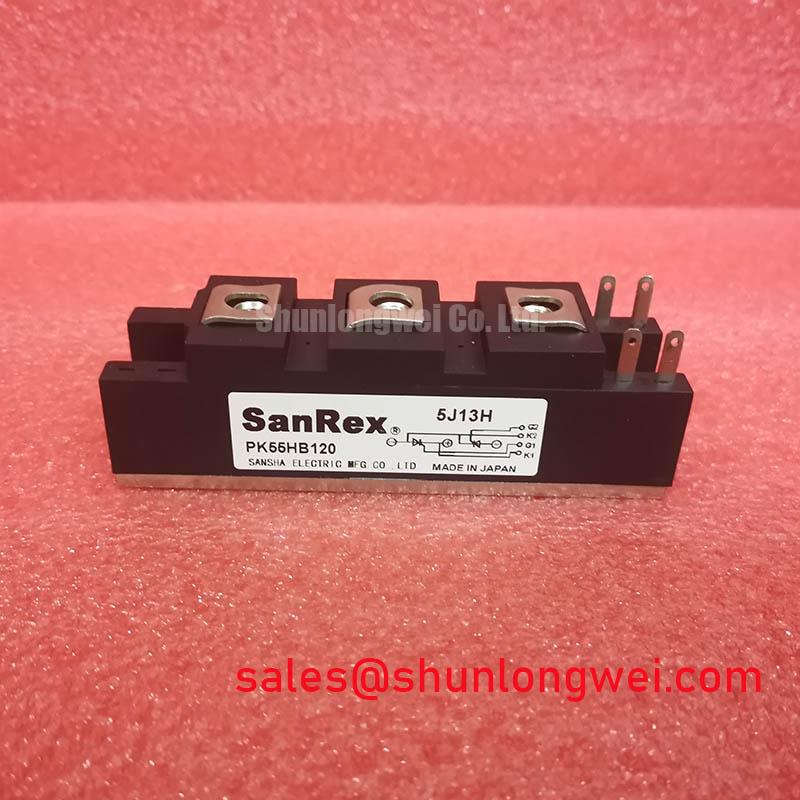
The Sanrex PK55HB120 is a dual thyristor module offering a robust solution for medium-power AC control and rectifier applications. It integrates two SCRs in a standard isolated package, delivering reliable performance with a high blocking voltage of 1200V and an average on-state current of 55A. This module is built to handle significant electrical stresses, ensuring long-term operational stability in demanding industrial environments.
- Core Specifications: 1200V | 55A (IT(AV)) | VISO 2500V
- Key Advantages: High surge current immunity, excellent electrical isolation.
- Engineering Value: Simplifies thermal management and enhances system safety.
Download the Official PK55HB120 Datasheet (PDF)


Technical Analysis for System Reliability
The engineering of the PK55HB120 centers on durability and safety. A key parameter is its non-repetitive surge on-state current (ITSM) rating of 1100A (50Hz). This high surge capability allows the module to withstand substantial inrush currents, which are common during the startup of motors or the energization of transformer-coupled loads. This feature provides a critical layer of protection against premature failure in applications with unpredictable line conditions, contributing to a more resilient system design.
Another crucial specification is the 2500V AC isolation voltage (VISO). Think of this isolation rating as the strength of a protective barrier separating the high-power mains from sensitive low-voltage control circuits. The robust 2500V rating ensures a significant safety margin, safeguarding both the equipment and personnel from potential electrical faults. This is fundamental for building systems that comply with stringent industrial safety standards. For further reading on this topic, explore the principles of isolated baseplates and their role in high-voltage reliability.
Effective thermal management is directly addressed by the module’s thermal resistance from junction to case (Rth(j-c)) of 0.5 °C/W per thyristor. This value acts as a guide for selecting an appropriate heatsink. A lower thermal resistance value signifies a more efficient path for heat to escape from the semiconductor junction. Proper heat dissipation is critical for maintaining the device’s operating temperature within safe limits, which is essential for achieving long-term operational life. A deeper understanding can be gained by reviewing how to master thermal design using characteristic curves.
Optimized Application Scenarios
The PK55HB120 is specified for line-frequency applications where robust, controlled switching is required. Its characteristics make it particularly suitable for:
- AC Motor Soft Starters: The high ITSM rating of 1100A safely manages the initial high inrush current of AC motors, preventing electrical stress and mechanical shock.
- Industrial Heater and Furnace Control: Enables precise phase-angle control for regulating power to resistive heating elements, offering a reliable and simple control method.
- Large-Scale Lighting Dimmers: Effectively handles the current demands for dimming large arrays of incandescent or compatible lighting fixtures in commercial or theatrical settings.
- Static Switches and AC Contactors: Provides a solid-state alternative to mechanical contactors for switching high-power AC loads, offering faster response and longer operational life.
Its high isolation and surge ratings make the PK55HB120 an optimal component for industrial AC power controllers requiring high reliability.
Key Specifications of the PK55HB120
| Absolute Maximum Ratings (Tj=25°C unless otherwise specified) | |
|---|---|
| Repetitive Peak Off-State/Reverse Voltage (VDRM/VRRM) | 1200V |
| Average On-State Current (IT(AV)) | 55A (Single phase, half wave, 180° conduction, Tc=85°C) |
| RMS On-State Current (IT(RMS)) | 86A |
| Surge On-State Current (ITSM) | 1100A (50Hz, one cycle, non-repetitive) |
| Isolation Voltage (VISO) | 2500V (AC, 1 minute) |
| Electrical & Thermal Characteristics (Tj=25°C) | |
| Peak On-State Voltage (VTM) | Max 1.50V (at 165A) |
| Gate Trigger Current (IGT) | Max 100mA |
| Critical Rate of Rise of On-State Current (di/dt) | 150 A/µs |
| Thermal Resistance, Junction to Case (Rth(j-c)) | Max 0.50 °C/W (per arm) |
| Operating Junction Temperature (Tj) | -40 to +125°C |
Engineer’s FAQ for the PK55HB120
What is the circuit configuration of the PK55HB120?
The PK55HB120 module contains two thyristors (SCRs) connected in a half-bridge configuration. This topology is common for single-phase controlled rectifiers or as a building block for more complex AC controllers.
What does the 1100A surge current rating mean for my design?
The 1100A surge current rating indicates the maximum non-repetitive current the device can handle for a single 50Hz cycle. This high tolerance is crucial for applications like motor starters, where a large inrush current occurs at startup. It ensures the module will not fail under these brief but intense stress conditions, enhancing overall system robustness.
What are the mounting torque specifications?
According to the datasheet, the recommended mounting torque for the main M6 mounting screws is 2.5 to 3.9 N·m. The M5 electrode terminals should be tightened to a torque of 1.5 to 2.5 N·m. Adhering to these specifications is critical for ensuring good thermal and electrical contact without causing mechanical stress. For a deeper dive, consider this article on the critical role of terminal torque.
How should I approach heatsink selection for this module?
To select a heatsink, you must first calculate the total power dissipation under your specific operating conditions (current, conduction angle, ambient temperature). Using the thermal resistance Rth(j-c) of 0.50 °C/W, you can determine the required heatsink-to-ambient thermal resistance needed to keep the junction temperature below the 125°C maximum.
Design and Integration
The Sanrex PK55HB120 thyristor module provides a foundational component for reliable medium-power AC control systems. Its high surge current immunity and robust electrical isolation allow engineers to design with confidence, knowing the device can withstand the rigors of industrial environments. These features enable the development of durable and safe power control solutions.