SEMIKRON SKKT250/18E: A Technical Review for Industrial Power Control
## SKKT250/18E Thyristor Module by SEMIKRON: 1800V 250A
Introduction and Core Highlights
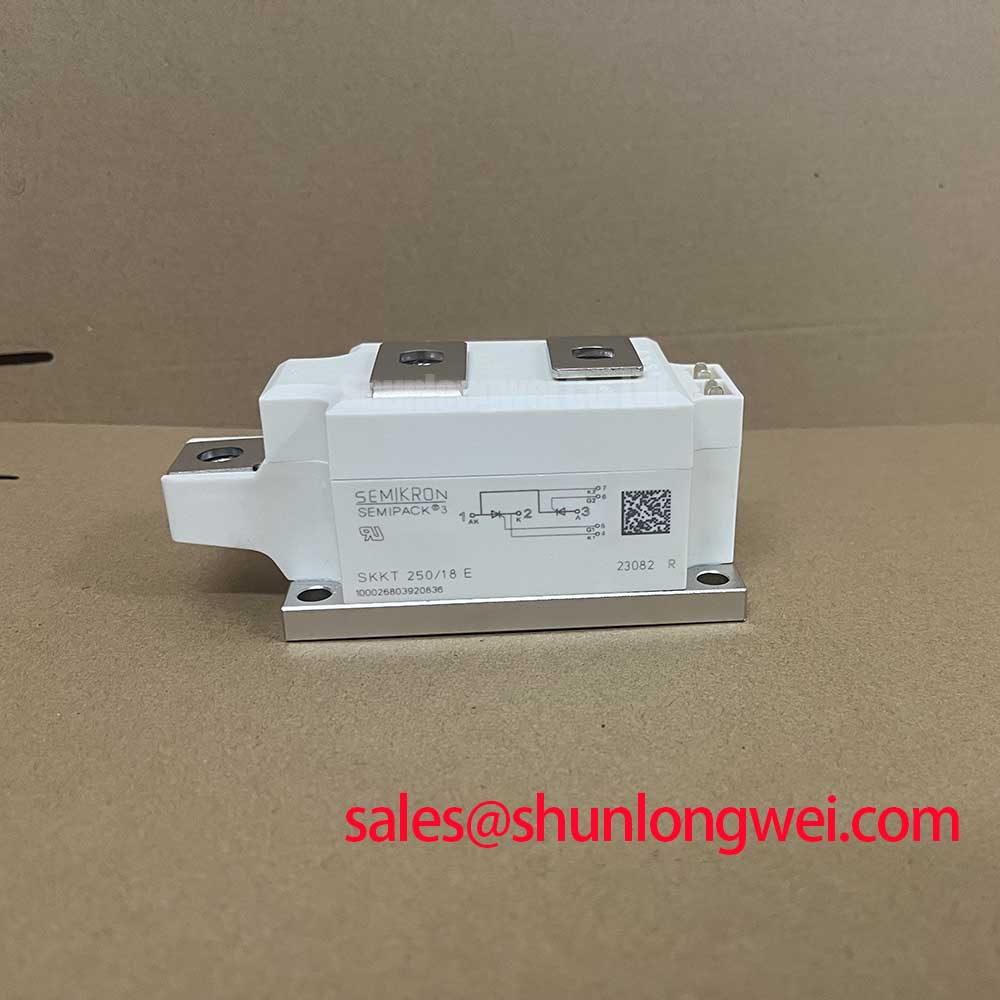
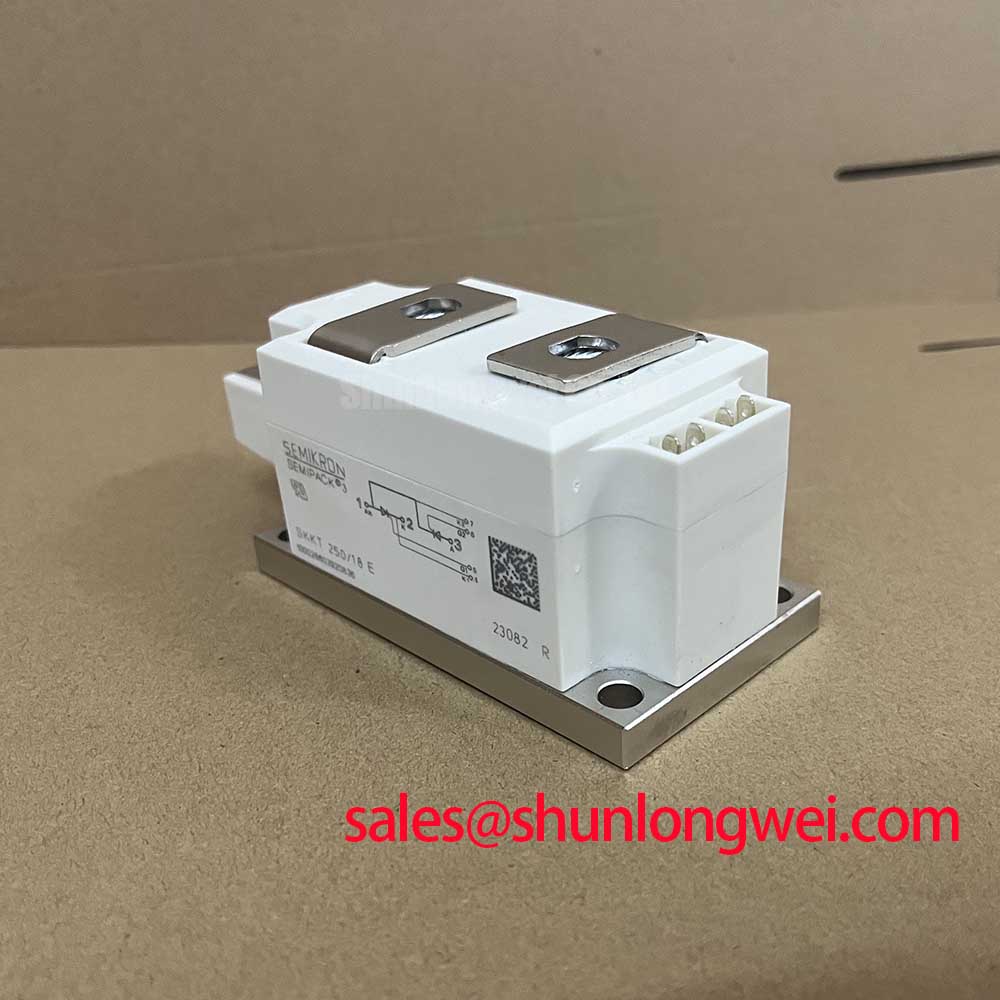
The SEMIKRON SKKT250/18E is a Thyristor/Diode Module engineered for high-reliability power control in demanding industrial environments. Its core value lies in delivering robust high-power switching capability combined with superior thermal efficiency and long-term durability. This is achieved through an electrically isolated baseplate and hard-soldered internal joints, ensuring consistent performance under rigorous thermal cycling.
- Core Specifications: 1800V VDRM/VRRM | 250A ITAV | 6500A ITSM
- Key Advantages: High electrical isolation simplifies thermal design, while robust construction ensures a long operational lifespan.
This module is well-suited for systems requiring precise and reliable control of high-power AC loads, providing a dependable solution backed by proven technology.
Download Official Datasheet (PDF)

Technical Analysis: Reliability and Thermal Performance
A defining feature of the SKKT250/18E is its construction, which directly contributes to its operational robustness. The datasheet specifies “hard soldered joints,” a feature that provides superior resilience to the mechanical stresses induced by repeated temperature changes. This method of construction ensures high reliability and extends the module’s service life, particularly in applications with frequent on/off cycles or fluctuating loads.
The module’s thermal management is significantly enhanced by its heat transfer path through an aluminium oxide ceramic isolated metal baseplate. This design provides an insulation voltage (Visol) of 3600V (RMS). This high isolation allows multiple modules to be mounted onto a single, non-isolated heatsink, simplifying the overall mechanical design and assembly process. The module’s thermal resistance from junction to case (Rth(j-c)) is specified at 0.1 K/W per thyristor. This value is crucial for thermal calculations. You can think of thermal resistance like the width of a pipe for heat flow; a lower value means heat can escape more easily, preventing the silicon from overheating and ensuring stable operation at high currents.


Optimized Application Scenarios
The electrical and mechanical characteristics of the SKKT250/18E make it highly suitable for a range of high-power control applications.
- AC Motor Soft Starters: The module’s high surge current rating (ITSM) of 6500A (at 50 Hz) allows it to safely manage the high inrush currents typical of large motor startups.
- High-Power Controlled Rectifiers: With a repetitive peak reverse voltage (VRRM) of 1800V, this module provides a substantial safety margin for building controlled rectifiers in 400V or 690V AC line systems.
- Industrial Temperature Control: For applications like furnaces and chemical processes, its robust thermal cycling capability ensures long-term reliability where precise, continuous power regulation is needed.
- Professional Light Dimming: The precise gate control and high power handling are ideal for managing the heavy loads found in large-scale studio and theater lighting systems.
Its combination of high voltage rating and robust thermal design makes this module an excellent fit for line-powered industrial AC power control and rectification systems.
Key Specification Parameters
| Key Electrical and Thermal Specifications | |
|---|---|
| Repetitive Peak Off-State and Reverse Voltage (VDRM, VRRM) | 1800 V |
| Average On-State Current (ITAV @ Tcase=85°C) | 250 A |
| RMS On-State Current (ITRMS @ Tcase=85°C) | 400 A |
| Peak On-State Voltage (VT @ IT=800A, Tj=25°C) | ≤ 1.65 V |
| Gate Trigger Current (IGT @ Tj=25°C) | ≤ 200 mA |
| Critical Rate of Rise of Off-State Voltage (dv/dt) | ≥ 1000 V/µs |
| Thermal Resistance, Junction to Case (Rth(j-c)) | ≤ 0.1 K/W (per thyristor) |
| Insulation Test Voltage (Visol) | 3600 V (RMS, t=1s) |
Engineer’s FAQ
1. What are the primary applications for the SKKT250/18E thyristor module?
The SKKT250/18E is designed for high-power phase control applications. Based on its 1800V and 250A ratings, it is principally used in AC motor soft starters, industrial temperature controllers, professional light dimmers, and controlled DC power supplies. For further reading on power semiconductor applications, you can explore resources on power semiconductors.
2. What is the recommended mounting torque for this module?
The datasheet specifies a mounting torque of 5 Nm ± 15% for the M6 mounting bolts. Adhering to this specification is critical. Insufficient torque can lead to poor thermal contact with the heatsink, causing overheating. Excessive torque can damage the ceramic baseplate, compromising the module’s electrical isolation and mechanical integrity.
3. How does the isolated baseplate simplify thermal design?
The module’s baseplate is electrically isolated from the active semiconductor elements. This allows the module to be mounted directly to a grounded heatsink without needing an additional, external insulating layer. This not only simplifies the mechanical assembly but also improves thermal transfer compared to using external insulators. This concept is fundamental to the reliability of many high-voltage power modules.
4. What is the significance of the dv/dt and di/dt ratings?
The dv/dt rating (1000 V/µs) indicates the maximum rate of voltage increase across the thyristor that it can withstand without false triggering. The di/dt rating (150 A/µs) indicates the maximum rate of current rise during turn-on that the device can handle without damage. These parameters are crucial for ensuring the device operates reliably in electrically noisy environments and during fast switching events. For more on managing power module thermals, consider reviewing guides on the Zth curve.
Design Enablement
The SKKT250/18E provides engineers with a foundational component for robust power control systems. Its blend of high voltage and current ratings, combined with a design focused on thermal efficiency and long-term durability, enables the development of reliable and simplified industrial power electronics.