Semikron SKKT273/16E Thyristor/Diode Module: Technical Analysis and Specifications
Semikron SKKT273/16E Thyristor/Diode Module | 1600V 273A SEMIPACK 2
High-Reliability Power Control with SKKT273/16E SEMIPACK Technology
The SKKT273/16E is an industry-standard Thyristor/Diode module engineered for robust power conversion in demanding industrial environments. Utilizing the SEMIPACK 2 package, this component delivers a 1600V blocking voltage and a 273A average forward current rating (at Tc=85°C). Its core identity is defined by high-reliability hard soldered joints and an aluminum oxide ceramic isolated baseplate, which ensures superior heat transfer and mechanical durability. This module is a strategic choice for engineers seeking consistent performance in high-current rectification and AC/DC control systems.
- Core Specifications: 1600V Repetitive Peak Voltage | 273A Average On-state Current | 9100A Surge Current (10ms).
- Key Advantages: Enhanced thermal cycling capability and simplified cooling management via isolated baseplate technology.
- Engineering Intent: Addresses the critical need for robust surge handling in soft starters and heavy-duty motor drives where fault current management is paramount.
Download Official SKKT273/16E Datasheet (PDF)
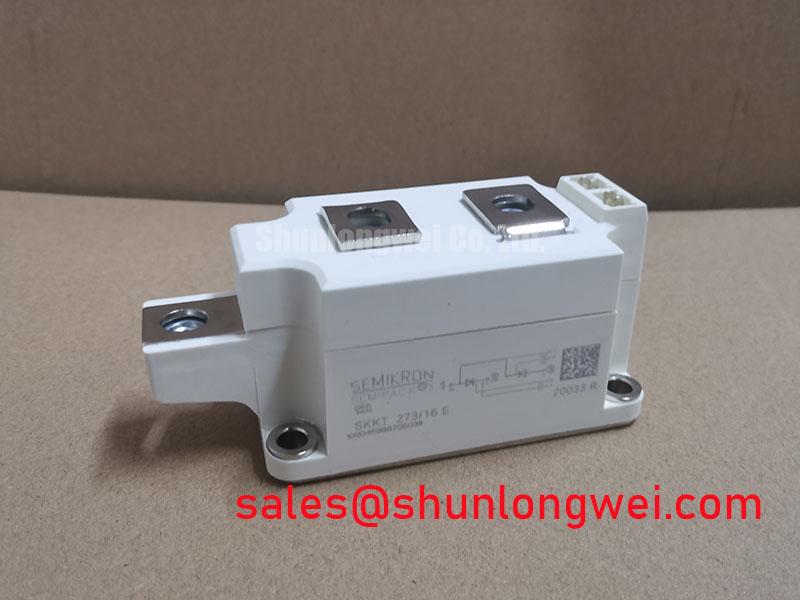

Technical Analysis: Thermal Efficiency and Surge Robustness
The SKKT273/16E module is built upon an aluminum oxide ceramic baseplate. In power electronics design, this material choice is vital because it provides an excellent dielectric barrier while maintaining low thermal resistance (Rth). To visualize this, one can think of thermal resistance as the width of a physical exhaust pipe; a lower value means heat can flow out of the semiconductor junction more rapidly, preventing the destructive effects of localized hotspots during high-load intervals. By minimizing the junction-to-case thermal resistance to 0.11 K/W for the thyristor, this module allows for more compact heat sink designs.
Another defining parameter is the non-repetitive peak surge current (ITSM) of 9100A. This rating indicates the module’s ability to withstand extreme, short-duration overloads, such as those occurring during system startup or fault conditions. This robustness is critical for maintaining power semiconductor integrity in applications like large DC motor drives. Furthermore, the hard soldered joints provide a rigid internal structure that resists the mechanical stresses of repetitive power cycling, a feature often discussed in technical reviews regarding fortifying reliability in high-voltage modules.


Optimized Application Scenarios
- DC Motor Control: Frequently used in large-scale line-rectified converters where its high IT(AV) of 273A supports stable motor torque under varying loads.
- Soft Starters: The 9100A surge current capability is ideal for managing the initial inrush current of three-phase asynchronous motors.
- Industrial Heating Control: Suited for phase control in electric furnaces, where precision and long-term thermal stability are necessary.
- Battery Chargers: High blocking voltage (1600V) provides an ample safety margin against line transients in professional charging equipment.
Best Match Conclusion: The SKKT273/16E is optimally specified for high-current AC controllers and line-rectifiers requiring 1600V transient protection and superior surge current resilience.
Critical Specification Parameters
| Parameter | Condition | Value |
|---|---|---|
| V_RRM / V_DRM | Repetitive Peak Reverse/Off-state Voltage | 1600 V |
| I_T(AV) | Average On-state Current (Tc = 85°C) | 273 A |
| I_TSM | Surge On-state Current (10ms, Tvj = 25°C) | 9100 A |
| V_T | Max. On-state Voltage (at 750A) | 1.52 V |
| R_th(j-c) | Thermal Resistance Junction to Case (per Thyristor) | 0.11 K/W |
| V_isol | Isolation Voltage (RMS, 1 min) | 3600 V~ |
Engineer FAQ
Q1: How do I calculate the required heat sink for the SKKT273/16E?
A: Calculate the total power dissipation (P_tot) based on your average on-state current and the forward voltage drop (V_T) found in the datasheet. The required heat sink thermal resistance (Rth_s-a) is determined by (T_j_max – T_ambient) / P_tot, subtracting the module’s internal Rth(j-c) and case-to-sink Rth(c-s).
Q2: What are the torque specifications for the electrical and mounting terminals?
A: According to the SEMIPACK 2 design standard, the mounting torque to the heat sink should be 3-5 Nm, and the terminal screw torque should also be within 3-5 Nm to ensure optimal electrical contact and thermal conductivity without damaging the internal ceramic layer.
Q3: Can this module be used in parallel for higher current applications?
A: Yes, the SKKT273/16E can be paralleled, but it requires careful attention to symmetrical busbar design and current sharing inductors to compensate for the slight variations in forward voltage between individual modules.

Design Summary
The Semikron SKKT273/16E represents a balanced synthesis of high voltage blocking and significant surge current capacity within the reliable SEMIPACK 2 framework. By integrating advanced ceramic isolation and hard soldering, it provides engineers with a stable foundation for high-power rectification. This module aligns with rigorous industrial standards for isolation and thermal performance, ensuring design longevity in complex AC/DC power systems. For more information on similar components, explore our guide on Semikron high-reliability power control modules.