SK30GD123D IGBT Module: A Technical Review for Power Applications
SK30GD123D IGBT Module Technical Review
Introduction to the SK30GD123D: Performance and Reliability
The SK30GD123D is a half-bridge IGBT module from Semikron that integrates Trench Gate IGBTs and CAL (Controlled Axial Lifetime) freewheeling diodes. This combination delivers a well-balanced performance profile, focusing on reducing both static and dynamic power losses. It is engineered for power conversion systems requiring high efficiency and robust thermal performance.
- Core Specifications: 1200V | 50A @ 25°C | VCE(sat) 2.0V (typ)
- Key Advantages: Optimized for low conduction losses and includes a fast, soft-recovery freewheeling diode.
- Design Consideration: The module’s integrated NTC thermistor provides a direct method for monitoring operating temperature, crucial for implementing over-temperature protection.
For complete electrical and thermal specifications, refer to the official SK30GD123D datasheet (PDF).


Technical Analysis for System Integration
The engineering value of the SK30GD123D is rooted in its component technologies. The use of Trench Gate IGBTs results in a low collector-emitter saturation voltage (VCE(sat)). Think of VCE(sat) as a valve’s resistance to flow; a lower value means less energy is converted into heat when the switch is fully on. This directly contributes to higher system efficiency and reduces the demands on the cooling system, a key aspect of mastering IGBT thermal design.
The module also incorporates a CAL freewheeling diode. This diode is optimized for soft recovery characteristics, which minimizes voltage overshoots and electromagnetic interference (EMI) during the IGBT’s turn-on phase. This “soft” switching behavior is critical in applications like motor drives, where reducing electrical noise is essential for the reliability of surrounding control electronics. The low reverse recovery charge (Qrr) also lowers the switching energy (Eon) of the IGBT, further enhancing efficiency, particularly at higher operating frequencies.
Optimized Application Scenarios
The specific characteristics of the SK30GD123D make it a strong candidate for several power conversion applications.
- AC Motor Drives: Its balanced loss profile and the soft-recovery CAL diode are highly suitable for the variable switching conditions found in modern variable frequency drives (VFDs).
- Uninterruptible Power Supplies (UPS): The module’s thermal efficiency and the integrated NTC thermistor support the high-reliability requirements of UPS systems.
- Welding Power Supplies: The device’s robust thermal cycling capability and solid current handling are well-suited for the demanding, pulsed-load nature of welding applications.
For mid-power inverter stages up to approximately 15 kW, the SK30GD123D provides a well-rounded and reliable core switching component.
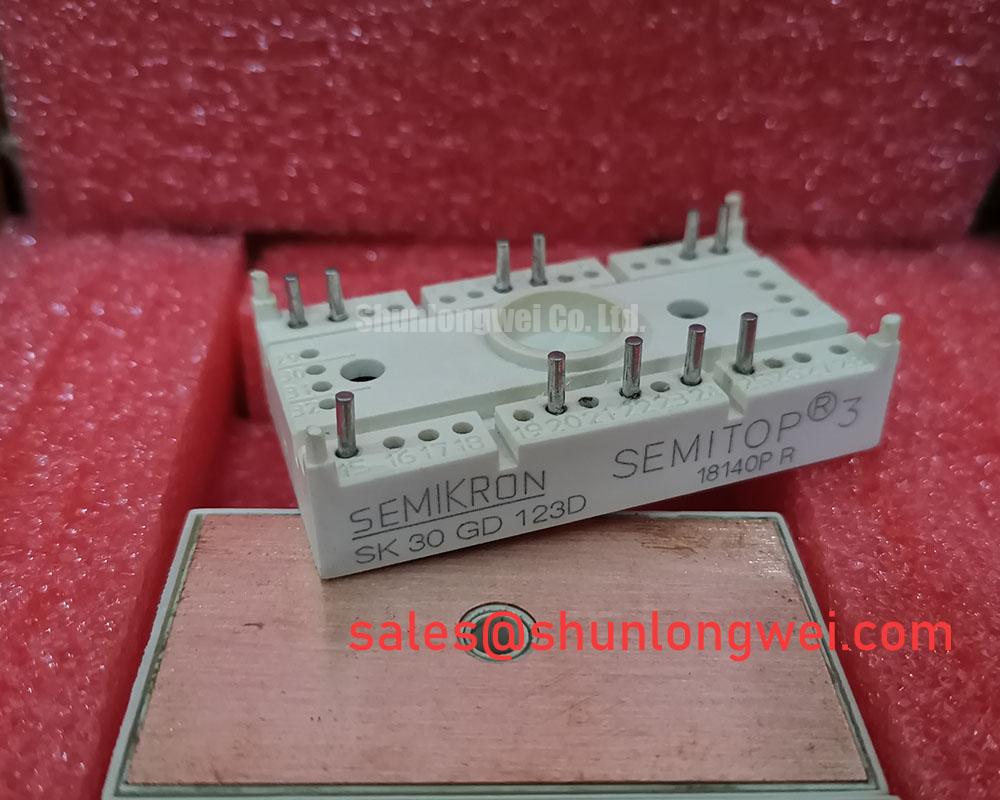
Key Specifications of the SK30GD123D
| Parameter | Symbol | Value | Conditions |
|---|---|---|---|
| Absolute Maximum Ratings (per IGBT) | |||
| Collector-Emitter Voltage | VCES | 1200 V | Tj = 25 °C |
| Continuous DC Collector Current | IC,nom | 30 A | Tc = 80 °C |
| Repetitive Peak Collector Current | ICRM | 60 A | tp = 1 ms |
| Electrical Characteristics (per IGBT) | |||
| Collector-Emitter Saturation Voltage | VCE(sat) | 2.0 V (typ) / 2.45 V (max) | IC = 30 A, VGE = 15 V, Tj = 25 °C |
| Gate-Emitter Threshold Voltage | VGE(th) | 5.8 V (typ) | IC = 1.2 mA |
| Thermal Characteristics | |||
| Thermal Resistance, Junction to Case | Rth(j-c) | 0.7 K/W (per IGBT) | – |
Engineer’s FAQ
What are the recommended gate drive voltage settings for the SK30GD123D?
The datasheet specifies the parameters using a gate-emitter voltage (VGE) of +15V for turn-on and typically 0V or a small negative voltage (e.g., -8V to -15V) for turn-off. A negative turn-off voltage is often recommended to improve noise immunity and prevent unintended turn-on events, a topic further explored in enhancing IGBT noise immunity.
How should the module be mounted to a heatsink for effective cooling?
For optimal thermal transfer, ensure the heatsink surface is flat and clean. A thin, uniform layer of thermal interface material (TIM) with a thermal conductivity of around 1 W/(m·K) should be applied. The module should be secured with the specified mounting torque for its M5 screws to ensure proper contact without inducing mechanical stress on the substrate.
What is the purpose of the integrated NTC thermistor?
The NTC (Negative Temperature Coefficient) thermistor provides a means for real-time temperature feedback from the module’s baseplate. This allows the system’s controller to monitor the IGBT’s operating temperature, enabling functions like fan speed control, power derating, or shutdown in an over-temperature fault condition, which is a cornerstone of IGBT module safety and reliability.
Can this module be used in a hard-switched, high-frequency application?
While the SK30GD123D is efficient, its characteristics are primarily balanced for applications operating in the typical motor drive frequency range (e.g., 2-16 kHz). For very high-frequency hard-switched designs (above 20-25 kHz), total switching losses could become the dominant factor in heat generation. A detailed loss calculation based on the datasheet’s Eon, Eoff, and Erec curves is necessary to confirm its suitability for a specific high-frequency design.
Enabling Efficient Power Conversion
The SK30GD123D module offers a robust, technically sound solution for designers of mid-power inverters and drives. By integrating proven Trench Gate IGBT and CAL diode technologies, it provides a reliable foundation for building systems where efficiency, thermal management, and electrical ruggedness are primary design objectives.