SKKT 323/12 E: A High-Surge Thyristor Module for Robust AC Power Control
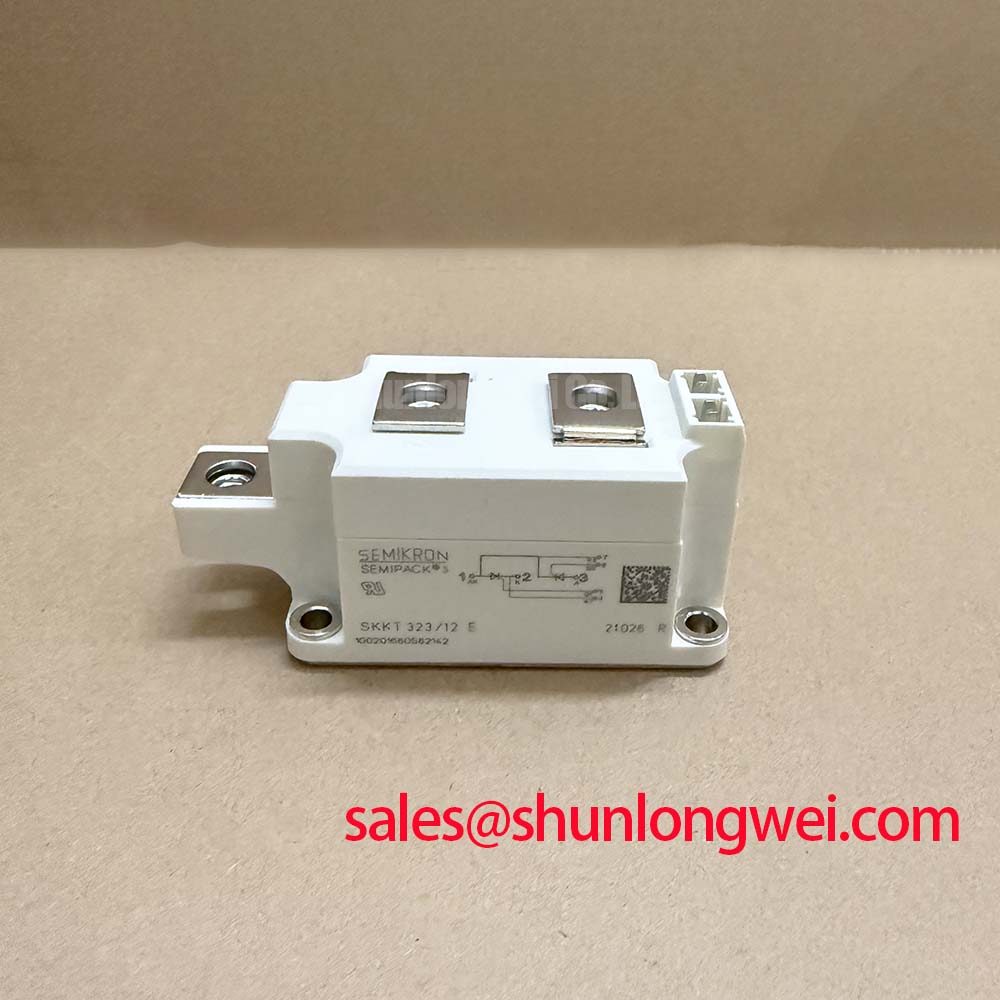
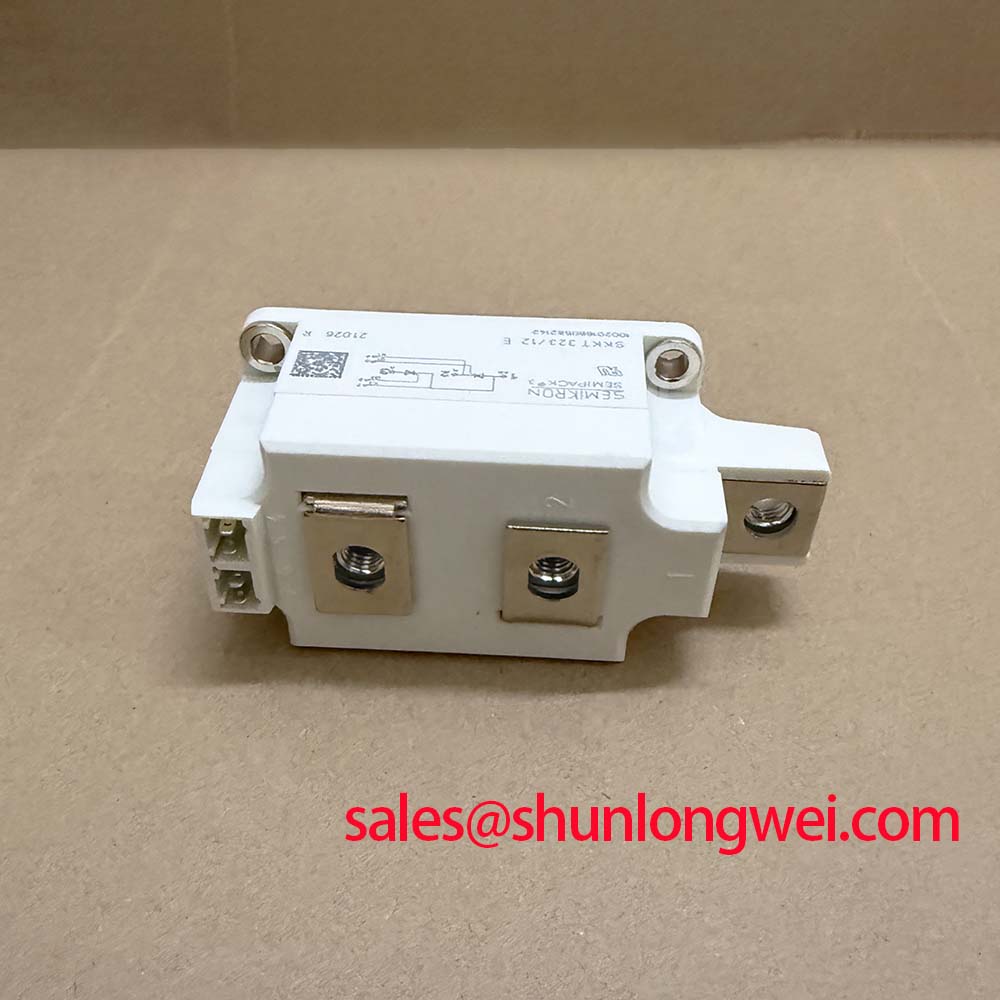
SKKT 323/12 E: Semikron 1200V 320A Thyristor Module
High-Surge Capability for Robust AC Power Control
The Semikron SKKT 323/12 E is a thyristor module engineered for high-reliability AC power control in demanding industrial environments. Its primary value lies in its exceptional surge current handling and efficient thermal design, which provides a robust foundation for power control systems. The module integrates two thyristors in a series configuration, commonly used for AC controllers. This design is optimized for longevity and stable performance under significant electrical and thermal stress.
- Core Specifications: 1200V | 320A | I²t = 720,000 A²s
- Key Advantages: High fault current survivability, simplified thermal management.
The module’s high I²t rating is a critical parameter, ensuring it can withstand substantial inrush currents or line faults without failure. This characteristic is essential for protecting the device and the overall system.
Download the SKKT 323/12 E Datasheet (PDF)

Technical Analysis for System Reliability
Two key datasheet parameters underscore the suitability of the SKKT 323/12 E for high-power AC control: its surge current capability and thermal resistance. The repetitive peak off-state voltage (VDRM/VRRM) of 1200V provides a safe operating margin for line-powered applications. However, it’s the module’s ability to handle abnormal conditions that defines its robustness.
Surge Current and I²t Rating
The non-repetitive surge peak on-state current (ITSM) is rated at 8200 A for a 10 ms pulse. More critically, the I²t rating of 720,000 A²s quantifies the thermal energy the device can absorb during a short-duration fault before sustaining damage. This can be compared to a dam’s structural integrity; a higher I²t value means the device can withstand a more significant and sudden surge of energy, such as from a motor stall or short-circuit, which is vital for system protection and longevity. For a deeper understanding of fault protection, resources on fuse coordination and I²t ratings provide valuable context.
Efficient Thermal Management
The module features a low thermal resistance from junction to case (Rth(j-c)) of 0.07 K/W per thyristor. This metric is like the width of a pipe for heat flow; a lower value indicates a wider pipe, allowing heat to escape the semiconductor junction more easily. This efficiency, enabled by the aluminum oxide ceramic insulated baseplate, allows engineers to design more compact cooling systems or operate at a higher average current (ITAV of 320 A at a case temperature of 85°C) without exceeding the 130°C maximum junction temperature. Effective thermal management is fundamental to the long-term reliability of all power semiconductors.
Optimized Application Scenarios
The specifications of the SKKT 323/12 E make it a strong candidate for several key industrial applications:
- AC Motor Soft Starters: The high surge current (ITSM) rating is ideal for managing the significant inrush currents experienced when starting large AC induction motors.
- Industrial Heater and Temperature Control: Its ability to handle 320 A continuously allows for precise phase-angle or zero-crossing control of high-power heating elements in industrial ovens and chemical processes.
- High-Power AC Switches: The 1200V blocking voltage and 3600V isolation voltage (Visol) make it a reliable component for static switches in mains-connected equipment.
- Professional Light Dimming: Suitable for controlling large banks of incandescent lights in studios and theaters where high current and reliable AC phase control are required.
This module is best matched for line-frequency AC control systems that demand high current capacity and robust fault-handling capabilities.
Key Specifications of the SKKT 323/12 E
| Parameter | Value | Conditions |
|---|---|---|
| Repetitive Peak Off-State Voltage (VDRM, VRRM) | 1200 V | – |
| On-State Current (ITAV) | 320 A | Tcase = 85°C |
| Surge Peak On-State Current (ITSM) | 8200 A | 10 ms, Tvj = 25°C |
| I²t Value | 720,000 A²s | 10 ms, Tvj = 25°C |
| Thermal Resistance, Junction to Case (Rth(j-c)) | 0.07 K/W | Per Thyristor |
| Isolation Test Voltage (Visol) | 3600 V | AC, 50 Hz; 1 min |
| Operating Junction Temperature (Tvj) | -40 to +130 °C | – |
Engineer’s FAQ for the SKKT 323/12 E
What makes the SKKT 323/12 E suitable for high-power AC controllers?
Its combination of a high average on-state current (320 A), high blocking voltage (1200V), and a very high surge current rating (8200 A) makes it robust enough to manage both continuous loads and potential fault conditions in line voltage applications. Its low thermal resistance also simplifies heatsink design for reliable operation.
What is the recommended mounting procedure for optimal thermal performance?
The datasheet specifies cleaning the mating surfaces of the module and heatsink to remove any contamination. A thin, even layer of thermal compound should be applied. The module should be fastened using M6 screws with a mounting torque of 5 Nm ± 15% to ensure proper contact without inducing mechanical stress on the ceramic substrate.
What is the purpose of the series-connected (AC controller) topology?
This “anti-parallel” or “back-to-back” thyristor configuration within the module allows for control of both the positive and negative half-cycles of an AC waveform. This is the standard topology for applications like AC phase-angle control for dimming, motor speed control, and temperature regulation.
How should the maximum junction temperature of 130°C influence the cooling system design?
Engineers must calculate the total power dissipation under worst-case operating conditions and use the specified thermal resistance (Rth(j-c)) to select a heatsink with an appropriate thermal resistance to ambient (Rth(c-a)). The goal is to ensure the junction temperature (Tj) remains below 130°C at the highest expected ambient temperature to prevent thermal runaway and ensure long-term reliability.
This SKKT 323/12 E module provides a dependable and thermally efficient component for engineers developing high-current AC power control systems. Its high surge immunity and standard industrial footprint deliver a durable solution for new designs and system upgrades.