Tianma TM070RDH10-42: A Robust Display for Industrial Environments
Tianma TM070RDH10-42: 7″ WVGA Industrial TFT-LCD Module
Reliable Visuals for Demanding Industrial Environments
The Tianma TM070RDH10-42 is an a-Si TFT-LCD module that delivers consistent and clear image quality for industrial applications requiring operational stability. Its core value proposition is rooted in a wide operating temperature range and a standard, easy-to-integrate parallel interface, ensuring reliable performance where commercial-grade displays would falter. This display provides a practical solution for engineers developing robust human-machine interfaces.
- Core Specifications: 7.0-inch WVGA (800×480) | -20°C to +70°C Range | Parallel RGB Interface
- Key Advantages: Ensures operational integrity in fluctuating temperatures, simplifies integration with common embedded controllers.
This module is a strong candidate for systems that must function reliably in environments without consistent climate control.
Download Official Datasheet (PDF)
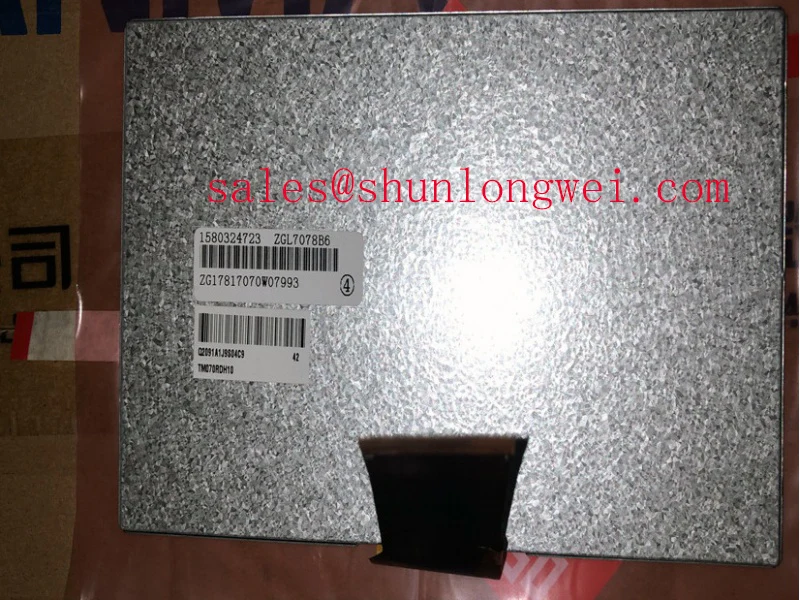


Technical Analysis for System Integration
Engineered for Thermal Resilience
The standout feature of the TM070RDH10-42 is its specified operating temperature range of -20°C to +70°C. This parameter is critical for devices deployed in environments that lack heating or cooling, such as factory floors, unenclosed kiosks, or vehicle cabins. The module’s ability to initialize and operate at -20°C ensures functionality during cold starts, a common failure point for displays with narrower temperature ratings. This resilience can be compared to an all-weather industrial lubricant; just as the lubricant maintains its viscosity and protective properties in both freezing and high-heat conditions, this display maintains its operational state, preventing costly downtime and field failures.
Streamlined Electrical Interface
This display utilizes a 50-pin Parallel RGB interface, a widely supported standard in the embedded systems industry. This choice of interface directly benefits engineers by simplifying the hardware and software design process. Unlike more complex high-speed serial interfaces, the parallel RGB standard does not typically require specialized driver ICs or intricate signal integrity management for an 800×480 resolution. This allows for direct connection to a broad range of microcontrollers and application processors, reducing board complexity and accelerating development timelines. The anti-glare surface treatment further enhances its utility, improving screen readability under the varied lighting conditions common in smart factory HMI designs.
Optimized Application Scenarios
The specific set of features in the TM070RDH10-42 makes it well-suited for several industrial use cases:
- Industrial Control Panels: The 7-inch diagonal and WVGA resolution provide ample space for displaying process data and control elements, while the wide temperature range ensures reliability.
- Test and Measurement Equipment: Its robust construction and straightforward interface make it a durable and practical choice for both portable and benchtop analytical instruments.
- Building Automation Systems: Suitable for climate control panels and security system interfaces that may be installed in areas with significant temperature fluctuations.
- Agricultural Vehicle Displays: The operational resilience is a key factor for in-cabin displays used in farming equipment, which experience a wide range of environmental conditions.
This module is an optimal fit for systems needing a proven, durable 7-inch display for challenging indoor and semi-outdoor industrial applications.
Key Specifications of the TM070RDH10-42
| Parameter | Specification |
|---|---|
| Display Characteristics | |
| Screen Size | 7.0 inch (Diagonal) |
| Resolution | 800(RGB) × 480 [WVGA] |
| Display Technology | a-Si TFT-LCD, Transmissive |
| Surface Treatment | Anti-Glare |
| Optical Characteristics | |
| Luminance | 350 cd/m² (Typical) |
| Contrast Ratio | 500:1 (Typical) |
| Viewing Angle (L/R/U/D) | 70°/70°/50°/70° (Typical) |
| Backlight | White LED (WLED) |
| Backlight Lifetime | 20,000 hours (Minimum) |
| Interface & Electrical | |
| Interface Type | Parallel RGB (1 ch, 8-bit) + SPI, 50-pin FPC |
| Power Supply (Logic) | 3.3V (Typical) |
| Environmental Ratings | |
| Operating Temperature | -20°C to 70°C |
| Storage Temperature | -30°C to 80°C |
Engineer’s FAQ
1. How does the TM070RDH10-42 perform at its lower temperature limit of -20°C?
Based on the datasheet, the display is fully operational at -20°C. However, like most LCD core technology, users should anticipate an increase in liquid crystal response time at this temperature. This may manifest as slower screen transitions or “ghosting.” The display’s electrical characteristics and backlight will function within their specified limits.
2. What are the primary signals required for the 50-pin Parallel RGB interface?
To drive the display, you must provide the main logic power (VDD), ground, and the standard RGB timing signals. These include the pixel clock (DCLK), horizontal sync (HSYNC), vertical sync (VSYNC), data enable (DE), and the 8-bit parallel data lines for Red, Green, and Blue.
3. Is an external backlight driver required?
The datasheet indicates the module contains the LED backlight unit. However, it requires an external power source for the backlight LEDs. Engineers must supply the specified voltage and current to the backlight anode and cathode pins as detailed in the electrical characteristics section of the official documentation.
4. What is the typical surface hardness of the front polarizer?
The datasheet specifies a surface hardness of 3H for the anti-glare polarizer. This provides a moderate level of scratch resistance suitable for typical HMI use where the display might be operated with a finger or stylus, but it may require a protective cover glass for more rugged applications.
Enabling Reliable System Design
The Tianma TM070RDH10-42 provides a robust foundation for industrial user interfaces where operational reliability across a wide temperature spectrum is a primary design requirement. Its use of standard, well-documented technology allows engineering teams to focus on application-level development rather than complex display integration challenges.