VUO160-16NO7: A Technical Review of a 1600V Industrial Rectifier Module
VUO1-160-16NO7 Three-Phase Rectifier Bridge Module
Reliable High-Voltage Rectification for Industrial Power Systems
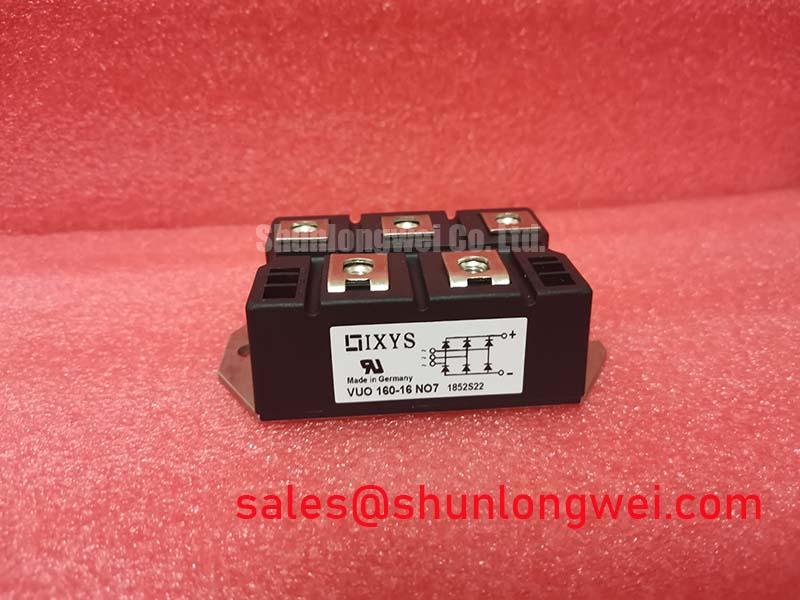
The IXYS VUO160-16NO7 is a three-phase rectifier bridge module engineered for high-reliability power conversion. It delivers a robust 1600V repetitive reverse voltage capability combined with an industry-standard package that simplifies thermal design. This module integrates planar passivated chips, ensuring very low forward voltage drop and minimal leakage current for efficient and stable operation in demanding industrial environments.
- Core Specifications: 1600V | 175A | 3000V~ Isolation
- Key Advantages: Simplified thermal management, enhanced power cycling capability.
This component is an effective solution for implementing the input stage of high-power power semiconductors and systems like Variable Frequency Drives (VFDs), where robust performance and electrical isolation are critical.
Download the VUO160-16NO7 Official Datasheet (PDF)
Technical Analysis for System Integration
The standout feature of the VUO160-16NO7 is its high repetitive peak reverse voltage (VRRM) of 1600V. This provides a substantial safety margin for industrial systems connected to 380V or 480V AC mains, effectively protecting the system from common line voltage transients and surges. The module’s average forward current rating of 175A (at a case temperature of 110°C) allows it to serve as the main input rectifier for a wide range of medium-to-high power inverters and converters.
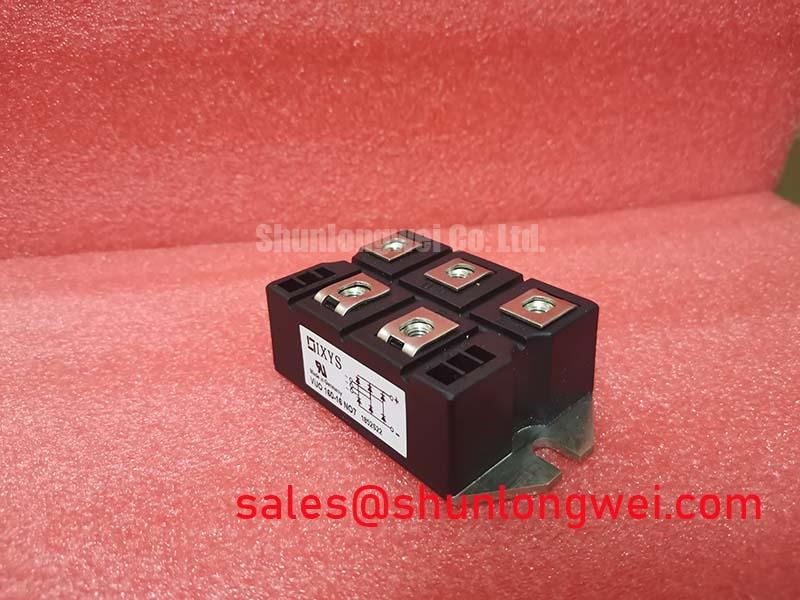
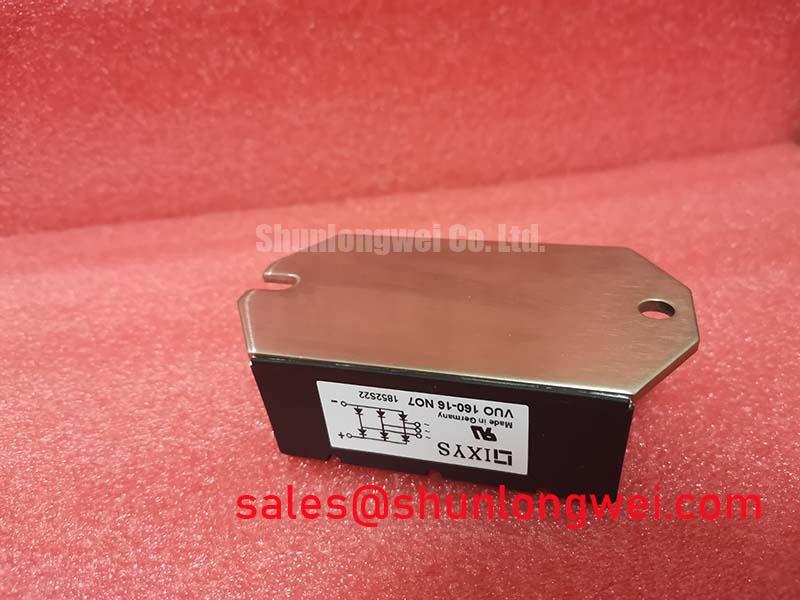
A key element for mechanical and thermal design is the module’s PWS-E package, which incorporates a copper base plate internally isolated with Direct Bonded Copper (DBC) ceramic. This construction provides excellent electrical isolation of 3000V~ (VISOL), allowing multiple modules to be mounted on a single, non-isolated heatsink without additional insulating hardware. This not only reduces assembly complexity and component count but also enhances thermal transfer. The junction-to-case thermal resistance (RthJC) is an important parameter; it can be thought of as the width of a pipe for heat dissipation. The low RthJC of 0.5 K/W for the entire module signifies a very efficient path for heat to travel from the active silicon to the heatsink, which is fundamental for maintaining reliability during heavy loads.
Optimized Application Scenarios
The specific characteristics of the VUO160-16NO7 make it highly suitable for several power conversion applications:
- Input Rectifiers for PWM Inverters: Its 1600V rating and high current handling are ideal for the front-end of AC motor drives and uninterruptible power supplies (UPS).
- Supplies for DC Power Equipment: Provides robust and efficient bulk DC power for various industrial machines and processes.
- Field Supply for DC Motors: The module can reliably rectify AC line voltage to provide the main DC power for controlling large DC motors.
- Industrial Battery Chargers: Capable of handling the high currents required for charging large-capacity battery banks in logistics or backup power systems.
This module is an optimal match for industrial power systems that require high voltage rectification with simplified mechanical and thermal assembly.
Key Specification Parameters
| Parameter | Value | |
|---|---|---|
| Absolute Maximum Ratings | ||
| Repetitive Peak Reverse Voltage (VRRM) | 1600 V | |
| Average Forward Current (IDAV) @ TC=110°C | 175 A | |
| Peak Forward Surge Current (IFSM), t=10ms, 50Hz | 1800 A | |
| Electrical Characteristics (TVJ = 25°C unless otherwise specified) | ||
| Forward Voltage (VF) @ IF=60A | 1.1 V (Typ.) | |
| Reverse Current (IR) @ VR=1600V | 0.2 mA (Max.) | |
| Thermal and Mechanical Characteristics | ||
| Thermal Resistance, Junction to Case (RthJC) | 0.5 K/W | |
| Operating Junction Temperature (TVJM) | -40°C to 150°C | |
| Isolation Voltage (VISOL), 50/60 Hz, RMS, t=1min | 3000 V~ | |
Engineer’s FAQ
What are the main considerations for the thermal design when using the VUO160-16NO7?
Effective thermal management is crucial. The design should start with the module’s specified junction-to-case thermal resistance (RthJC) of 0.5 K/W. An appropriate heatsink must be selected based on the calculated power dissipation and the maximum ambient operating temperature. Ensure a flat and clean mounting surface and apply a thin, uniform layer of thermal grease to minimize the case-to-heatsink thermal resistance (RthCH).
What is the correct mounting torque for this rectifier module?
To ensure optimal thermal and electrical contact without causing mechanical stress, the module should be mounted using two M5 screws. The recommended mounting torque, as per the official datasheet, is 3.0 – 3.5 Nm. Over-tightening can damage the ceramic substrate, while under-tightening leads to poor thermal performance.
How does the isolated baseplate benefit my design?
The electrically isolated baseplate, rated for 3000V~, simplifies the mechanical assembly process. It allows direct mounting onto a common, non-isolated heatsink alongside other isolated modules, eliminating the need for separate insulating pads. This reduces parts count, lowers assembly costs, and provides a more reliable thermal interface compared to external insulation methods. A deeper understanding of this can be found in our articles on the foundation of high-voltage reliability.
Why is a 1600V VRRM rating important for a 480V AC system?
A standard 480V three-phase AC line has a peak voltage of approximately 679V (480V * √2). However, industrial power lines are prone to transient overvoltages (spikes) caused by motor switching, lightning, or other disturbances. A 1600V VRRM rating provides a safety factor of over 2.3x the nominal peak voltage, ensuring the rectifier diodes are not damaged during these common events and contributing to overall system longevity.
Enabling Robust Power Conversion
The VUO160-16NO7 provides system designers a robust, high-voltage rectification component. Its blend of high electrical ratings and a thermally efficient, isolated package facilitates the creation of reliable and streamlined power conversion systems for demanding industrial applications.