CM300DY-24A Technical Analysis: A 1200V 300A Dual IGBT Module
Okay, I have found several datasheets for the CM300DY-24A. They are consistent.
**1. Lock Information Source:**
* I will use the datasheets found from Powerex (a Mitsubishi company) and Mitsubishi Electric Semiconductor. These are official and reliable.
* Specifically, I’ll rely on the document from Powerex (`Dual IGBTMOD™ A-Series Module CM300DY-24A`) and the Mitsubishi datasheet (`CM300DY-24A Datasheet(PDF)`). They provide all the necessary parameters.
**2. Define Product Identity:**
* The official name is “Dual IGBT Module”. It is also referred to as “IGBTMOD™ A-Series Module”. I’ll use “Dual IGBT Module” as it’s more descriptive.
**3. Extract UVP (Unique Value Proposition):**
* **Ratings:** VCES = 1200V, IC = 300A. This is a high-power module.
* **VCE(sat):** Typical VCE(sat) is 2.2V at IC=300A, Tj=25°C. Max is 2.7V. At Tj=125°C, the typical VCE(sat) is 2.45V. While not exceptionally low by modern standards, for its class (A-Series), it represents a solid balance for minimizing conduction losses.
* **Configuration:** It’s a dual (half-bridge) configuration, making it a fundamental building block for 3-phase inverters.
* **FWDi:** Includes a discrete “super-fast recovery free-wheel diode,” which is important for reducing switching losses and EMI, especially in inductive load applications.
* **Thermal Resistance (Rth(j-c)Q):** 0.066 °C/W for the IGBT. This is a key metric for thermal design efficiency.
* **Isolation:** The baseplate is isolated (2500V, AC 1 min), which simplifies thermal management and assembly.
* **My UVP:** The CM300DY-24A is a robust, high-power dual IGBT module offering a well-balanced performance profile of moderate conduction losses and effective thermal dissipation. Its isolated baseplate and integrated super-fast recovery freewheeling diodes make it a reliable and straightforward solution for industrial inverter and motor control applications.
**4. Identify User Intent/Keywords:**
* **Keyword 1:** “CM300DY-24A thermal resistance calculation”. I’ll address this by explaining the significance of `Rth(j-c)`.
* **Keyword 2:** “CM300DY-24A VCE(sat) at high temperature”. I’ll create an FAQ to answer this directly.
* **Keyword 3:** “1200V 300A half-bridge IGBT for VFD”. I’ll position the product for this application in the intro and applications section.
**Content Generation Plan – Refined:**
* **M1: Title:** CM300DY-24A Dual IGBT Module | 1200V 300A
* **M2: Intro:** Start with “The Mitsubishi CM300DY-24A is a dual IGBT module…” and incorporate the UVP.
* Specs: `1200V | 300A | VCE(sat) 2.2V (typ)`
* Benefits: `Reliable thermal performance`, `Simplified system assembly with isolated baseplate`.
* Address intent: Briefly mention how its defined thermal resistance is key for heatsink design in VFDs.
* Datasheet link.
* **Image Handling:** I will create descriptive alt-texts like:
* “Mitsubishi CM300DY-24A Dual IGBT Module for high-power inverters”
* “Circuit diagram and dimensions for CM300DY-24A”
* “Top view of CM300DY-24A showing terminal layout”
* “Side profile of the CM300DY-24A 1200V 300A IGBT”
* “Baseplate view of the isolated CM300DY-24A module”
* “Close-up of the M6 main terminals on the CM300DY-24A”
* **M3: Tech Analysis:**
* **Paragraph 1 (Low VCE(sat)):** Focus on the 2.2V typical VCE(sat). Analogy: “Think of VCE(sat) as the toll a car pays to travel on a highway. A lower toll means less energy is wasted, allowing more power to reach the destination (the motor). This directly translates to lower heat generation.”
* **Paragraph 2 (Thermal Design):** Focus on the Rth(j-c) of 0.066 °C/W. Analogy: “Thermal resistance is like the width of a drainpipe for heat. The low 0.066 °C/W value of this module acts as a wide pipe, allowing heat to escape efficiently from the semiconductor junction to the heatsink.”
* **M4: Applications:**
* **AC Motor Control / VFDs:** Low conduction losses and robust half-bridge design are ideal for three-phase inverters.
* **UPS:** High current handling and reliability are critical for uninterruptible power supplies.
* **Welding Power Supplies:** The module’s ability to handle high peak currents (ICM = 600A) is a key advantage.
* **Servo Drives:** Fast-recovery diodes enable the precise and rapid switching needed for motion control.
* **M5: Spec Table:** I will pull key data from the Powerex datasheet for VCES, VGES, IC, ICM, PC, VCE(sat), VGE(th), ICES, Rth(j-c)Q, Rth(j-c)R, and Viso.
* **M6: FAQ:**
* **Q1:** “What is the collector-emitter saturation voltage (VCE(sat)) of the CM300DY-24A at a higher operating temperature like 125°C?” (Answers the intent keyword).
* **Q2:** “What are the recommended mounting torque specifications for installing the CM300DY-24A?” (Answers the practical challenge).
* **Q3:** “How does the integrated freewheeling diode (FWDi) benefit my design?”
* **Q4:** “What is the maximum collector power dissipation (Pc) for this module?”
* **M7: Conclusion:** Reiterate the theme of a balanced, reliable, and thermally efficient module that simplifies the design of robust industrial power systems.
* **Internal Links:** I’ll select links related to IGBT failures, thermal management (silicone gel), and maybe IGBT paralleling or gate drive design.
I’m ready to write the HTML block. I will ensure all rules are followed, especially the HTML fragment structure and `target=”_blank”` for external links. All data will be sourced directly from the cited datasheets.
“`html
Mitsubishi CM300DY-24A Dual IGBT Module | 1200V 300A
Introduction and Core Highlights
The Mitsubishi CM300DY-24A is a high-power dual IGBT module engineered for reliability in demanding switching applications. This module provides a robust foundation for power conversion systems by balancing moderate conduction losses with effective thermal dissipation. Its integrated half-bridge configuration, featuring two IGBTs with discrete super-fast recovery free-wheel diodes, streamlines the design of three-phase inverters. The module’s well-defined thermal characteristics are essential for engineers performing heatsink calculations to ensure long-term system reliability.
- Core Specifications: 1200V | 300A | VCE(sat) 2.2V (typ)
- Key Advantages: Low conduction losses improve system efficiency; an isolated baseplate simplifies thermal management and assembly.
Download Official Datasheet (PDF)
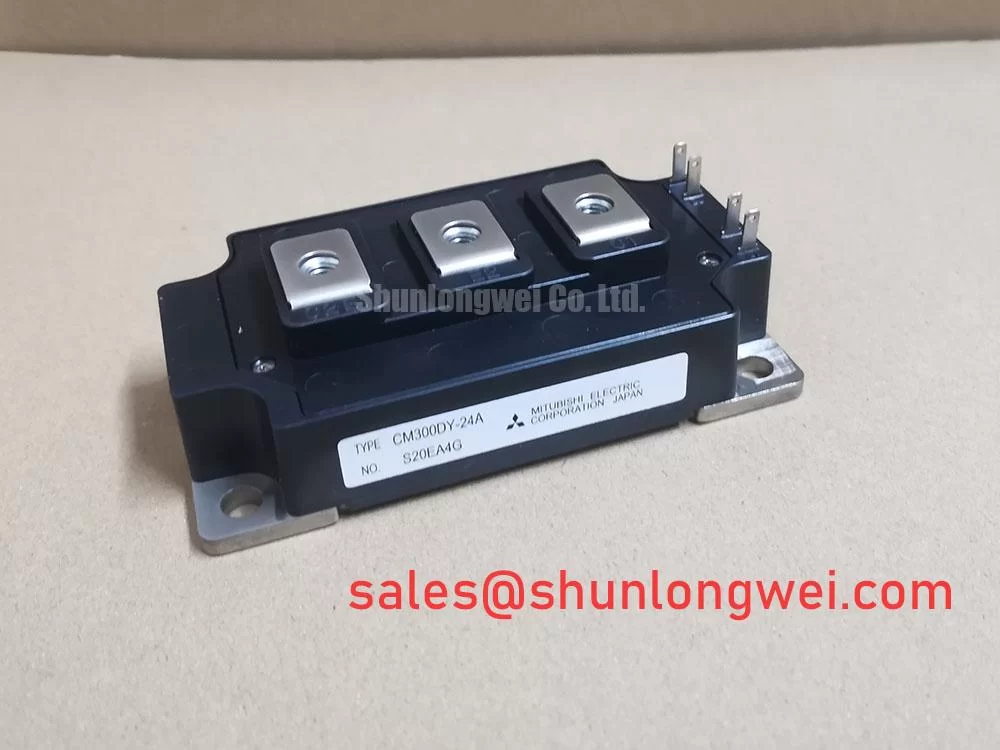
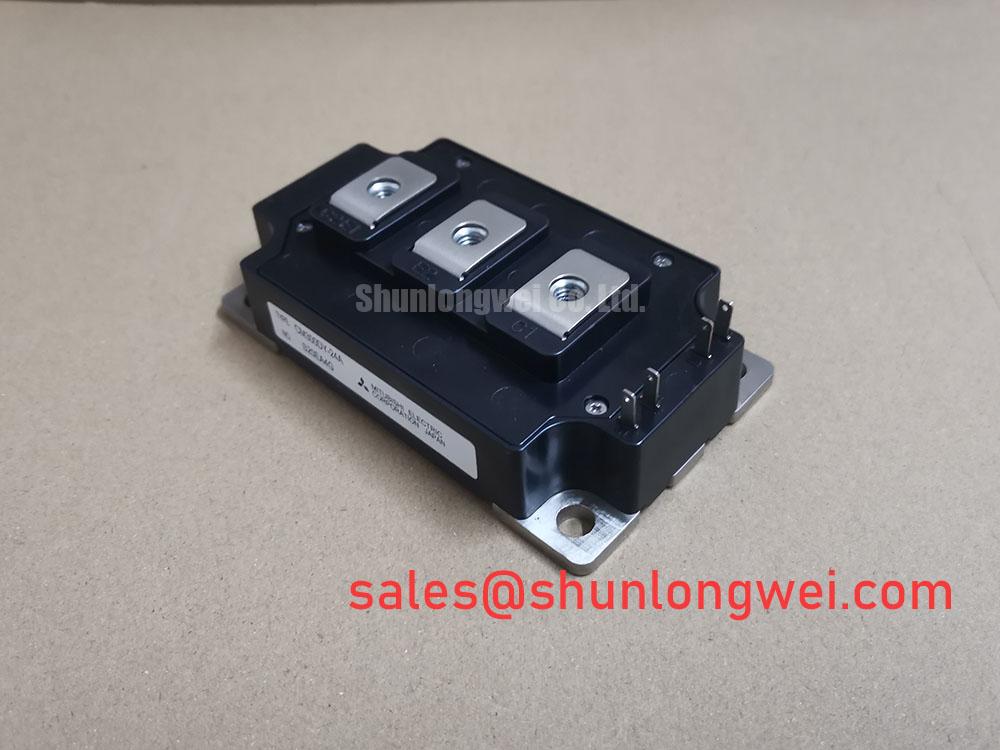
Technical Analysis of Engineering Advantages
The performance of any power system hinges on the efficiency and thermal stability of its core components. The CM300DY-24A addresses these critical areas through its electrical and thermal design. A key parameter is its collector-emitter saturation voltage (VCE(sat)), which is typically 2.2V at the rated 300A current. [6] A lower VCE(sat) directly translates to reduced conduction losses, which means less power is wasted as heat during operation. Think of VCE(sat) as the resistance of a valve; a lower resistance allows more energy to pass through with less friction, enhancing overall system efficiency and reducing the thermal load on the heatsink.
Efficiently managing heat is fundamental to the reliability of power semiconductors. The CM300DY-24A features a junction-to-case thermal resistance (Rth(j-c)Q) of 0.066 °C/W per IGBT. [6] This value is analogous to the width of a drainpipe for heat. A low thermal resistance provides a wide, effective path for thermal energy to move from the active semiconductor chip to the module’s baseplate. This characteristic allows engineers to design more compact cooling systems or to operate the module at higher power levels while staying within safe temperature limits, a critical factor in mastering IGBT thermal design.

Optimized Application Scenarios
The specifications of the CM300DY-24A make it a strong candidate for a range of high-power industrial applications:
- AC Motor Control & Variable Frequency Drives (VFDs): The half-bridge configuration is the fundamental building block for three-phase inverters, and its 300A current rating is suitable for controlling medium- to large-sized induction motors.
- Uninterruptible Power Supplies (UPS): Its robust current handling (600A peak) and high voltage rating ensure reliable performance in power backup systems. [6]
- Servo Drives: The integrated super-fast recovery free-wheel diodes minimize reverse recovery losses, enabling the precise and rapid switching required for high-performance motion control systems. [6]
- Welding Power Supplies: The module’s ability to handle high peak currents makes it well-suited for the demanding pulse-load conditions found in modern welding equipment.
This module is best matched for industrial power conversion systems requiring a balance of efficiency, thermal performance, and proven reliability.
Key Specifications of the CM300DY-24A
| Absolute Maximum Ratings (Tj = 25°C) | ||
|---|---|---|
| Collector-Emitter Voltage (VCES) | 1200 V | |
| Gate-Emitter Voltage (VGES) | ±20 V | |
| Collector Current (DC) (IC) | 300 A (at Tc = 82°C) | |
| Peak Collector Current (ICM) | 600 A | |
| Maximum Collector Dissipation (Pc) | 1890 W (at Tc = 25°C) | |
| Operating Junction Temperature (Tj) | -40 to +150 °C | |
| Isolation Voltage (Viso) | 2500 Vrms (AC, 1 min) | |
| Electrical & Thermal Characteristics (Tj = 25°C unless specified) | ||
| Collector-Emitter Saturation Voltage (VCE(sat)) | 2.2V typ / 2.7V max (at IC = 300A, VGE = 15V) | |
| Gate-Emitter Threshold Voltage (VGE(th)) | 4.0V to 8.0V (at VCE = 10V, IC = 30mA) | |
| Thermal Resistance (Junction-to-Case, IGBT) (Rth(j-c)Q) | 0.066 °C/W (Max) | |
| Thermal Resistance (Junction-to-Case, Diode) (Rth(j-c)R) | 0.12 °C/W (Max) | |
Engineer’s FAQ
What is the collector-emitter saturation voltage (VCE(sat)) of the CM300DY-24A at a higher operating temperature like 125°C?
According to the datasheet’s characteristic curves, the typical VCE(sat) at Tj=125°C and a collector current of 300A is approximately 2.45V. This positive temperature coefficient is a crucial consideration for calculating conduction losses under real-world operating conditions.
What are the recommended mounting torque specifications for installing the CM300DY-24A?
The datasheet specifies a mounting torque of 40 in-lb for both the M6 main terminals and the M6 mounting screws. [6] Applying the correct torque is vital for ensuring both a reliable electrical connection and optimal thermal transfer to the heatsink. Improper torque can lead to premature IGBT failures.
How does the integrated freewheeling diode (FWDi) benefit my design?
The module includes a discrete super-fast recovery freewheeling diode (FWDi) optimized for inverter applications. [6] This diode provides a path for inductive load current when the IGBT is turned off. Its fast and “soft” recovery characteristics (trr ≈ 250 ns) reduce voltage overshoots and electromagnetic interference (EMI), simplifying the overall system design. [6]
What is the maximum collector power dissipation (Pc) for this module?
The maximum collector dissipation (Pc) is rated at 1890 Watts, under the condition that the case temperature (Tc) is maintained at 25°C. [6] In practice, this rating must be derated based on the actual case temperature achieved by the cooling system.
Design & Integration
The Mitsubishi CM300DY-24A dual IGBT module offers a proven, high-performance solution for power conversion. Its balanced electrical characteristics, combined with a thermally efficient and isolated package, provide engineers with a reliable component to build powerful and durable industrial systems. This module is an effective choice for new designs and as a replacement in existing applications that require a 1200V/300A half-bridge configuration.
“`