Mitsubishi CM200DY-24H: A Technical Review for Industrial Power Applications
Mitsubishi CM200DY-24H | 1200V 200A Dual IGBT Module
High-Power Switching for Industrial Inverter Applications
The Mitsubishi CM200DY-24H is an H-Series dual IGBT module engineered for robust performance in high-power industrial systems. It provides a reliable foundation for power conversion circuits by integrating two IGBTs in a half-bridge configuration. This design is particularly effective for simplifying the construction of three-phase inverters used in motor control.
- Core Specifications: 1200V | 200A | 1380W Max Power Dissipation
- Key Advantages: High current capability for demanding loads, integrated free-wheeling diodes for component protection.
The module’s high voltage and current ratings ensure a substantial operating margin for systems connected to 400V or 480V AC lines. Its internal isolated construction simplifies thermal management and assembly. For a full technical overview, please download the official datasheet (PDF).
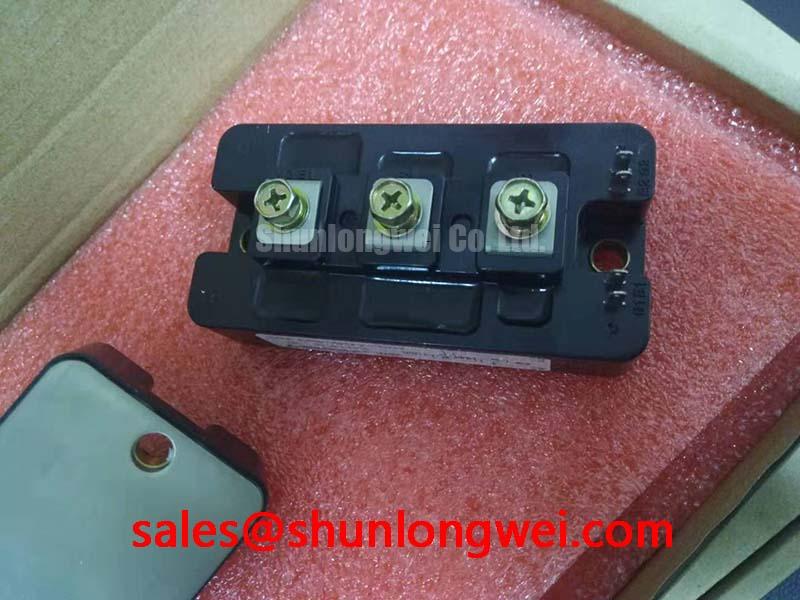
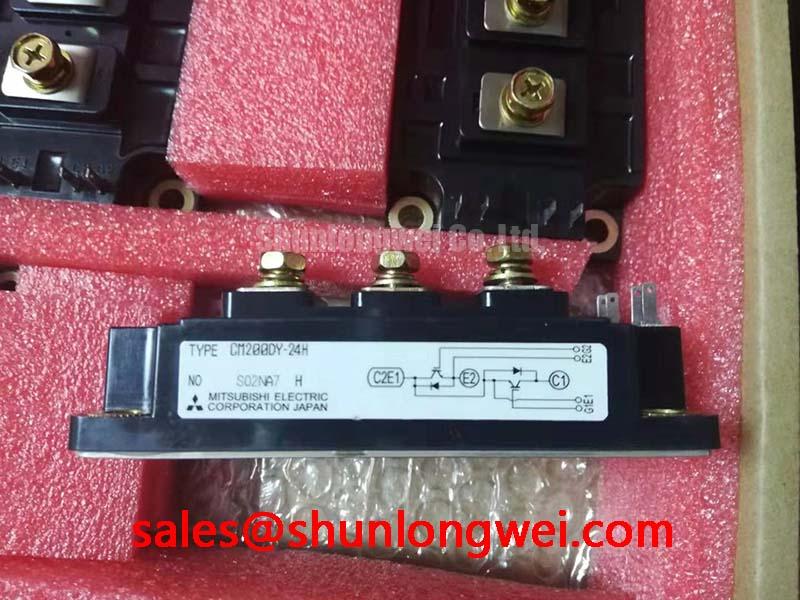
Technical Analysis for System Integration
The engineering value of the CM200DY-24H lies in its balance of power handling and thermal efficiency, which are critical for industrial reliability. The maximum collector current (DC) is rated at 200A, providing the capacity to drive large motors and handle substantial power conversion tasks. The 1200V collector-emitter voltage (VCES) rating offers the necessary headroom to safely operate in inverter systems, protecting against transient voltage spikes commonly found in industrial environments. A robust free-wheeling diode is co-packaged with each IGBT to provide a safe path for inductive current, a crucial feature for motor drive applications.
Effective thermal management is fundamental to leveraging the module’s power capabilities. The thermal resistance from junction to case (Rth(j-c)) per IGBT is specified at a maximum of 0.09°C/W. This value can be imagined as the width of a pipe for heat transfer; a lower number signifies a wider pipe, allowing heat to escape more easily from the active semiconductor junction to the heatsink. Efficiently managing this heat transfer is essential to keep the junction temperature below the 150°C maximum limit, thereby ensuring long-term operational reliability.
Optimized Application Scenarios
The CM200DY-24H is specified for performance in low to medium-frequency switching applications where power density and reliability are key design criteria. Its specifications make it a strong candidate for several industrial uses:
- AC Motor and Servo Drives: The dual half-bridge topology is the fundamental building block for three-phase inverters that control the speed and torque of industrial motors.
- General Purpose Inverters: Its high voltage and current ratings are well-suited for converting DC power to AC for a wide range of industrial machinery.
- Uninterruptible Power Supplies (UPS): The module’s capacity to handle 200A continuously ensures it can support critical loads during power interruptions.
- Welding Power Supplies: Capable of managing the high-current, pulsed-load conditions required in professional welding equipment.
This module is best matched for systems requiring robust 1200V/200A switching without the need for ultra-high frequencies.
Key Specification Parameters
| Parameter | Symbol | Conditions | Value |
|---|---|---|---|
| Absolute Maximum Ratings (Tj = 25°C) | |||
| Collector-Emitter Voltage | VCES | VGE = 0V | 1200 V |
| Collector Current (DC) | IC | – | 200 A |
| Maximum Power Dissipation | Pc | Tc = 25°C | 1380 W |
| Max. Junction Temperature | Tj max | – | 150 °C |
| Electrical & Thermal Characteristics (Tj = 25°C) | |||
| Collector-Emitter Saturation Voltage | VCE(sat) | IC = 200A, VGE = 15V | 2.7 V (Max) |
| Gate-Emitter Threshold Voltage | VGE(th) | IC = 20mA, VCE = 10V | 5.5 V (Typ) |
| Thermal Resistance (Junction to Case) | Rth(j-c) | Per IGBT | 0.09 °C/W (Max) |
| Isolation Voltage | Viso | AC, 1 minute | 2500 Vrms |
Engineer’s FAQ for the CM200DY-24H
How should the CM200DY-24H be mounted to a heatsink for proper thermal performance?
To ensure effective heat dissipation, the module’s baseplate must make complete contact with the heatsink. Apply a thin, even layer of thermal grease (recommended thickness 80-120 µm). The module should be secured using the specified mounting torque of 3.5 to 4.5 N·m to prevent warping and ensure optimal thermal transfer without undue mechanical stress.
What is the impact of the VCE(sat) on heatsink selection?
The collector-emitter saturation voltage, or VCE(sat), directly determines the conduction losses (Power Loss = VCE(sat) × Collector Current). A higher VCE(sat) results in more heat generation. For the CM200DY-24H, designers must calculate the total power dissipation based on VCE(sat) and switching losses to select a heatsink with a low enough thermal resistance to keep the junction temperature below 150°C under worst-case conditions.
Can this IGBT module be used in high-frequency SMPS designs?
While technically possible, the CM200DY-24H is optimized for lower-frequency applications like motor control (typically below 20 kHz). Its switching characteristics (turn-on/turn-off times) are not as fast as dedicated high-frequency IGBTs. Using it at higher frequencies would result in significantly increased switching losses, leading to lower efficiency and greater thermal stress.
What does the positive temperature coefficient of VCE(sat) mean for system design?
A positive temperature coefficient means that as the IGBT chip heats up, its on-state voltage (VCE(sat)) increases. This is a beneficial characteristic for paralleling IGBT modules. If one module starts to carry more current and heat up, its rising VCE(sat) will naturally encourage current to redirect to the other, cooler modules, promoting better current sharing and preventing thermal runaway.
Enabling Robust Power Systems
The Mitsubishi CM200DY-24H IGBT module delivers a well-documented and reliable solution for industrial power conversion. Its high power handling capabilities and proven thermal performance provide engineers with the necessary components to build durable and efficient motor drives, UPS systems, and general-purpose inverters. This module facilitates the creation of systems where long-term reliability is a primary objective.