PWB60A40 Technical Analysis: A Workhorse for Industrial Power Systems
## PWB60A40 | Sanrex 400V 60A Power Diode Module
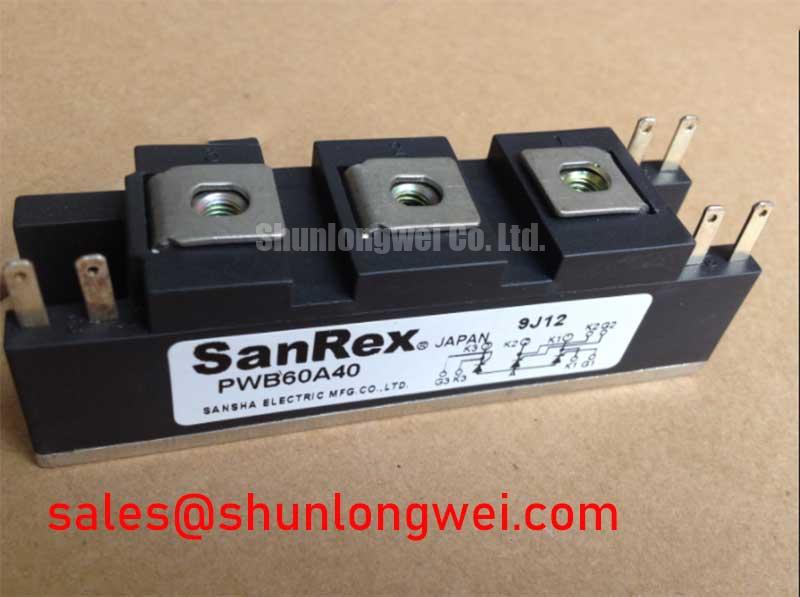
The Sanrex PWB60A40 is a Power Diode Module that integrates a three-phase bridge rectifier into a single, compact package. It is engineered for robust performance in industrial power conversion systems, offering a combination of high current handling and excellent surge survivability. This module simplifies the design and assembly of the front-end rectification stage for a variety of DC power supplies and motor control applications.
* **Core Specifications**: 400V | 60A | I_FSM 600A
* **Key Advantages**: High tolerance for inrush current, simplified thermal design due to isolated base.
* **Design Focus**: Enables reliable power rectification in demanding industrial environments.
Download Official Datasheet (PDF)
### Technical Analysis
The PWB60A40 module is defined by its robustness and straightforward integration. A key parameter is its high non-repetitive surge forward current (I_FSM) rating of 550A (50Hz) or 600A (60Hz). This capability is critical for applications that experience high inrush currents, such as motor drives during startup or capacitor charging in large DC power supplies. This high surge rating ensures the module can withstand these brief, high-stress events without failure, contributing directly to overall system reliability and longevity. Explore more about how different power components handle system stress in our guide to understanding and preventing IGBT latch-up.
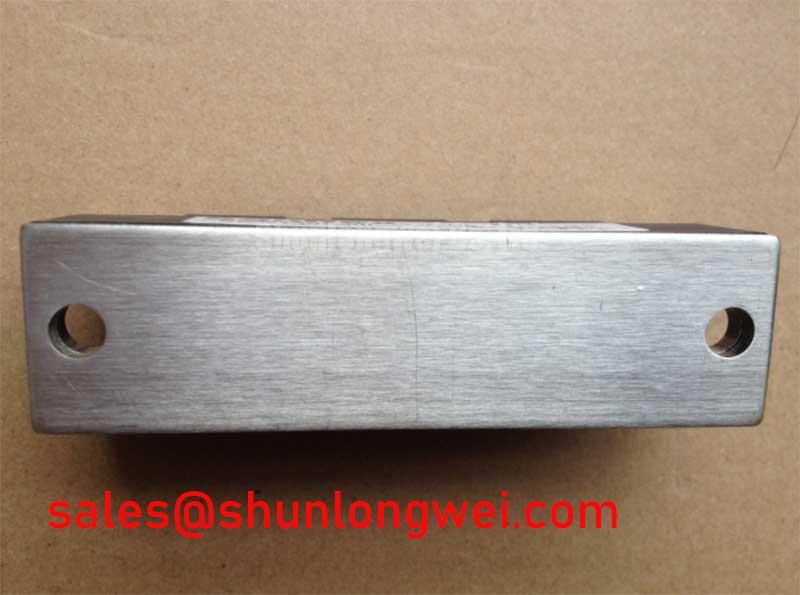
Efficient thermal management is another cornerstone of the PWB60A40’s design. The module features an electrically isolated mounting base, providing 2500V of isolation between the terminals and the heatsink. This integration simplifies assembly by eliminating the need for separate, often thermally inefficient, insulating pads. Further enhancing heat dissipation is the low thermal resistance from junction to case (Rth(j-c)) of 0.38°C/W per diode. Think of thermal resistance as the width of a pipe for heat; a lower value means a wider pipe, allowing heat to escape more easily. This efficient heat transfer helps keep the diodes within their safe operating temperature range, which is essential for maintaining performance and reliability. For more on thermal strategy, see our analysis on mastering IGBT thermal design.
### Optimized Application Scenarios
This power diode module is well-suited for a range of industrial power systems that require dependable three-phase AC to DC conversion.
* **AC/DC Motor Drives:** The 60A average forward current rating and high surge survivability make it ideal for the input stage of Variable Frequency Drives (VFDs), where it reliably handles the power demands of inductive motor loads.
* **General Purpose DC Power Supplies:** Its robust construction and UL recognition (File E76102) provide the reliability needed for industrial-grade power supplies that energize a wide array of factory equipment.
* **Welding Power Supplies:** The module’s ability to withstand a 600A surge current is particularly valuable in welding applications, which are characterized by high, intermittent current pulses.
* **Battery Chargers:** The PWB60A40 provides a solid and efficient rectification front-end for industrial battery charging systems.
The module’s balance of current capacity, surge toughness, and thermal efficiency makes it a best-match for industrial systems requiring reliable, cost-effective power rectification.
### Key Specifications of the PWB60A40
| Absolute Maximum Ratings (Tj=25°C unless otherwise specified) | |
|---|---|
| Repetitive Peak Reverse Voltage (V_RRM) | 400 V |
| Average Forward Current (I_F(AV)) | 60 A |
| Surge Forward Current (I_FSM) | 600 A (60Hz, 1 cycle) |
| I²t for Fusing | 1650 A²s |
| Electrical and Thermal Characteristics | |
| Maximum Forward Voltage Drop (V_FM) | 1.3 V (at I_FM = 60A) |
| Repetitive Peak Reverse Current (I_RRM) | 10 mA (at V_RRM, Tj=125°C) |
| Operating Junction Temperature (T_j) | -40 to +125 °C |
| Thermal Resistance (Rth(j-c)) | 0.38 °C/W (per diode) |
| Isolation Voltage (V_isol) | 2500 V (AC, 1 minute) |
### Engineer’s FAQ
**1. What is the primary advantage of the PWB60A40’s isolated baseplate?**
The integrated 2500V isolation simplifies the mechanical and thermal design. It allows the module to be mounted directly to a grounded heatsink without needing an additional insulating layer, which reduces assembly complexity and improves thermal transfer compared to non-isolated modules that require external insulation. A deeper look at this topic can be found in our article on isolated baseplates.
**2. How do I calculate the required heatsink performance for this module?**
To start, determine the total power dissipation (P_total) across all six diodes under your load conditions. You can approximate this by P_total ≈ V_FM * I_F(AV)_avg * 2 (as two diodes conduct at any time). Then, use the formula: Rth(s-a) ≤ (T_j_max – T_a) / P_total – Rth(j-c) – Rth(c-s). Here, T_j_max is 125°C, T_a is your ambient temperature, Rth(j-c) is 0.38°C/W, and Rth(c-s) is the thermal resistance of your thermal interface material. The result, Rth(s-a), is the maximum thermal resistance your heatsink can have.
**3. What does the 600A surge current rating practically mean for my design?**
The 600A I_FSM rating signifies high robustness against fault conditions and large inrush currents. In applications like motor drives, the initial current to magnetize the motor and charge the DC link capacitors can be many times the nominal operating current. This module is built to survive these events, preventing catastrophic failure of the power supply’s front end.
**4. Is the PWB60A40 suitable for use in a three-phase motor drive?**
Yes, it is an excellent choice for the input rectifier stage of many AC motor drives. Its 60A continuous current rating and ability to handle high inrush currents make it well-suited for converting the three-phase AC line voltage to the DC bus voltage required by the inverter section of the drive.
### Design Enablement
The Sanrex PWB60A40 delivers a reliable and straightforward solution for three-phase power rectification. Its high surge tolerance provides a critical safety margin in demanding industrial environments, while the isolated base and efficient thermal characteristics enable engineers to develop compact and cost-effective power conversion systems. This module is a dependable building block for robust power supply designs.