SKKT27B16E: A High-Reliability 1600V Thyristor Module for AC Power Control
## SKKT27B16E Thyristor/Diode Module for AC Power Control
Robust 1600V Power Control with Enhanced Thermal Reliability
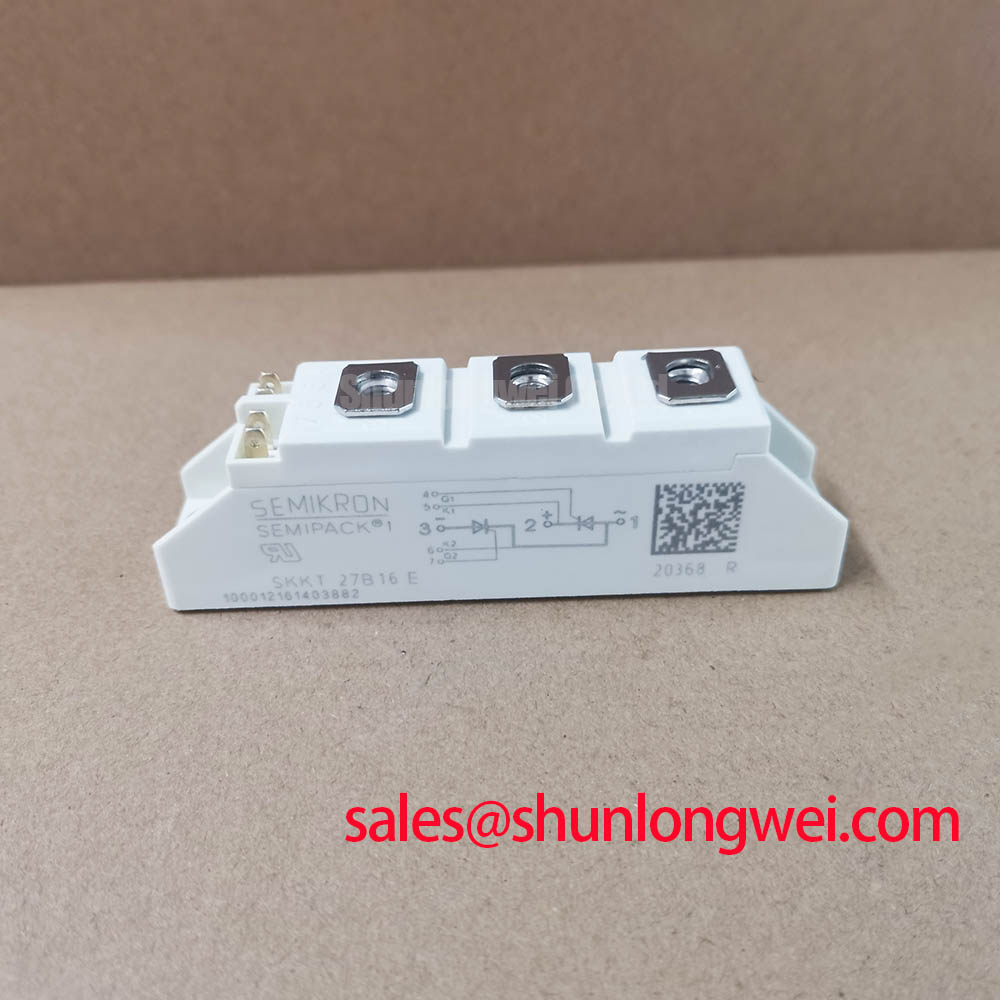
The SKKT27B16E by SEMIKRON is a Thyristor/Diode Module engineered for robust control in line-frequency applications. Its primary value lies in its construction, which combines a high repetitive peak reverse voltage with an industrially proven, isolated package. This integration provides a dependable component for power control systems requiring both electrical ruggedness and simplified thermal management.
- Core Specs: 1600V | 27A | 2500V Isolation
- Key Advantages: High reliability under thermal cycling, simplified heatsink mounting.
This module’s use of an isolated copper baseplate directly addresses a common engineering challenge: it removes the need for separate, often fragile, insulating materials between the module and its heatsink. This simplification streamlines assembly and enhances overall thermal performance.

Technical Analysis for System Integration
A key feature of the SKKT27B16E is the SEMIPACK 1 package, which utilizes an isolated copper baseplate. This design provides a V_isol rating of 2500V (RMS), ensuring robust electrical separation between the live terminals and the mounting surface. For system designers, this built-in isolation simplifies mechanical layout, reduces bill-of-materials complexity, and minimizes potential assembly errors associated with external insulating pads. The result is a more direct and efficient thermal path to the heatsink, contributing to stable operating temperatures.
The module’s construction with glass passivated thyristor chips further enhances its reliability. Glass passivation is a process that protects the sensitive semiconductor junctions from environmental contaminants and electrical field stress, ensuring stable blocking voltage characteristics over the device’s lifetime. Think of the thermal resistance (Rth) as the width of a pipe for heat; the low junction-to-case thermal resistance specified in the datasheet signifies a wide pipe, allowing heat to flow away from the active silicon efficiently. This robust thermal design is crucial for longevity in industrial applications that experience frequent on/off cycles, such as in power semiconductors for motor control.
Optimized Application Scenarios
The characteristics of the SKKT27B16E make it highly suitable for a range of phase control and rectifier applications.
- AC Motor Soft Starters: The module’s ability to handle repetitive current pulses and its robust thyristors are ideal for gradually ramping up voltage to large motors, preventing mechanical shock and electrical inrush currents.
- Industrial Heating and Temperature Control: Its precise phase-angle control capability allows for accurate power regulation of heating elements, while the isolated package simplifies integration into control cabinets.
– Light Dimming Systems: Well-suited for controlling high-power incandescent lighting in theatrical or industrial settings where reliability is paramount.
– Controlled Rectifiers: The half-bridge configuration is a fundamental building block for single-quadrant DC motor drives and battery chargers.
For line-frequency AC control demanding simplified assembly and long-term stability, this module delivers a well-balanced and reliable performance profile.
Key Specifications of the SKKT27B16E
| Absolute Maximum Ratings (T_case = 25°C unless otherwise specified) | |
|---|---|
| Repetitive Peak Reverse Voltage (V_RRM) | 1600 V |
| Average On-state Current (I_TAV) | 27 A (sin. 180; T_case = 85°C) |
| RMS On-state Current (I_TRMS) | 40 A |
| Surge Forward Current (I_TSM) | 550 A (10 ms, 50 Hz, T_vj = 25°C) |
| Electrical & Thermal Characteristics | |
| On-state Voltage (V_T) | < 1.6 V (I_T = 60 A, T_vj = 25°C) |
| Gate Trigger Current (I_GT) | < 150 mA (T_vj = 25°C) |
| Thermal Resistance, Junction to Case (R_th(j-c)) | < 0.9 °C/W (per thyristor) |
| Isolation Test Voltage (V_isol) | 2500 V (r.m.s., 1 min.) |
| Operating Junction Temperature (T_vj) | -40 to 125 °C |
Engineer’s FAQ
1. What are the critical mounting considerations for the SKKT27B16E to ensure proper thermal performance?
For optimal heat dissipation, mount the module on a flat, clean, and scratch-free heatsink surface. Apply a thin, uniform layer of thermal grease (approx. 100µm). Ensure the mounting screws (M6) are tightened to the specified torque of 3 – 5 Nm and the electrical terminals (M4) to 1.5 – 2.0 Nm to achieve low thermal resistance without inducing mechanical stress on the ceramic substrate.
2. What does the “B” designation in the part number signify?
The “B” in the SKKT27B16E part number typically refers to the internal circuit configuration. According to the datasheet’s circuit diagram, this module contains two thyristors connected in a half-bridge (common cathode) arrangement, a common topology for AC controllers and half-controlled rectifiers.
3. Can this module be used for high-frequency applications like a switching power supply?
No, this module is not suitable for high-frequency switching. It is a line-commutated or phase-control thyristor designed for low-frequency applications (typically 50/60 Hz). Its turn-off characteristics are not fast enough for high-frequency operation, which would result in excessive switching losses, overheating, and device failure. For such designs, IGBT or SiC modules are the appropriate choice.
4. What is the purpose of the glass passivated chips?
Glass passivation creates a hermetic seal around the active silicon junction. This layer protects the semiconductor from moisture and contaminants that could degrade its high-voltage blocking capability over time. It is a key element for ensuring the long-term reliability and stability of the module, particularly in harsh industrial environments.
Enabling Robust Power Control Systems
The SKKT27B16E module provides a durable component for AC power control by integrating proven thyristor technology into a thermally efficient and electrically isolated package. This focus on robust construction and simplified integration allows engineers to develop reliable and cost-effective solutions for motor control, heating, and rectifier applications.