Technical Overview of the NIEC PT76S16A 1600V 76A Thyristor Power Module
NIEC PT76S16A 1600V 76A Thyristor Module Power Block
Introduction and Core Highlights
The NIEC PT76S16A is an industrial-grade Thyristor-Thyristor (SCR) power module engineered for high-voltage phase control and AC switching applications. Designed by Nihon Inter Electronics Corporation (NIEC), this power block integrates two series-connected thyristors on an isolated mounting base to simplify thermal assembly and minimize external components.
- Core Specifications: 1600V Repetitive Peak Voltage | 76A Average On-State Current | 2500V AC Isolation Voltage
- Engineering Value: Highly stable glass-passivated chips ensure low off-state leakage currents. The integrated electrically isolated baseplate eliminates the need for external isolation barrier sheets during heatsink mounting.
For detailed thermal curves and gate trigger specifications, engineers can download the PT76S16 technical overview or request the official manufacturer datasheet directly from our technical sales desk.
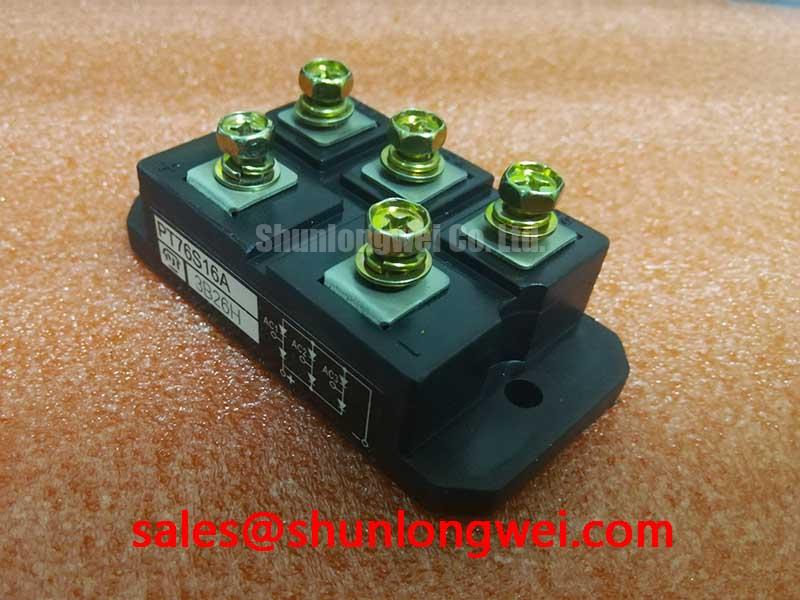
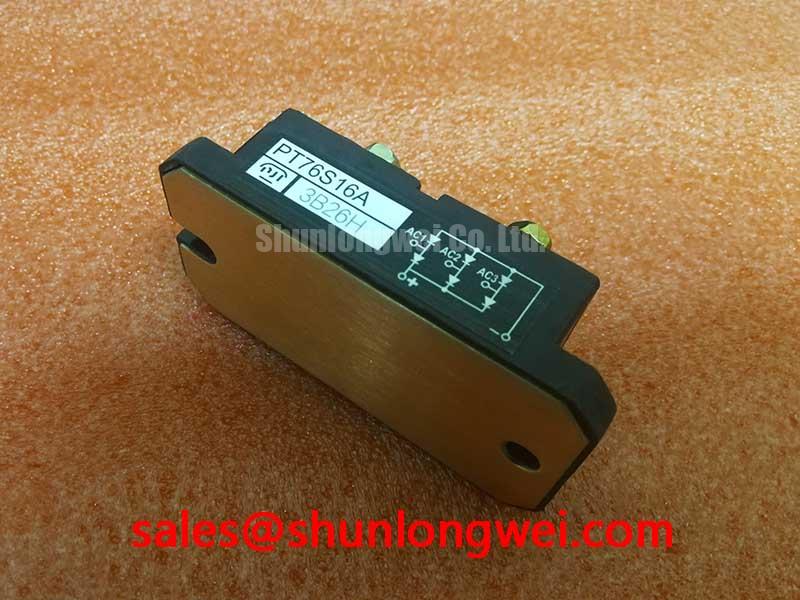
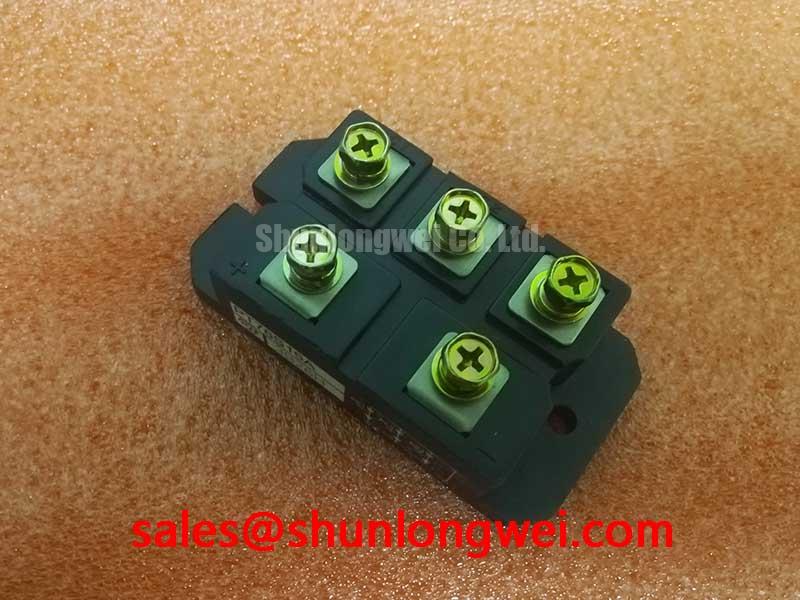
Technical Analysis of the PT76S16A
The PT76S16A relies on glass-passivated thyristor junctions to maintain low off-state leakage currents even under high thermal stress. This passivation technology forms a microscopic barrier that shields the silicon junction from environmental contaminants, ensuring long-term parameter stability. When operating at a repetitive peak off-state voltage ($V_{DRM}$) of 1600V, the device effectively suppresses parasitic leakage, protecting sensitive downstream control circuitry.
Thermal management is a critical factor in maintaining thyristor reliability. You can visualize the junction-to-case Thermal Resistance ($R_{th(j-c)}$) as the diameter of a drainage pipe. A lower thermal resistance represents a wider pipe, allowing heat to flow rapidly from the internal silicon junction to the heatsink. The PT76S16A achieves a low junction-to-case thermal resistance of approximately 0.35°C/W per thyristor, which keeps junction temperatures ($T_j$) well below the absolute maximum limit of 125°C under nominal load conditions.
Furthermore, the module features a high-density copper baseplate that utilizes isolated baseplate technology. This construction isolates the electrical active terminals from the physical mounting chassis with an internal ceramic substrate. As a result, multiple modules can be mounted to a single heatsink, reducing the footprint of industrial motor drives and power supply cabinets.
Optimized Application Scenarios
This module is highly suited for several demanding industrial systems:
- AC Motor Soft Starters: The 1600V blocking rating handles the back-EMF spikes generated by heavy inductive motor loads during startup cycles.
- Industrial Furnace Temperature Controllers: High continuous current handling (76A at $T_c = 85^circ C$) allows precise phase-angle control of high-power heating elements.
- Phase-Controlled Rectifiers: Performs highly efficient AC-to-DC conversion in industrial plating systems and battery charging stations.
- Uninterruptible Power Supplies (UPS): Serves as a reliable static bypass switch to ensure seamless power transfers during grid disruptions.
Best Fit: The PT76S16A is the ideal choice for industrial designs requiring robust 1600V phase control with isolated multi-module heatsink configurations.
PT76S16A Key Specifications Table
The following technical values are derived from the official manufacturer datasheet parameters. For a wider range of modules, visit our Power Semiconductors category.
| Parameter Category | Symbol | Maximum Ratings / Conditions | Unit |
|---|---|---|---|
| Absolute Maximum Ratings | $V_{RRM} / V_{DRM}$ | 1600 | V |
| $I_{T(AV)}$ | 76 (at $T_c = 85^circ C$) | A | |
| $I_{TSM}$ | 1600 (50Hz, half sine wave, 1 cycle) | A | |
| Electrical Characteristics | $V_{TM}$ | 1.45 max (at $I_{TM} = 230A$) | V |
| $I_{GT}$ | 100 max (at $T_j = 25^circ C$) | mA | |
| $V_{GT}$ | 3.0 max (at $T_j = 25^circ C$) | V | |
| Thermal Characteristics | $R_{th(j-c)}$ | 0.35 max (Junction to Case, per SCR) | °C/W |
Engineer FAQ
Q1: What are the primary advantages of the isolated baseplate in the PT76S16A module?
A1: The baseplate provides 2500V AC electrical isolation between the internal silicon junctions and the external copper mounting plate. This allows design engineers to mount multiple PT76S16A modules on a single heatsink, reducing mechanical hardware overhead and minimizing structural space requirements inside industrial enclosures.
Q2: How should the surge current limit ($I_{TSM}$) be utilized for circuit protection designs?
A2: The $I_{TSM}$ rating of 1600A is a non-repetitive peak value, intended for fault-condition safety margins (such as short circuits) rather than continuous operation. Designers should select fast-acting semiconductor fuses with an $I^2t$ rating below the module’s maximum limits to protect the silicon junctions from thermal runaway during overcurrent faults.
Q3: Can the PT76S16A operate reliably in high-humidity or corrosive industrial environments?
A3: Yes, the glass-passivated structure provides stable barrier characteristics against moisture. However, for harsh environment deployments, we recommend applying a thin layer of thermal grease to the heatsink interface to prevent joint oxidation and ensure continuous thermal contact.
Concluding Technical Statement
The NIEC PT76S16A Thyristor Power Module stands as a mature, field-proven solution for industrial phase control and electrical rectification. By pairing a high 1600V blocking voltage with a robust isolated baseplate, this power block gives electrical engineers the physical and electrical margins required to design reliable, space-efficient control cabinets for severe operating conditions.